August 30, 2004
Berlin bear's break-out bid fails
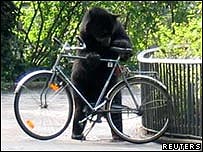
A bold amphibious escape bid by a bear at Berlin zoo has been foiled in a dramatic shoot-out.
Juan the Andean spectacled bear first paddled across a moat using a log for a raft, then scaled a wall.
Finally he appeared to commandeer a bicycle, before zookeepers with brooms cornered him, and a colleague picked him off with a tranquiliser gun.
"Just think what could have happened," said a mother who saw the bear escape and head for the children's carousel.
"It went straight for the playground", said Liane Hertrampf to the Berliner Kurier newspaper.
Parents grabbed their children and fled as they realised what was happening.
But the zoo's deputy director Heiner Kloes was not so concerned.
"Spectacled bears eat both vegetables and meat but children tend not to be on their menu," he said.
"I'd have been a lot more worried if one of our polar bears had escaped," he added.
He did say, however, that he was "alarmed at how some fathers were too busy filming the bear to check where their children were".
Amateur photographers captured the bear investigating a bicycle and roaming around the playground.
The incident was the second breakout since June, when a gorilla climbed over a fence.
After being stopped with darts from a tranquiliser gun, 110kg (294lb) Juan was carried back to his enclosure.
Mr Kloes told the Berliner Kurier newspaper zoo staff would make sure there were no further logs in the moat to prevent Juan's future bids for freedom.
various links
Live from Noreascon
Writing IN versus Writing ABOUT
Comparing Tiptree & Fowler
Trickes of the Trade
Time Travel Fund
Living Earth
Should Amazon Post Reviews?
August 27, 2004
Tarantino to star in Muppets film
Kill Bill director Quentin Tarantino is to appear in a new Muppets film based on The Wizard of Oz.
The Muppets' Wonderful Wizard of Oz will also feature R&B star Ashanti as Dorothy and Chicago star Queen Latifah as Auntie Em.
Filming is due to start in Vancouver next month. It is set to be screened on US TV in the autumn.
Tarantino, who also appeared in From Dusk Till Dawn, is often criticised for the graphic violence in his movies.
Described as a "madcap adventure", the film is based on L Frank Baum's The Wonderful Wizard of Oz.
Popular foam puppets The Muppets will take most of the leading roles.
Miss Piggy will appear as three wicked witches and Glinda, Good Witch of the South.
Kermit the Frog will be the Scarecrow, the Great Gonzo will be the Tin Man and Fozzie Bear will play the Lion.
The Muppets' Wonderful Wizard of Oz will follow the acclaimed 1939 film version, starring Judy Garland, and 1978 re-make The Wiz, which featured Diana Ross as Dorothy.
The Muppets film and TV rights were sold to the Walt Disney corporation by the family of their late creator, Jim Henson, in February.
Famous Five top child book poll
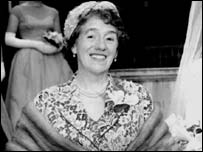
Two million Enid Blyton books are sold around the world each year
The Famous Five books, which were penned by Enid Blyton, have topped a poll to discover which books adults most enjoyed as children.
Over 1,000 adults, aged between 25 and 54, were asked to name their favourite children's book while growing up.
Blyton's series of 21 Famous Five adventures, written between 1942 and 1963, narrowly beat classics like Treasure Island and Lord of the Rings.
Two million copies of the Famous Five novels are sold worldwide each year.
The adventure series featuring Julian, Dick, George, Anne and Timmy the dog made Blyton the most successful children's author all time.
The Lion, The Witch and The Wardrobe - the 1950 fantasy tale penned by CS Lewis - came second in the survey, which was carried out by the Cartoon Network.
Children's Top Five
- The Famous Five
- The Lion, The Witch and The Wardrobe
- Treasure Island
- The Secret Seven
- Black Beauty
And Robert Louis Stevenson's Treasure Island, published in 1883, came third.
Another Blyton creation, The Secret Seven, came fourth in the poll.
The adventure series aimed at younger readers featured the likes of Peter, Janet, Jack and Scamper the dog.
Enid Blyton's daughter Gillian Baverstock, who lives in Ilkley, West Yorkshire, welcomed the results of the poll.
She said: "It is wonderful that my mother's books are remembered so fondly.
"The secret of their success is that they centre squarely on children, with adults only ever playing a minor role.
"The injection of adventure and excitement on to every page stimulates a child's desire to continue to read not just one book but the whole series."
The survey was done for the Prince of Wales' StoryQuest Children's Literary Festival, which takes place across the UK in October.
Pheidippides paid the price for day in the sun
Pheidippides, the Greek courier who ran the first marathon 2500 years ago, died of a heart attack, 19th century English poet Robert Browning wrote.
In his poem, Pheidippides, Browning refers to the ecstasy and agony of the runner carrying to Athens news of the Greeks' victory over the Persians at the Battle of Marathon. He writes, "Joy in his blood bursting his heart, he died - the bliss!"
Pheidippides was a professional foot courier. He may have been the man who a few days before the battle ran 240 kilometres in 48 hours to seek help from the Spartans.
It is almost certain a heart attack didn't kill him. Dr Jenni Saunders, a sports medicine specialist with the Australian Olympic team in Athens, said: "The chances of a fit runner having a congenital defect which comes up under stress is one in 100,000. It would have surfaced earlier. I think Pheidippides died of sunstroke."
The battle of Marathon, 490BC, occurred in September when Athens experiences scorchers. It lasted only from breakfast to lunchtime when a Persian army of 30,000 lost 6400, while the Athenians suffered just 192 casualties according to Herodotus, the Greek historian with a reputation for exaggeration. Pheidippides would not have had time to carbohydrate load before he set off for Athens 40 kilometres away with his message of victory, "Be joyful, we win."
Nor would he have had any drink stations along the way. There are few streams in this Attic inferno. In fact, the only advantage Pheidippides enjoyed over today's marathoners was the shade. In the fifth century BC, the terrain between Marathon and Athens was wooded, whereas today it is barren and treeless.
Pheidippides would not have had lightweight shorts, running shoes which weigh as much as airplane slippers, shirts with more air holes than fibre or sunglasses. In fact he may have run nude and shoeless. As a professional soldier, he may have been forced to wear leather thongs.
"I'd hate to treat his blisters afterwards," Saunders said.
Pheidippides would also have run along a stone-studded path. The runners in last Sunday's womens' marathon and the men's this Sunday will run on a smooth bitumen highway. It is a fallacy that it is less tiring running on soft surfaces, even grass, compared to pavement.
Nor would Pheidippides have had the benefit of distance training. The longest race in the Olympics at the time was 4614 metres.
Modern marathoners rarely run more than half marathons in training and combine easy runs with speed work.
Saunders said: "He wouldn't have had the benefit of the knowledge of today's exercise physiologists."
Although it is almost heretical to suggest it in Athens, Pheidippides may not have existed. Herodotus did not mention him and the Battle of Marathon was important enough for Aeschylus, the father of Greek tragedy, to record it. The first mention of Pheidippides is from Plutarch in the first century AD.
The other nagging aspect of the story is why he ran so fast, without water and stops, in blazing temperature, simply to report a victory. Unless it was to warn the Athenians that the Persians, who took to their ships, may attack the city by sea.
But the local folk tell me this is a 10-hour sail and another hour from the port of Piraeus, meaning he still had plenty of time if his personal best was around today's 2 hours and 11 minutes.
And why didn't he ride a horse?
Still, Greeks are good at marathons and Australians shouldn't mock their history. Another Greek soldier courier, Spiridon Louis, won the first marathon at the modern Olympics in 1896 in 2:58:50 and Australia's Edwin Flack, winner of gold medals in the 800 metres and 1500m, dropped out at the 37km mark. In fact, Flack, dazed and disoriented, punched a Greek volunteer who came to his aid, knocking him to the ground.
Two and a half millennia after Pheidippides's death, almost certainly from dehydration, organisers still hadn't learnt anything about the importance of water. At the 1896 Games, all runners were served milk and later two beers at the start.
Flack was revived by eggnog and brandy given by Prince Nicholas of Greece. Louis was handed some red wine and an Easter egg at the 14km mark but his victory may have come because someone finally understood the value of water.
When he asked for water, the race marshall, mounted on a horse, gave him cognac. Louis spat it out.
By Roy Masters
Blade Runner's the best, vote scientists
LONDON - A poll of top scientists has named Blade Runner as the world's best science fiction film.
The 1982 movie, based on Philip K. Dick's novel Do Androids Dream of Electric Sheep?, was the favourite among the 60 British, North American and New Zealand scientists surveyed by the U.K.'s Guardian newspaper.
Starring Harrison Ford and set in the future in a dystopic version of Los Angeles, the film portrays a retired cop hunting down human clones.
"It was so far ahead of its time and the whole premise of the story ? what is it to be human and who are we, where we come from. It's the age-old questions," said Stephen Minger, a stem cell biologist at King's College, London.
2001: A Space Odyssey came in a close second, followed by Star Wars and The Empire Strikes Back, which tied for third place. The other favourites, in descending order, were: Alien, 1972's Solaris, the first two Terminator films, The Day the Earth Stood Still, War of the Worlds, The Matrix and Close Encounters of the Third Kind.
In a related poll, the scientists named their favourite science fiction authors, with Isaac Asimov, John Wyndham, Fred Hoyle, Philip K. Dick and H.G. Wells being the top five.
'This Land Is Your Land' OK'd for JibJab
LOS ANGELES - The internet creators of a popular political send-up have reached an agreement with the publisher of Woody Guthrie's classic song This Land Is Your Land.
Ludlow Music has agreed to allow JibJab Media, whose recent animated short pokes fun at both U.S. President George W. Bush and Senator John Kerry, to continue using the song.
In return, the media company has dropped its federal lawsuit against Ludlow. JibJab had argued that its use of the song was protected, as it is a parody.
JibJab has agreed to provide a link from their website to the original lyrics and to donate 20 per cent of any profits made to the Woody Guthrie Foundation.
Since its debut in early July, the comic cartoon short has been viewed by about 20 million people, reports the Santa Monica-based media company.
Doctors grow new jaw in man's back
LONDON, England (AP) -- A German who had his lower jaw cut out because of cancer has enjoyed his first meal in nine years -- a bratwurst sandwich -- after surgeons grew a new jaw bone in his back muscle and transplanted it to his mouth in what experts call an "ambitious'' experiment.
According to this week's issue of The Lancet medical journal, the German doctors used a mesh cage, a growth chemical and the patient's own bone marrow, containing stem cells, to create a new jaw bone that fit exactly into the gap left by the cancer surgery.
Tests have not been done yet to verify whether the bone was created by the blank-slate stem cells and it is too early to tell whether the jaw will function normally in the long term.
But the operation is the first published report of a whole bone being engineered and incubated inside a patient's body and transplanted.
Stem cells are the master cells of the body that go on to become every tissue in the body. They are a hot area of research with scientists trying to find ways to prompt them to make desired tissues, and perhaps organs.
But while researchers debate whether the technique resulted in a scientific advance involving stem cells, the operation has achieved its purpose and changed a life, said Stan Gronthos, a stem cell expert at the Institute of Medical and Veterinary Science in Adelaide, Australia.
"A patient who had previously lost his mandible (lower jaw) through the result of a destructive tumor can now sit down and chew his first solid meals in nine years ... resulting in an improved quality of life,'' said Gronthos, who was not connected with the experiment.
The operation was done by Dr. Patrick Warnke, a reconstructive facial surgeon at the University of Kiel in Germany. The patient, a 56-year-old man, had his lower jaw and half his tongue cut out almost a decade ago after getting mouth cancer. Since then, he had only been able to slurp soft food or soup from a spoon.
In similar cases, doctors can sometimes replace a lost jawbone by cutting out a piece of bone from the lower leg or from the hip and chiseling it to fit into the mouth.
This patient could not have that procedure because he was taking a potent blood thinner for another condition and doctors considered it too dangerous to harvest bone from elsewhere in his body since extraction leaves a hole where the bone is taken, creating an extra risk of bleeding.
Artificial jaws made from plastic or other materials are not used because they pose too much of a risk of infection.
"He demanded reconstruction,'' Warnke said. "This patient was really sick of living.''
Warnke and his group began by creating a virtual jaw on a computer, after making a three-dimensional scan of the patient's mouth.
The information was used to create a thin titanium micro-mesh cage. Several cow-derived pure bone mineral blocks the size of sugar lumps where then put inside the structure, along with a human growth factor that builds bone and a large squirt of blood extracted from the man's bone marrow, which contains stem cells.
The surgeons then implanted the mesh cage and its contents into the muscle below the patient's right shoulder blade. He was given no drugs, other than routine antibiotics to prevent infection from the surgery.

Arrows show a titanium cage, in which patient's new jaw was grown, implanted under his shoulder blade.
The implant was left in for seven weeks, when scans showed new bone formation. It was removed about eight weeks ago, along with some surrounding muscle and blood vessels, put in the man's mouth and connected to the blood vessels in his neck.

CT scan shows new jaw in place.
Scans showed new bone continued to form after the transplant.
Four weeks after the operation, the man ate a German sausage sandwich, his first real meal in nine years. He eats steak now, but complains to his doctor that because he has no teeth he has to cut it into such small pieces that by the time he gets to the end of the steak, it's cold.
He has reported no pain or any other difficulties associated with the transplant, Warnke said, adding that he hopes to be able to remove the mesh and implant teeth in the new jaw about a year from now.
Paul Brown, head of the Center for Tissue Regeneration Science at University College in London, said it's not clear any major scientific ground has been broken, and tests may not be able to show whether the new bone came from stem cells, rather than from the growth factor alone.
The operation put established techniques together, resembling a well-known experiment in which University of Massachusetts scientists grew a human ear using a mold on the back of a mouse in 1995, he said.
"If you put loads of blocks of bone mineral into a hole and you induce cellular activity by putting in growth factors, it's a standard approach that people have used to induce the body's own response,'' said Brown, who was not connected with the study. "Clearly some of them are going to work and it sounds like for this patient, this has worked.''
Biopsies of the jaw bone could later provide some answers on the quality of the bone, experts said.
"Just making the gross tissue shape right isn't really the problem,'' Brown said. "It's what the shape of the tissue is at the microscopic and ultramicroscopic level. That's the architecture which is so tricky and which is what gives function.''
Pilgrim carries mother on 17-year trek
Village womenfolk consider him a saint as he trudges along the national highway leading towards India's technology hub, Bangalore, in the southern state of Karnataka.
Some of them prostrate themselves before the saffron-clad 32-year-old, Kailashgiri Brahmachari.
Swami, as he is described, is on an epic mission - he is carrying his aged, blind mother, Kethakdevi, on his shoulders on an all-India pilgrimage.
He has already covered more than 6,000km (3,750 miles), beginning the journey in his native village of Piparia, near Jabalpur in the northern state of Madhya Pradesh eight years ago.
If all goes well, Kailashgiri's grand plan is to end his spiritual quest at the next Kumbh Mela Hindu festival in the holy city of Varanasi in 2013.
"It is the will of God," says Kailashgiri on his decision to carry his mother on the holy expedition.
Ash stuck on his forehead, the bearded pilgrim dresses like a swami, or a Hindu holy man.
The loving son carries two baskets on his shoulders, balanced by a wooden bar.
In one, his mother, in the other his meagre belongings.
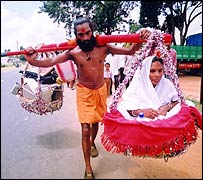
"It does ache, but I am determined to complete the yatra [pilgrimage] even it takes another 12 years," says Kailashgiri.
Villagers liken him to the Hindu mythological figure, Shravana Kumar, who is said to have carried his aged, blind parents on pilgrimages.
"In this modern age, this is very rare. It shows how much he cares for his mother," says Gowaramma, a grandmother from Buvanahalli, a village 25km from Bangalore.
"He is truly a swami," says another woman, seeking Kailashgiri's blessing.
"My message is simple," Kailashgiri says. "Take care of your parents. If you don't, your children will also neglect you."
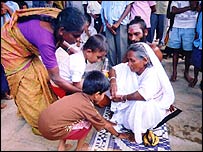
People offer money and food along the route but Kailashgiri says his mother prefers food cooked by him.
Her favourite food is roti with cereal.
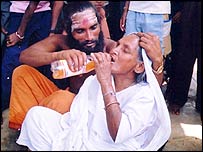
"He is a nice son but I am getting tired. I sometimes feel like ending the journey and getting back home," says his mother, wrapped in a white sari.
In her 60s, Kethakdevi, who was born blind, is dependent on her only surviving son. She lost her elder son and daughter over a decade ago.
Kailashgiri undertook the trip to fulfil his mother's lifelong wish to offer prayers at important holy places in the country.
The holy trek has covered the northern city of Ayodhya, the birthplace of Lord Rama and Kashi, one of the holiest Hindu sites.
It has taken son and mother to Madhya Pradesh, Uttar Pradesh, Maharashtra, Andhra Pradesh and Karnataka.
"I am very happy. I have visited so many temples," says Kethakdevi.
Her remaining wish?
"I want to touch the abode of God," she says.
Kailashgiri is philosophical about the health risks of such an epic journey.
"It does not bother me. Even if I die it does not matter. What is important is the spirit of our yatra."
He walks three or four kilometres every day but on occasions logs more than 20.
"It all depends on how my mother and I feel. Sometimes, we are so exhausted, we take a rest for a couple of days before resuming our journey," says Kailashgiri.
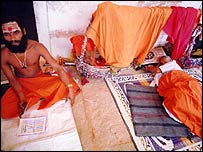
The pair rest at temples and schools on the way.
Dagaji Shivaji Shellar, a truck driver who met Kailashgiri on the highway has become a devotee.
"I will be spending some time to serve the guru," says Shellar, who helps with daily chores.
Kailashgiri says he and his mother have been treated well. "Only near Ananthpur [in Andhra Pradesh], my money and a bag were stolen."
His Spartan possessions include a stove and pots, a couple of rugs, some clothes, a gold-plate wristwatch and a mobile phone.
Is this to keep in touch with relatives?
"The entire Sansar [world] is my family," he says.
By Habib Beary
BBC correspondent in Bangalore
Hot lunch - a tiffin lady's burden
Every morning Laxmibai Bagade collects hot home-made lunches made in the homes of office-goers in the western city of Bombay (Mumbai) - then she has to get them to the hungry office workers on time.
She is one of the few women among the city's estimated 5,000 tiffin carriers - locally known as dabbawallahs - who deliver some 175,000 lunch boxes daily. It is a century-old tradition.
"Tiffin" is an old English word which means midday snack.
A unique tracking system ensures that all the lunch boxes reach their rightful owners in time, earning a rating of 99.99% for precision and accuracy from Forbes magazine.
That's one error in eight million deliveries.
In a predominantly male trade, 45-year-old Laxmibai is a rarity walking the streets with 25 kg of lunch boxes slung around her lean shoulders.
After lunch hour, she has to pick up the boxes again and return them to the homes.
Laxmibai became a tiffin carrier some 20 years ago and joined her husband in the same trade to keep the home fires burning.
Her tough job coupled with the burden of housework and the responsibility of looking after a large family has taken its toll on Laxmibai, who earns $85 a month.
"I also have to take care of all the household chores. How much can one person do?'' she asks.
But she is grateful for her son, Krishna, who has taken most of the load off her shoulders.
"For years my mother has delivered scores of lunch boxes but now I have taken over most of them, so that she may get a little rest."
The chief of the tiffin carriers' association, Raghunath Medge, says that women do not take up the job voluntarily.
"It is very physically demanding. This is not a job for women. They can't pick up so much weight. A typical consignment of boxes weighs around 80 to 90 kg. So we give them less weight to carry, almost half of what men carry," he says.
For the city's housewives, tiffin carriers like Laxmibai are a godsend.
Komal Shah has been using her services to send her husband's lunch for almost a decade now.
"If I have to prepare the lunch for my husband by the time he leaves for office, I will have to get up very early.
"Also, I have small kids who make demands on my time in the morning. So it suits me to send the tiffin through Laxmibai as it gives me a couple of hours more to cook," she says.
Office-goers, too, have come to rely on their hot lunches arriving from home every day on time.
Komal's husband, Sujal, a diamond merchant, says: "We have become used to it. We know that the tiffins will be there when we sit down to have lunch."
The efficiency and punctuality of the tiffin carriers in the city has become the subject of study in business schools and industry associations.
The Prince of Wales paid them a visit during his trip to India last year.
Raghunath Medge says that Prince Charles' visit has helped business immensely. "People give us more respect now. It has made us famous," he says.
By Jayshree Bajoria
BBC correspondent in Bombay
August 26, 2004
Revellers wage tomato war
Knee-deep in red mush, tens of thousands of revellers pelted each other with tonnes of ripe tomatoes in Spain's messiest summer party.


Police in the eastern village of Bunol - population 10,000 - said some 36,000 people waged the hour-long food fight, bathing themselves, walls and streets with 130 tonnes of fruit-turned-projectiles.
Television footage some warriors literally swimming in the fresh tomato puree, only their heads peeking out of the sea of red pulp.
It all started with a pistol shot at high noon, after which six trucks unloaded ammunition for Spaniards and tourists from as far away as Japan who had gathered for two hours to paste each in the decades-old battle called "La Tomatina".
Residents who preferred to watch from balconies poured water on the crowd.
Town hall set up 500 makeshift showers for the revellers to clean up. Others bathed in a river.
The festival, held each year on the last Wednesday of August, is said to have started in the 1940s when a clutch of youths began throwing their lunch at each other one day in a downtown square.
They met again the following year, this time pelting passers-by as well and giving birth to the now-legendary food fight.
Kubler-Ross free at last
Elisabeth Kubler-Ross, the Swiss-born psychiatrist and author who won international fame for her landmark work on death and dying, had achieved peace when she died this week, a colleague said.
Dr Kubler-Ross, 78, who wrote the groundbreaking 1969 book On Death and Dying, died on Tuesday night of natural causes while surrounded by close friends and family in her home in Phoenix, her colleague David Kessler said on Wednesday.
Dr Kessler said Dr Kubler-Ross, also known for her pioneering work in hospice care, died with children playing in the room and the television she loved to watch playing in the background.
"I really believe we saw acceptance on her face, that she ultimately had found her peace," he said. "She was happy. She no longer was paralysed, she no longer was sick, she no longer was confined to a bed, to a room, to this world. She was free again."
Dr Kubler-Ross, who moved to Arizona nine years ago after a series of strokes, had just finished her second book with Dr Kessler, On Grief and Grieving.
During her 50-year career she established herself as an expert in the field, with more than 20 books, countless lectures and workshops on terminal illness and death. But it was her outline of the five stages of death - denial, anger, bargaining, depression, and acceptance - that would make her known to everyday people.
Born in Zurich as one of triplets, she wrote in her autobiography The Wheel of Life that her eyes were opened by a visit to a former Nazi concentration camp when she offered to work for the International Voluntary Service for Peace in 1945.
In 1957 she graduated from medical school at the University of Zurich and moved to New York after marrying Dr Manny Ross. It was while working at a New York hospital that she began her life's work with terminally ill patients.
Dr Kubler-Ross lectured throughout the 1970s on life after death. In a 1997 interview she said:
"[When I die] I'm going to dance first in all the galaxies ... I'm going to play and dance and sing."
Tiny telescope spots new Jupiter-sized planet
WASHINGTON - Astronomers have used a network of small telescopes to discover a planet circling a far-off star.
"This discovery demonstrates that even humble telescopes can make huge contributions to planet searches," said Guillermo Torres of the Harvard-Smithsonian Center for Astrophysics in a release.
Planet hunters normally detect a planet by measuring changes in the composition of a star's light caused by the planet's gravitational tug.
In this case, American and Spanish researchers looked for dimming as the planet transited, or passed in front of its star.
A telescope with a diameter of about 10 centimetres, or about the size of some backyard instruments, detected the dimming about 5,000 light-years away in the constellation Lyra. (A light-year is about 9.5 trillion kilometres, the distance light travels in a year.)
The telescope was part of a network called the Trans-Atlantic Exoplanet Survey or TrES, which synchronizes three small telescopes to search for extrasolar planets orbiting bright stars.
Observations from the larger lenses at the W.M. Keck Observatory in Hawaii confirmed the discovery.
The newfound planet, called TrES-1, has a mass about three-quarters that of Jupiter and about the same diameter.
TrES-1 orbits its star approximately every three days from a distance of 6.4 million kilometres, much closer and faster than the planet Mercury in our solar system, the researchers said.
A study describing the discovery appears in the online edition of Astrophysical Journal Letters.
'Super Earth-like' planet discovered
PARIS - European astronomers announced Wednesday the discovery of what they say is the smallest known planet orbiting a star other than our sun.
The planet orbits a star called mu Arae some 50 light years away in the southern constellation of Altar.
The unnamed extrasolar planet appears to be the smallest yet discovered, said French astronomer Francois Bouchy in a statement by the European Southern Observatory.
Scientists say it has a mass of 14 times the Earth, or about the size of Uranus. It is bright enough to be seen with the naked eye.
Unlike Uranus, the planet appears to be rocky, with a gaseous atmosphere, making it a "possible super Earth-like object," the institute said.
More of the estimated 125 "extrasolar" planets have been about the size of Jupiter.
To find the planet, researchers used a sophisticated velocity-measuring instrument called the HARPS spectrograph. The instrument is found on ESO's 3.6-metre telescope at La Silla, Chile.
The research will be described in an upcoming issue of the journal Astronomy and Astrophysics.
Internet machine shop offers custom tooling
(AP) -- It's the Internet Revolution meets the Industrial Revolution: a new program that lets people design 3-D objects like car parts and door knobs in metal or plastic then order them online.
Programs for computer-aided design, or CAD, have been around for decades, but eMachineShop.com appears to be the first service that checks whether a design can be made, tells the customer how much it will cost. If the customer wants the item the design goes to a "real world" machine shop for manufacturing.
The key to this enterprise is free design software provided by eMachineShop that aims to be simple enough for hobbyists and other non-engineers.
Prices won't be competitive with Wal-Mart, but Wal-Mart won't make ten copper door knobs, then sandblast them for you. EmachineShop charges $143 for that.
The company was created by Jim Lewis, a programmer and self-professed "tinkerer." One previous credit: "the world's hardest sliding block puzzle."
Lewis' software company, Micrologic, designed eMachineShop and contracts with machine shops all over the world to do the manufacturing.
Even though the Midland Park, New Jersey, company, which has 19 employees, doesn't advertise, it has handled more than 1,000 orders for things like door signs, motorcycle seats, robot frames, car engine covers, guitar plates and camera parts.
The most expensive item it's sold since it began beta testing last year is a $4,011 aluminum, 26-inch diameter part for a high-powered laboratory magnet.
The customers range from large companies that make prototypes to hobbyists including Dennis J. Vegh of Mesa, Arizona, who had the company make metal parts for an airplane he's building after a 1929 design.
"I had to have the pieces made because they do not exist anywhere," Vegh said.
He found the software quick and easy to use. The quality of the finishing has varied a bit between orders, but has been acceptable, he said.
"Being able to sit at you home computer, draw up some parts, submit them and 30 days later they are on your doorstep, all without human contact, is mind-blowing," Vegh says.
Lewis, the company founder, estimates that with conventional methods, it takes about 40 hours to design a part, get a quote, straighten out manufacturing problems with the machine shop and put the order in.
Taylan Altan, professor at the College of Engineering at Ohio State University, agrees, saying the process can easily drag out to two weeks.
"One of the biggest problems we have today in American design and manufacturing is that designers know very little about manufacturing," he says.
As a result, designers draw parts that are hard to make and require several rounds of modification before they can be put in production, a problem eMachineShop aims to avoid by building the knowledge of a machinist into the design software.
For instance, if you're designing a part made of sheet metal, it won't allow you to include a bend too close to an edge -- the machinist needs enough surface to hold on to when bending.
Lewis is also working on Pad2Pad, an application that makes electronics. Manufacturers of printed circuit boards, like PCBExpress.com, are already online but Lewis aims to take the concept one step further by also attaching components like resistors, capacitors and chips to the boards.
Pad2Pad is taking orders, but is "a couple of years behind eMachineShop" in its development, Lewis says. One problem is stocking the components customers want.
Lewis also wants into branch into what is perhaps the least sexy segment of manufacturing: making cardboard boxes for packaging.
"My dream is essentially to become the Amazon in the manufacturing segment," Lewis says.
Women's Equality Day: Remembering Marilla Ricker
NEW DURHAM -- Few people know that Women's Equality Day is celebrated in the United States on Aug. 26, but perhaps fewer know about Marilla Ricker, a pivotal soldier in the battle for women's equality.
Did you know, for instance, that in 1870, the New Durham-born activist was the first woman in the United States to attempt to vote? She argued that the right was afforded her as a landowner and taxpayer under the 14th Amendment. In 1910, she was also the first woman to attempt to run for governor. Both were denied her.
Ricker is reputed to have been modest and informal with a "lively sense of humor." She was born in 1840, the oldest daughter and second of four children of Jonathan B. and Hannah (Stevens) Young of New Durham. Her father was a Freethinker and her mother a devout Freewill Baptist. Ricker took after her father, eventually not only becoming a Freethinker, but also a suffragist and lawyer.
The Business Folio, a five-cent magazine, quoted Ricker in 1895 as saying her father told her, "It is no matter what you believe, as long as you do right."
His influence might have cost her some political clout later in life, as she was staunchly non-religious. As a child, Ricker refused to pray at home and at 16, while still in school, she became a teacher. During her tenure, she refused to lead her students in Bible readings as was customary at that time.
The Boston Sunday Herald quoted her in a Sept. 9, 1906, article as saying, "Do I believe in God? No, I do not."
Freelance writer Ronald Bruce Meyer also quotes from one of her books written later in life, "The greatest danger which confronts our nation today is not political, but religious, and the preservation of our free institutions does not depend upon our army and navy, but upon the emancipation of the human mind from ecclesiastical slavery. ...You cannot have free schools, free speech and a free press where the mind is not free."
When the Civil War broke out, Ricker attempted to join the Union as a nurse, but she did not meet the requirements of maturity and experience with the sick and returned to teaching. At 23, she married 56-year-old John Ricker, a wealthy farmer, who shared her father's views on equality, regardless of sex. He died five years later, leaving her $50,000.
At this point, Marilla Ricker was financially independent and secure in being able to stand her ground.
She was quoted in the 1906 Sunday Herald article as saying, "I don't care what people think of me. They can disagree as much as they like. I am financially independent of them. They can't hurt me."
She traveled to Europe for four years, beginning in 1872, where she learned several languages, becoming fluent in German. She also studied concepts of free thought, birth control and political equality. During these years, she settled on a life as a lawyer before returning to Washington, D.C.
In New Hampshire in 1870, it was legal for a widow to own land, which meant that she also paid taxes on it.
Her response was, "In the eyes of the law, it is better to be a widow than a wife."
But she used her position as landowner and taxpayer in an attempt to vote during that year.
Ricker noted that she was a law-abiding, tax-paying citizen when she handed a letter to then Dover selectmen John R. Varney, William Vickery and Charles Shepard. The letter stated, "I come before you to declare that my sex is entitled to the inalienable right to life, liberty and the pursuit of happiness ... I ask the right to pursue happiness by having a voice in that government to which I am accountable ... so long as women are hanged under the laws, they should have a voice in making them."
According to the Folio article, the men were "astounded and somewhat amused."
They denied her, but Ricker continued in her struggle for women's equality. On May 12, 1882, she was admitted to the District of Columbia bar and in 1891, was admitted to the bar of the Supreme Court. Through her position as attorney, Ricker completed some of her most important work, bringing an end to the District of Columbia's "poor convict's law," which held criminals indefinitely for fines they were unable to pay.
In 1884, Marilla Ricker was appointed a United States Commissioner and examiner in chancery by the judges of the District's Supreme Court, becoming the first woman in the District of Columbia to perform quasi-judicial functions.
She fought for prisoner's rights, waiving her fee for those who couldn't afford it. She also instigated legislation giving prisoners the right to send sealed letters to the governor and council without interference from the warden. Her battles for the imprisoned garnered her the name "the prisoners' friend."
Although Marilla Ricker lived in Washington, D.C., for decades, she returned to New Hampshire in the summers. In 1890, she secured the right for women to practice law in New Hampshire, although there is no record of her being admitted.
Ricker was a staunch Republican and suffragist. During President McKinley's administration, she requested an appointment as Minister to Colombia, but although she had considerable support, it was not to be.
She encouraged the suffragists' movement to try to reach the common woman rather than men in charge. She said that her experience taught her that men could be better affected at home.
"I have found," she said, during the 1906 Herald article, "that men will listen to all of your arguments readily and then will go home and forget everything you have said."
She drew on her teaching experience in New Durham when she added, "I once taught school in the country, you know -- up in (New) Durham -- and there among those country people I learned human nature as city-bred people never learn it. I learned to know how much influence women had in their homes and how much influence common action among them had. There's no standing against that, mark me."
In New Hampshire, in 1910, Marilla Ricker became the first woman to announce her candidacy for governor. Despite the fact that the candidacy was treated with respect, the attorney general denied her request on the grounds that she could not vote.
Her waning years were engaged in writing, including essays attacking clergy, missionaries and religious reverence. She referred to the practices as "mental suicide."
And drawing together her anti-religion and equal rights philosophies, Ricker once wrote, "the church claims that woman owes her advancement to the Bible. She owes it much more to the dictionary."
The last two years of her life were spent in the home of Dover Tribune Editor John W. Hogan, in Dover, succumbing to a stroke at 80.
Her life was the focus of a film made by Presto! Productions of Hampton Falls entitled True Light: The Life of Marilla Ricker. The half-hour film was made possible through the UNH Women's Studies Program and is available for viewing at the New Durham Public Library.
Ricker's ashes were scattered around an apple tree, no longer standing, at her childhood home in New Durham.
For 50 years, Ricker tried to vote in every election. In 1920, the year Ricker died, women received that right.
Historians are unsure whether or not she was able to cast a ballot.
Thanks for this article is given to Eloise Bickford, New Durham Town Historian.
Information for this article was collected from Notable American Women: A Biographical Dictionary; www.stanford.edu/group/WLHP/articles/mricker.pdf
www.ronaldbrucemeyer.com/rants/0318almanac.htm
The Persistancy of Mrs. Ricker, The Sunday Herald, Sept. 9, 1906; The Business Folio, Vol. 1, No. 9, Sept. 1895; Ricker's Fight to vote still honored in NH, Norma Love, Associated Press, Aug. 27, 1995.
By CONOR MAKEM
Rochester [N.H.] Times
August 25, 2004
Kill Microsoft Word
Why the Popular Word Processing Program Should Be Scrapped
Commentary
By John C. Dvorak
PC Magazine
Aug. 24, 2004 -- When is the last time anyone talked about Microsoft Word? Here's a program on its last legs that should probably be discarded and rethought completely. It has become a kludge. This is apparent with the latest version in Office 2003.
Let me start out with a couple of my current complaints. My biggest annoyance with the current version is that it keeps reinstalling features, which requires me to reinsert the master disc over and over. I'm not sure if this is a trick to check with Microsoft's database to make sure I'm a registered user or if the program is just stupid.
Here's the scenario. I get a .doc file as an e-mail attachment. I click on it and Word boots. Then I'm told I need to add a feature to read the file. It's always the same feature, apparently. I say Yes to adding the feature. It installs it, then loads the file from the e-mail. The next time I click on the e-mail, the same thing happens, and so on. Obviously the feature is never actually added.
While that was an eye-roller, within six months a more ominous error cropped up. Now when I start Word I get a message saying, "An error occurred and this feature is no longer functioning properly. Would you like to repair this feature now?" It never says what feature it wants to repair. I click Yes and it asks for the disc, and then it repairs the feature -- at least until the next time I start Word, when I get the same message.
If I stop repairing, I get another dialog that says, "The document contains macros. Macro language support for this application is disabled. Features requiring VBA are not available. Would you like to open this document read-only?" Whether I click Yes or Cancel makes absolutely no difference, as there is no document involved! I merely started the program. After bypassing these roadblocks, the program runs fine.
I suppose I should reinstall Word, but other people have told me they have the same problems. So why bother?
Messy Markups
My irritation with Word began last year when we were finishing Online! The Book for Prentice-Hall. The editing required a lot of markups using Word, since the publisher seemed enamored with Word's markup capability, whereby you can track changes. This was great, except that between the various versions of Windows (Word 97, Word 2000, Word XP, Word 2003, and a couple of Mac versions) used by the authors and editors, we had a huge mess.
This was laughable -- actually, a nightmare. I concluded that the program is out of control and needs to be scrapped. Users should all be given some new program for an upgrade charge of $10 ? just to get everyone on the same page.
Meanwhile, let's not forget the historical issues with Word. Let's list a few.
Previous Problems
- The ever-changing .doc format.
Even saving to older .doc formats or .rtf seldom gets perfect results. I'm always amused by the warning that things will change if I save in some format or other, yet after the save absolutely nothing has changed. - Dubious HTML creation.
How hard is it for Word to create a simple brain-dead HTML file without embedding a ton of junk? It can't seem to handle any moderate formatting either. The newest version can create some sort of XML file too, but for what purpose I have no idea. Because its HTML creation is so poor, though, why would I trust it to do anything fancier? - Plain-text conundrum.
Users of plain-text editors know that Microsoft has never been able to get Word to generate a simple ASCII file without issues. First, there is no option to create a plain ASCII file. Instead, we can create a variety of so-called "plain text" files, none of which seem to be plain text.
End of the Line?
With the newest version of Word, when you want to save plain text you get a dialog box with a near infinite variety of "plain text" options, including a variety of IBM EBCDIC, Icelandic-Macintosh code, and a laundry list of weird options. The user has to now determine if line breaks are to be added and must choose between 4 different EOL (end of line) options and whether or not to allow character substitutions.
Microsoft must have concluded that there is no such thing as a plain-text file; this new option box proves it in some sick way.
There are many more issues than these. It's clear the program is in decline, with too many patches and teams of coders passing in the night. It's about time that it's junked and we get something new. This code can no longer be fixed.
Technical itch hits Radio Cyprus
Cyprus state radio has been forced to suspend live programming after an infestation of fleas, attributed to scores of stray cats that live around the station's premises.
"The Cyprus Broadcasting Corporation (CyBC) announces that due to the immediate need to spray its studios, Radio 1 and Radio 2 will broadcast recorded programs until 2100 tonight, with news on the hour," an announcer told listeners on Tuesday.
"The problem with the cats is causing a terrible situation, there are hundreds of them and they are running into the studios and onto the roof," one reporter said.
"At one point, a cat fell through the roof and landed on someone's head."
The infestation was first noticed when CyBC staff reported sick and the cause of the illness was traced to the flea-ridden strays.
"This was a little unexpected, but it's also inevitable when you have all these strays wandering around," senior manager Michalis Stylianou said.
"We are proposing the cats either get vaccinated or gotten rid of," he said.
"The dog should also go."
According to the French news agency AFP, the station's unofficial mascot, Rika the poodle, is also believed to be a culprit.
A CyBC memo to staff said the studios would be closed for 24 hours while they are fumigated.
"We were told a day would do, but now we are hearing this could go on for the better part of this week", a staff member told the agency.
'Heat-proof' glass could save on air-con
The glass has a microscopic coating that allows glazing to keep heat out of buildings while allowing light to pass through.
The key is a thin coating of vanadium dioxide, around the thickness of a human hair, that is placed on normal window glass.
"This coating can actually be used for modifying the properties of the glass," said Ivan Parkin, of the team at University College London that has developed the coating.
"When put onto a window, it will let in only a certain fraction of the sunlight," he told the BBC World Service programme, Science In Action.
"When the window gets hot, it becomes more reflective. But it only becomes more reflective of the heat portion of the sunlight, not in the visible portion."
Architects are increasingly using glass in modern designs - such as for the planned "Shard Of Glass" London Bridge Tower, potentially the highest skyscraper in Europe - as it creates light places for people to live and work.
But many windows also let in great quantities of heat, especially in hot climates. This drives demand for air-conditioning.
In some cities, such as Tokyo, all the air-conditioning equipment creates a haze across the skyline in summer.
But the UCL scientists are hopeful that if their method can be scaled up, it could mean a dramatic cut in the amount of air-conditioning required.
Air-conditioning in summer frequently uses more energy than heating a building in winter.
The UCL team have also found a way to choose at which temperature the glass begins to prevent heat coming in, by putting tungsten into the vanadium dioxide coating.
"By controlling the amount of tungsten dopent we introduce, we can change the temperature at which it will reject the heat," Dr Parkin explained.
"We can actually tune our system from anywhere between 70 degrees, which is the pure vanadium dioxide switching temperature, all the way down to zero degrees, if we wanted to."
However, currently the amount of glass they can cover at one time is around 10cm square.
The scientists are currently in negotiations with companies to look at scaling up the process.
Dr Parkin explained there were a number of problems that needed to be overcome to make it a full-scale commercial enterprise.
One is that the coating is a yellow colour that makes the window look dirty. The team are currently looking at a way of modifying this.
"Also there are issues when you scale up the chemistry. Sometimes the chemistry doesn't behave on a three metre-wide piece of glass as it does on a piece 10 centimetres wide," Dr Parkin said.
However he added that he was hopeful advances could be made very quickly.
"Unlike pharmaceuticals, in the glass industry it's generally a very rapid process to go from the laboratory bench scale all the way to the final product."
Unusual Forms of Sound to Emanate From RNC
Aug. 25, 2004 -- Coming soon to a convention near you: Sound like it has never (or at least, rarely) been heard before.
As politicians at the Republican National Convention use microphones to make themselves heard from the podium, other sounds in and around the event will be emitted in cutting-edge audio technology.
Outside the convention hall, New York City police plan to control protesters using a device that directs sound for up to 1,500 feet in a spotlight-like beam. Meanwhile, a display of former Republican presidents inside the hall will feature campaign speeches that are funneled to listeners through highly focused audio beams.
"These are totally different from the way an ordinary speaker emits sound," said Elwood (Woody) Norris, founder and head of American Technology Corp. of San Diego. "It's like it's inside your head."
Norris, an intrepid entrepreneur who has no college degree but more than 43 patents to his name, invented both the crowd control tool, called the Long Range Acoustical Device (LRAD), and the display audio technology, called HyperSonic Sound (HSS).
Both technologies feature unprecedented manipulation of sound, but for very different purposes. And while both technologies have unique, "gee-whiz" factors, some remain uneasy with the idea of using sound to control crowds.
"It produces sound in a way that for most people will be a novel experience, so I think it has potential to create confusion and panic," said Richard Glen Boire, founder of the Center for Cognitive Liberty and Ethics in Davis, Calif. "It can't be identified, it's an invisible force."
In fact, LRAD, which is 33 inches in diameter and looks like a giant spotlight, has been used by the U.S. military in Iraq and at sea as a non-lethal force. In these settings, operators can use the device not only to convey orders, but also as a weapon.
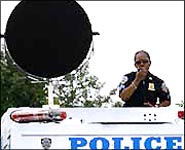
When in weapon mode, LRAD blasts a tightly controlled stream of caustic sound that can be turned up to high enough levels to trigger nausea or possibly fainting. The operators themselves remain unaffected since the noise is contained in its focused beam.
"We've devised a system with a multiplicity of individual speakers that are phased so sound that would normally go off to the side or up or down, cancels out, while sound directly in front is reinforced," Norris explained. "It's kind of like the way a lens magnifies a beam of light."
The Department of Defense gave Norris and his team funding to develop LRAD following the 9/11 attacks. The concept is to offer an intermediate tool to warn and ward off attacking combatants before resorting to force.
"Regular bullets don't have volume control on them," said Norris. "With this, you just cause a person's ears to ring."
The NYPD, however, has said they won't be using the $35,000 tool to make people's ears ring, but only as a communication device.
"We're only going to use them for safety announcements and directions," said Paul Browne, a police spokesman.
In tests, police have shown how they can convey orders in a normal voice to someone as far as four blocks away. The sound beam is even equipped with a viewfinder so the operator can precisely target the audio by finding a person in cross hairs. Rather than using pure volume to throw sound far, the LRAD reaches distant ears by focusing the audio beam.
This is the second time the device has been used by police -- Miami police also used it during the free-trade conference in that city last year.
Despite the NYPD's assurances that they won't use the tool to hurt protesters, Bill Dobbs of United for Peace and Justice, which has planned protests around the convention, has told reporters that the sound system presents "a potential Big Brother nightmare."
Inside the convention center, people will have the chance to experience -- at will -- another of Norris's inventions.
A TIME magazine display at the convention will feature speeches of past Republican presidents in tightly controlled beams of HyperSonic Sound (HSS). Viewers can literally step in and out of the display's different listening zones. A similar high-tech display of former Democratic presidents was featured at the Democratic National Convention in Boston in July.
HSS works by mixing regular, audible sound with two beams of super high frequency, inaudible sound waves. "Just the way artists mix their paint," says Norris.
The resulting ultrasonic sound wave can then be directed out in a tightly controlled beam. Wherever the beam makes contact with air, the air molecules interact in a way that isolates the original audible sound. So if you're standing in front of the ultrasonic sound wave, you can hear the sound. If you're a few inches away, you hear nothing.
This cuts down on ambient noise and gives listeners the somewhat eerie effect that the noise is inside their heads.
"We like to say we create silence instead of noise," said Norris. "You don't need to fill the space with a whole cacophony of noise."
The GOP convention display should perk up the ears of some curious attendees, but Norris is most excited about the device's marketing potential.
Already, some Coca-Cola machines in Japan are equipped with the technology so passers-by hear the enticing sound of soda being poured into a glass of ice. And dozens of Safeway supermarkets in California, Colorado and Virginia are testing the technology on patrons waiting in line to pay. Norris' company has also sent out HSS for testing at Wal-Mart and McDonald's. The narrow beams of sound advertise sale items at the store or restaurant and feature promotional material.
Glen Boire argues the concept is annoying and invasive, but Norris counters, "If you don't want to hear it, you can move your head a half foot away and it will go away."
Needless to say, it won't be as simple for convention-goers and protesters -- who may wish to tune each other out next week.
By Amanda Onion
August 24, 2004
Check out the ears before brawling
WASHINGTON (Reuters) -- It may be wise to check out a stranger's ears before picking a fight, U.S. researchers advised on Monday.
They found that women and men with asymmetrical extremities -- ears, fingers or feet of different sizes or shapes -- were more likely to react aggressively when annoyed or provoked.
This could make sense, the team at Ohio State University said. Factors such as smoking or drinking during a pregnancy could stress a fetus in various ways, causing not only slight physical imperfections but also poorer impulse control.
"Stressors during pregnancy may lead to asymmetrical body parts. The same stressors will also affect development of the central nervous system, which involves impulse control and aggression," said Zeynep Benderlioglu, who led the study.
"So while asymmetry doesn't cause aggression, they both seem to be correlated to similar factors during pregnancy."
Benderlioglu, Randy Nelson, a professor of psychology and neuroscience, and Paul Sciulli, professor of anthropology, reported their findings in the American Journal of Human Biology.
They told 100 college students they were taking part in a study of persuasive ability by asking them to call people to raise money for charity.
But their calls went to two experimenters who followed a careful script, either apologetically saying they did not have money to donate, or becoming confrontational and challenging the caller and the charity.
The researchers had rigged the phones so they could measure how hard participants slammed the receiver down after the call.
The more asymmetrical their ears, fingers and feet, the more force the volunteers tended to use when hanging up, they found.
Women were more likely to slam the phone when challenged, while men seemed angrier when politely turned down, they found.
"Research has shown that men are quicker to anger than are women," Benderlioglu said. "But while unprovoked men are generally more aggressive than women, the gender differences either disappear under provocation, or women may actually become more aggressive than men."
It could be men just dropped the aggressive call before it escalated, she added.
The frock of my life
I'm so excited I could sing a little song. The reason? I've just bought a dress. I really don't think there is any shopping experience to rival it. And I say that as someone who gets excited about going to the stationery store for a new packet of paperclips.
Of course, the shoe moment is always a very sweet thing, a hat purchase is delectable and a new handbag is like getting a pet, but nothing is as special as buying a dress. Possibly because it is so rare. You just can't find the bloody things.
The ability to design nice, wearable, comfortable, flattering dresses, that you can do up and that don't show your bra - dresses you can wear to work - seems to elude even the great designers.
They can all do the statement dress, the sundress, the Oscars gown and the result dress, but the Living Dress has for too long been the rarest creature on Planet Fashion.
By Living Dress I mean the garment that used to be the very staple of the female wardrobe - a simple thing that you just slip on for hassle-free daywear. You don't see women in them much these days, but I don't think that's because we really prefer the challenge of matching pants or skirts with tops every morning; it's because there just haven't been enough good dresses on offer.
This is beginning to change, though - and interestingly it's women designers who are bringing the Living Dress back. The great 1970s dress doyenne, Diane von Furstenberg, is currently enjoying a huge revival, and local heroine Leona Edmiston anchored her stand-alone label entirely on the dress, with very successful results and lots of international sales.
Maybe it's an Aussie gal thing, actually, because Collette Dinnigan has always been a great proponent of the frock, and the last great dress I bought, before this one, was by Zimmermann.
More recently in New York and London, a whole new swath of woman-designed labels has emerged, based largely on the dress for success. My new frock is by one of them, former model Jane Mayle, who has a gorgeous shop in New York's Nolita.
It's a beautiful thing, this dress, with a delicious hint of flirty French maid in cream lace appliqued onto black crepe. There's a little stretch in the fabric for fit and comfort, and a floating front panel that redefines the word flattering.
I really don't think a man could have designed it. Of course, as I say, male designers can conjure up wonderful dresses - Dolce & Gabbana particularly spring to mind - but they do tend to be those high-octane numbers, relevant only to a small set of limo-riding, size six lifestyle princesses. Say, Naomi Campbell and the Hilton sisters, and then start thinking hard for some more examples. I really think it takes a woman to design a dress that works for the real-life gal.
I don't know whether this is because only another woman understands the very particular imperfections and insecurities of the female form and psyche, or simply because the Living Dress is the most quintessentially feminine of garments.
And I'm sure this is the reason I get so excited when I buy one - it makes me feel so deliciously back in touch with my inner femme. I spend so much of my life charging around in pant suits and practical shoes, I sometimes feel less than a woman, which is a shame, because a woman is such a wonderful thing to be.
When I watch old movies with such ultrafemmes as Elizabeth Taylor in her silk underslips and Marilyn Monroe in curve-hugging day dresses, it makes me yearn for a kidney-shaped dressing table and a down powder puff.
Of course, I want to hold onto my desk and my laptop, too - I'll just wear a dress while I'm doing it.
By Maggie Alderson
August 23, 2004
Fat-reducing microwave unveiled
Sharp's new appliance generates 'super steam' that melts away fat for health-conscious consumers.
TOKYO (Reuters) - Eyeing up that juicy steak but worried about your waistline? Japanese electronics maker Sharp Corp. said it has developed a new fat-busting microwave oven that can melt some of your worries away.
Unveiling its invention Monday to the media, Sharp said the microwave generates "superheated steam" at a temperature of about 572 degrees Fahrenheit, hot enough to melt fat and reduce oil and salt from steak, chicken, fish and other foods.
Osaka-based Sharp said the product was developed to address a growing awareness among consumers about the need for a healthier diet, especially with obesity rates climbing to worrisome levels in many countries around the world.
"Obesity is becoming a global problem," said Itsuro Kato, a director that heads up Sharp's home appliances division.
Sharp said the machine's fat-zapping power derives from a steam generating unit that produces a combination of convective heat and condensation heat so hot that fat liquefies and flows out of the food in a very short period of time.
The company said the new oven can remove eight times more fat off a 200 gram beefsteak than if prepared in a frying pan, leading to a 13 percent reduction in calories.
It can cut nearly 19 percent of the fat off a 100 gram serving of mackerel, compared with about 12 percent reduction when using a gas grill, Sharp said.
Scheduled to go on sale in Japan next month and to be gradually introduced after that in overseas markets, Sharp's new oven can also reduce salt content in fish and limit the loss of vitamin C in vegetables, the company said.
But reducing the fat and calories of your meals will come at a price. Sharp said it expected the "AX-HC1" to sell for about ¥126,000, or $1,153, several times the price of a typical microwave oven that might retail in Japan for around ¥20,000.
Sharp said it would continue to make conventional microwave ovens and market the "AX-HC1" as a high-end model for health-conscious consumers.
The company said it would start with a monthly production of 10,000 units, but aimed to sell 500,000 worldwide in the business year to March 2008.
Shares of Sharp ended Monday trade up 2.8 percent at ¥1,558, outperforming the Nikkei average's 0.7 percent rise.
Flower marathon for Beijing Olympics
China is trying to breed hundreds of new varieties of flowers that will bloom in the hot, humid months when Beijing hosts the 2008 Olympic Games.
Few domestic species can blossom during the extreme summer conditions.
Five million pots of the new flowers are to be planted in the city over the next two years, to see if they have the required Olympic staying power.
Beijing is already undergoing extensive renovation for the Games, which are expected to cost $1.6bn.
Zhang Lannian, head of the Chinese research group into new flower breeds, told the China Daily that the flowers will be monitored for three years, to see if they bloom between July and September, when the Games are expected to be held.
A press official with the Beijing Municipal Bureau of Parks, Wang Zhongying, said the city had already been growing samples introduced from other domestic and foreign cities.
But she said that scientists had urged the capital to give precedence to locally grown flowers, so it did not lose its traditional features.
The Pope's new clothes
Tailor-made and fit for a Pope - have you ever wondered where the clergy go shopping?
At first glance the store looks much like any other tailor.
A little old-fashioned perhaps, with rows of small wooden drawers stretching to the ceiling.
There is a long, broad counter on which bolts of dark cloth are slapped with a resounding thud, ready for cutting.
Immaculately suited men bustle about with tape measures. There is a smell in the air of expensive aftershave, mixed with the odour of mothballs.
But the Gammarelli establishment - just off the Piazza Minerva in central Rome - is no ordinary tailors.
There is a sign over the door: Sartoria Ecclesiastica, or clerical outfitters.
Then there is the window display. No suits or shirts here; rather they are peaked clerical hats and priestly robes.
And in one corner, resting on a silk cloth, a solitary "zucchetto" - the small, white skullcap worn by the Pope.
Gammarelli is, in fact, the Pope's tailor.
It also serves other clerics - cardinals in their flaming red robes, monsignors in deep purple and cindery black for country priests.
Italy is considered to be the centre of the world's fashion industry and the Roman Catholic Church is not immune to changing tastes.
At one time, not so long ago, bishops would dress in long robes, a train of shimmering purple ribbed silk drifting after them.
There were plenty of tassels and pom-poms, highly elaborate vestments.
But then came Vatican II - the great ecclesiastical council in the 1960s - which decided the Church should try to move closer to the people and more into the modern age.
The council was something of a self-inflicted revolution. For instance, out went - for the most part - the Latin Mass.
Many of the old rituals were done away with. New, more simple, ceremonial was called for and orders were handed down from the Vatican that the pomp associated with the more elaborate vestments and costumes should go.
I enter Gammarelli.
Call it eccentricity, call it a ridiculous fashion statement, but for years - as long as I can remember - I have favoured wearing red socks.
The trouble is they are not always easy to come by, not in the right shade anyway.
Once, in the midst of a rather tedious European Union conference, a French foreign minister confided that the place to buy such things was here, at Gammarelli.
"Ask", he said, "for the same socks as a cardinal."
I take a deep, nervous breath and approach the counter.
The pictures of famous customers stare down from the wall. They are not film stars or sports personalities but sombre looking portraits of popes, past and present.
Some of the church hierarchy did not approve of the changes following Vatican II; those who were uncomfortable with the new, less elaborate Church, and in particular the phasing out of the ancient Latin liturgy.
Dress was another matter of concern. Cardinals no longer would wear the "galero" - their wide-brimmed hats.
A monsignor told me he was instructed that purple socks - part of his normal day wear for years - were no longer approved.
"The Church," he said, "had a terrible outbreak of Puritanism."
Is it possible, I ask the smiling man behind the counter, for non clerical customers to make purchases here?
Maximillian Gammarelli's family have been running the business for six generations. He could not be more obliging.
"Certainly", he says, "and what exactly, would Sir be requiring?"
"Well, I was rather keen on buying a pair of red socks," I say.
Steps are fetched and Maximillian ascends to the heights.
Interestingly, there is a reappraisal going on of those changes ushered in back in the 1960s at the Vatican II council.
There are those who feel that the Church, in losing some of its rituals, has also lost its status, its mystery.
Some say the Mass itself, in certain parts of the world, has been allowed to become little more than a "happy clappy" piece of entertainment.
The Pope himself has talked of preserving the Church's traditions and has also spoken of the importance of its cultural heritage.
Perhaps the Church pendulum is swinging, ever so slowly, backwards.
Some feel it will not be too long before the old, elaborate robes and vestments appear again.
A tissued package is placed on the counter. The covering is peeled back to reveal a flaming red pair of socks, knee length.
Maximillian asks me to clench my fist while the sock foot is curled round. This method of measuring guarantees a perfect fit, he says.
The label on the socks is in English: "Gentleman socks," it says. "Wash in tepid water with neutral soap."
I am concerned I might be stopping the normal flow of clerical business.
The Pope is unlikely to stroll in looking for a new robe but maybe a bishop is waiting to be served.
I ask how much the socks cost. Nine euros and 30 cents, just over £6.
I take two pairs and walk, a little ecclesiastically, out into the Rome sunshine.
By Kieran Cooke, BBC, Rome
From Our Own Correspondent was broadcast on Saturday, 21 August, 2004 at 1130BST on BBC Radio 4.
August 19, 2004
The art of not writing books
Imaginary novels and incredible stories are being collected for posterity in an unconventional UK arts project, the Library of Unwritten Books.
You will not find these titles on bookshelves or bestseller lists - One-Eyed Olaf, The Man Who Was Addicted to Seeing, Poke the Pig and Scrumping in Persia.
These books, along with many others, have not been written - so they are only to be found in the Library of Unwritten Books.
An art project travelling the UK, this library is collecting stories and ideas for books people would like to write - but never have, and probably never will.
Its two librarians - Sam Brown and Caroline Jupp - have collected more than 400 stories over the last two years, and are aiming for a total of 1,000.
Armed with a "mobile recording unit" - a converted shopping trolley - they have been eliciting stories from strangers before turning each tale into its own mini-book.
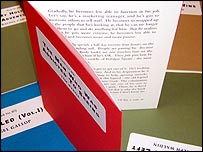
Tales are recorded then transcribed and turned into mini-books
At just a few pages each, these are pamphlets with the barest bones of an idea - and are distributed to libraries, pubs, community centres and doctor's waiting rooms.
Whether they are personal memories, wild fantasy or family history, these are stories that have never been told outside the author's circle of family and friends.
The original concept comes from the library of unpublished books in Richard Brautigan's novel The Abortion - and it was the desire to bring unpublished ideas into the open that brought the library into reality.
"I think it's curiosity about other things that drives me," Ms Jupp says. "The uncovering of those hidden things - that's a bit of a challenge."
In Portsmouth recently, one day saw the pair collect stories from a man with cerebral palsy about education, a man who went on an anti-Hitler pilgrimage to Austria, someone who had done children's illustrations of a family of conkers but not yet written the story, and an author of Chinese philosophical poetry.
"I think there's so much potential, there really is," Ms Jupp says. "But a lot of people just don't have the skill or the time - that very specific ability that it takes to write a book."
The following day included a story from an 80-year-old woman whose father was born in 1876 and served on HMS Terrible.
In a story that has all the hallmarks of a bestseller, her mother was originally engaged to one man - who went to war and was thought to have been killed.
So her mother married another man - only for the original fiance to come home alive from China with a Chinese wedding shoe.
Another participant, Fiona Davonport-White, 33, from Cambridge, came up with a tale about a middle-aged man whose life is changed after a conversation with a stranger in a pub.
"I was intrigued by the trolley," she says, adding that she had taken creative writing lessons but was too busy to write a real book.
"You get the overwhelming feeling that there's too many books already," she says. "I think the thing is to get myself a blog or something first to try it out."
When approached on the street, some people blankly refuse Ms Jupp and Mr Brown's advances - but a surprising number are willing to share their intimate thoughts, the pair say.
They say they have learnt to stop making assumptions about the people they encounter.
"They'll confound what you were thinking - which is a great part of the project," Mr Brown says.
Some want to use the experience as a personal catharsis, Ms Jupp says, but many have a message they want to convey to the world.
"A lot of these things are going to remain unwritten," Ms Jupp says, before Mr Brown adds: "And it's better that those ideas are out there in some form."
But not all concepts could or should be turned into full books, Mr Brown says.
"Unwritten books are different to the books that they would write," he says. "A good unwritten book doesn't necessarily mean it's going to be a good written book."
They are nice as "short snippets of people's lives", Ms Jupp adds. "Because they're so small, and you can't get everything in there, they're just suggestions of what could be.
"Giving the reader some little clues about the bigger picture is just as nice as giving them the whole picture and the whole book."
The Library of Unwritten Books is available to read at the Aspex gallery in Portsmouth until 28 August.

By Ian Youngs
BBC News Online entertainment staff
Proposed Dutch law would ban unsolicited toe-licking
AMSTERDAM, Netherlands (Reuters) -- Unsolicited toe-licking would be banned in the Netherlands under a law sought by the Dutch Labor party after police were unable to prosecute a would-be Casanova with a taste for female toes because he had committed no crime.
A police spokesman said Friday a man had been detained after women sunning themselves in Rotterdam's parks and beaches claimed he had snuck up on them and begun to lick their toes.
"The officers had to let him go. Licking a stranger's toes is rather unusual but there is really nothing criminal about it," the spokesman said.
Dutch press reports said the man, who is about 35, had been licking the toes of strangers for about three years but was only recently caught by police.
Peter van Heemst, a Labor member of parliament, asked Christian Democrat Justice Minister Piet Hein Donner Friday to explain why Dutch laws forbid littering but not uninvited toe-licking. Van Heemst demanded an amendment prohibiting it.
"It is a violation of one's privacy and one's physical integrity," he told a local news agency. "The norm... is that no one should touch your body if you haven't asked them first."
A spokesman for Donner said the minister could not immediately comment.
Delegates amble to laziness conference
The pressures and rhythms of modern life often prompt people to seek new ways of unwinding - a course of yoga, a massage or a long stroll.
In Italy, though, a group of people are this weekend proposing a different approach to the problem. Their answer - simply do nothing.
The first National Convention of the Idle is taking place in a village near the Swiss border.
Organisers say they hope the whole concept of idleness can be re-evaluated.
According to one of the organisers, comic actor and writer Gianni Fantoni, idleness is not a vice but a sign of intelligence, as idle people find smart ways of getting the same results with less effort.
He says it is also an elixir of long life in a world of deadlines.
Italy's lazybones will gather, if they can be bothered, in the mountain village of Champoluc, where they can comfortably arrive by cable car.
The event will include an exhibition of idleness through the ages, and a display of objects that reduce effort to a minimum - a dinner suit with shoes and socks incorporated, a rubbish bin with a chute attached, a mould to make snowballs without freezing your fingers and, almost a symbol of the movement, a hammock.
Participants have been promised that the seminar on idleness will last less than half an hour, a long siesta is obligatory and they will receive tips on perfecting laziness.
The organisers will also present a series of 10 commandments on how to avoid effort. These include letting others always make the first move, remembering that exercise is for other people, and never, ever volunteering for anything.
By Frances Kennedy
Chatting it up in the cyber White House
WASHINGTON (AP) -- The questions pour in: Will President Bush reschedule his prime-time speech to avoid a conflict with "American Idol?" (Nope.) Why does he hate nature? (He doesn't.) Do presidents pick up a hot line red phone? (No, phone colors of choice have been black, turquoise and white.)
Online exchanges like these offer a peek into the ways of the White House, not to mention a taste of what's on the minds of some Americans.
"Ask the White House" is an online chat held about five times weekly. People fire eclectic questions at administration officials and staffers, mixing heavy affairs of state with light fare about where Barney the dog sleeps. The forum is supplemented by e-mail exchanges that offer officials a bit more time to research their answer.
A Tucson, Arizona, man offered the White House chef a corndog stuffing recipe at Thanksgiving; a Richmond, Virginia, writer asked the Federal Trade Commission chief how he could get his ex-wife's name added to the Do-Not-Call Registry; a Cleveland man proposed to his girlfriend during a chat.
"When we take a question that is offbeat and funny, it's good," says Jimmy Orr, White House Internet director. "We encourage that. If there is an element of humor, they are more apt to be read."
Besides, Orr added, "it humanizes the guest. Instead of a senior administration official that is very governmental and stern, it shows they have a sense of humor too."
Hundreds, sometimes thousands, of questions are sent to Orr's e-mail during a single live session. He reviews them and forwards questions relevant to the topic of the discussion to the guest, but the guest can take on any question.
The topic is usually one that underscores the president's message, or reflects something he did that day.
Launched in April 2003, the forum has let people interact with first lady Laura Bush, National Security Adviser Condoleezza Rice and Homeland Security Secretary Tom Ridge. White House Chief Usher Gary Walters talked of in-residence ghosts, Presidential Chef Walter Scheib was offered a tip using chopped-up turkey corndogs as stuffing.
"This is a new recipe to me, but if you like it -- enjoy," a noncommittal Scheib replied.
A few softballs are tossed over the Internet. One coach asked how his young players could become eligible for tee-ball games hosted by the president on the South Lawn of the White House. (An application can be found on the Little League Web site.) Another wanted to know how many event invitations the president receives weekly. (More than 1,000.)
In either form of cyber communication, tough questions do get through, probing officials on the environment, education and national security. Jobless people want to know when the economy will improve.
In some cases, there is anger in the air. "Who in their right minds would give Saddam Hussein back? Did we not go into that country and take him out? So why are we giving him back?"
U.S. Deputy Secretary of State Richard Armitage delicately handled this one, responding that it was the "proper course of action."
"Saddam Hussein is responsible, some people estimate, for the deaths of a million Iraqis. He is responsible for the invasion of Kuwait and the raping and killing of thousands. Those are the people in the first instance who have a right to extract justice."
Others grouse, then get to the root of their frustration. "The Bush regime hates nature. How else to explain the war against our land, water and air?"
Jim Connaugton, chairman of the Council of Environmental Quality, rebuffed the attack, saying, "You apparently are not aware that the president is an avid outdoorsman and conservationist who enjoys restoring habitat, planting native grasses and reforesting his own land." Then, Connaugton went on to explain Healthy Forests legislation.
Orr said it's important to take the tough questions, to get a good balance. "If we only posted the questions that praised the president and the policies, people would think it's only red meat for the conservatives," he said.
The online Q&A has helped dispel some myths. Walters responded to a question about a red phone located in the Oval Office like one on the original "Batman" TV series.
"If it were a hot line, it may have been concealed in a desk drawer," he allowed. But he was only aware of black, turquoise and white desk phones used by recent presidents.
Among the testier questions:
--Chris from California: "This White House attempting to celebrate Earth Day is the biggest crock I've ever seen. How can you guys do it with a straight face?"
--Bon from France: "There will be no bygones. French people won't ever forgive your insulting behavior neither the sillyness of your president and his stupid people. You are not welcome in my country."
On a lighter note, White House press secretary Scott McClellan was asked by an Ohio middle schooler if he would move the president's speech to another time. "I want to watch 'American Idol.' How about moving the speech to 9 p.m?"
McClellan told her he thought they would stick to the 8:30 p.m speech.
"There are some important issues that the president wants to discuss with the American people at a time when most Americans will be able to hear what he has to say," he said.
US security: Protection or intrusion?
New York is on high alert, as it seems some of the world's big financial institutions have been surveyed by members of al-Qaeda. But what is it like living in a city constantly looking over its shoulder?
To live in America in these strange, tense times is to live in a country of the bizarre, the unsettling, the surreal.
We ordinary citizens go about our business, live our lives, with powerful forces shaping our paths and daily routines.
We know there are evil people out there intending to kill and maim us, perhaps watching us, riding the same trains.
Against them are the authorities, officialdom, offering us information which we have no way of verifying; so it is hard to make sense of the never-ending brouhaha of security.
A year ago, for example, I found myself as a tourist in northern New Mexico, and as any good tourist would do, I decided to find out if there was a museum at Los Alamos.
This is the remote town, you will remember, chosen for the Manhattan Project to build the world's first atom bomb.
Today, the site remains America's prime nuclear laboratory, the place where new generations of nuclear weapons are devised and engineered.
Top secret, you would think.
Yet, when I was there, I managed to drive unimpeded onto the site in a hire car, park it and wander round, trying to find someone to ask where the museum was.
Not only did nobody confront me, but I had a hard time finding anyone who could actually point me in the right direction.
Now, I am not saying I actually wandered round the cyclotron, where particles are whirled around and processed, but I did manage to park a car and wander, unimpeded by a heavy-booted officer or even a simple question about who or what I might be.
It is partly that Americans are not used to terrorism and the environment it creates.
The other day, I came out of the cinema on Union Square in Manhattan and spotted a small, black briefcase all alone on the pavement.
After years of living in London, any unattended case arouses suspicion so, no doubt to my discredit, I decided to head away sharpish - at which point, two security guards appeared in black T-shirts marked appropriately "Security".
They waddled up, they looked a bit, and then one of them kicked the case. No bang - so that is all right, then.
On the one hand, security seems lax; on the other, it seems to be everywhere.
Photo-identity like a passport is demanded constantly - to travel on trains and planes, of course, but also to get hotel rooms.
Why? I am not quite sure.
It is true there is slightly less chaos now at airports. The searches seem swifter and more focused.
We have moved on from the time when I witnessed an official at Detroit airport shouting: "Everything through the X-ray, everything on the belt," only to see a grand lady place the plastic case carrying her dog on the conveyor.
This sweet, roly-poly creature - the dog not the lady - was then heading towards the scanner and, I surmised, its doom.
Nothing but charcoal would be left of the curls and ribbons. There was a moment of mischief in my mind, but then I relented and spoke out.
"Ma'am", I said, "if I were you I'd take the dog off the belt".
It is, of course, easy to sneer but there is a serious point.
If security regimes at public buildings seem arbitrary, the public will not trust them. And crying wolf is now a problem.
It is true I am only a sample of one, but I live in Lower Manhattan and work in Times Square - two targets on any evil doer's list, you would think - yet when the authorities tell me I am more at risk today than yesterday, I have to say that I am unconvinced.
There is a view that states of permanent high alert and tension suit President George W Bush's election hopes.
You do not have to subscribe to that theory to think that the authorities are getting it right.
It may be, rather, that putting security at the top of the agenda legitimises endless intervention in our lives. And because the enemy is unknown, it is impossible to know how much intervention is warranted.
So the police scream around in convoys. People in uniform - railway officials, hotel staff, security guards - seem to think they have a right to know your business.
That is not a conspiracy to keep the people frightened.
Anyway, I am not sure that a state of constant alert does suit President Bush.
A weariness and a wariness of officialdom may be setting in with people who think they have heard that cry of "Wolf!" once too often.
Of course, if there were a serious bomb attack, let us say a week before the election, that would be a different political matter.
Mr Bush might then look like the strong defender, the man whose warnings were prescient.
Terrorists shape our daily lives in tedious ways.
They also shape the election for president of the United States of America.
By Stephen Evans
North America business correspondent
From Our Own Correspondent was broadcast on Saturday, 7 August, 2004 at 1130 BST on BBC Radio 4.
August 18, 2004
TECHBITS: pool-playing robot
KINGSTON, Ontario (AP) -- Deep Green, a pool-playing robot built in a lab at Queen's University, isn't spending nights at bars challenging human champs -- yet.
Michael Greenspan, an associate professor of electrical computer engineering, sees the project as a way to explore robotic vision and game theory. But it began with less lofty notions, when, after a frustrating night of pool at a robotics conference, Greenspan decided it would be easier to build a pool-playing robot than master the game himself.
"At the point the system beats me, I'll have been proven correct," Greenspan says.
So far, Deep Green breaks about as well as its creator, but needs to work on accuracy. To that end, Greenspan and his students are developing better machine vision algorithms. They're also working on the computer's strategic abilities, an area where Greenspan sees the possibility of spin-off technology, since pool is more uncertain than most games.
"In chess, there's no uncertainty. A piece is either on a square or it isn't," Greenspan says. "Pool works in a continuous world."
TECHBITS: Mobile protest
NEW YORK (AP) -- Joshua Kinberg spent a year turning his bicycle into a mobile protest machine ready to take on the Republican National Convention -- and got a master's degree in the process.
Part of the former bike messenger's thesis at Parsons School of Design was bikesagainstbush.com, a Web site that will invite visitors to contribute 150-character-or-less thoughts about President George Bush.
Kinberg, 25, will receive the thoughts as SMS messages on a cell phone mounted on his bike's handelbars. The phone is connected to a chalk printer on the bike that sprays letters that look like the sidewalk version of skywriting.
As rider and moderator, Kinberg will pick the messages that meet his criteria and spray them on the streets during the Aug. 30-Sept. 3 convention. A webcam and GPS on the bike will record each message and its coordinates and relay them back to the Web.
Bikes Against Bush is really one Bike Against Bush, since Kinberg has only one printer-enabled bike. He says his protest is not graffiti, since the chalk is biodegradable.
Although Kinberg says he expects to receive a wide range of messages and each message will be archived on his site, he will not be printing any pro-Bush messages. "It's Bikes Against Bush," he says. "It has a point of view. And it's my bike."
?Ellen Simon, AP Business Writer
What entertainment journalism needs is a '60 Minutes'
DAN BROWN:
The other night I was gabbing on the phone with my friend Marni and, as often happens, we were doing our When Harry Met Sally routine ? I, in my apartment, and she, in her house, both of us channel surfing as we talked.
As she flipped, Marni came across one of those flashy show-biz newsmagazines. You know the kind -- the shows that feature chipper hosts, shallow correspondents and inane stories about celebrities. They're the television equivalent of junk food, and while seemingly no one will admit to watching these programs, this doesn't prevent them from having millions of viewers.
Marni paused momentarily, reported to me what her surfing had yielded, then said "You know what we need? A 60 Minutes of entertainment journalism."
She's absolutely right.
Shows like Entertainment Tonight and Extra are the antithesis of 60 Minutes which, as you're probably aware, is the gold standard of TV journalism. The reporters who work for 60 Minutes have earned a reputation as journalists who aren't afraid to ask tough questions, who can be relied on to be as impolitic as it takes to get to the heart of a story.
The reporters who do entertainment journalism for the small screen, on the other hand, are specialists in what is known as "the puff piece." These are stories that are as complimentary as possible and they are the result of an unspoken quid pro quo: in return for getting access to big-name stars, the reporters agree to promote whatever product the celebrity happens to be pushing.
The result is pretty awful. In fact, it's hard to call it journalism. If you don't believe me, do what I did after my conversation with Marni and try to sit through an entire evening of such programming. I put myself through this exercise a week ago, and my brain still hasn't reverted to its solid form after slowly turning to mush with each successive show I watched.
The first thing you'll notice when viewing celebrity-centred programs is the, er, celebratory tone. One of the shows I watched was Inside Edition, which featured a report -- essentially a short infomercial -- about a lingerie collection being offered by soap-opera vamp Susan Lucci. Just giving Lucci free air time to hawk her lacey underthings wasn't enough, so correspondent Victoria Recaño went one step further by telling viewers how to react: "The petite 56-year-old looks AMAZING modelling her collection."
Hmmm ... I thought it was up to me to judge what looked good.
If you believe the TV tabloids, however, everyone in the entertainment world is fabulously sexy. Over on etalk Daily, Canada's own contribution to the genre, I saw host Tanya Kim and gossip reporter Susie Wall discussing B-lister Skeet Ulrich, who is apparently in Alberta shooting his latest project. "The ladies are loving Skeet on the streets of Calgary!" Wall enthused.
Kim picked up this breathless tone. After an interview with Lionel Richie was shown, she looked into the camera and sighed: "Ah, I love Lionel."
Kim is actually a master of these kinds of prompts. After each item airs, she adds a word or two of verbal punctuation so viewers will know exactly how they should feel. For instance, after a report about Hollywood's most attractive stars, which ended with a clip of Brad Pitt, Kim's response would have done Homer Simpson proud: "Mmmm ... Brad." We get the message: people who appear in movies and on TV are way more attractive than your average schlub.
Kim and her colleagues go beyond being uncritical. They go beyond being flattering. They are essentially doing public relations work for celebrities, happily broadcasting whatever message the stars want to send the public.
If you think this isn't the case, just look at the coverage surrounding the launch of Tom Cruise's new movie, Collateral. There was a single theme running through all the reports, one that serves Cruise's interests. Almost every reporter asked Cruise if, after two unsuccessful tries, he plans to marry again. He responded enthusiastically in the affirmative, which led to story after story about Cruise's love for women. Thus is his heterosexuality confirmed. Thus is his box-office appeal preserved.
You might think that I believe we in the media should just ignore the glitterati. But I really am convinced there's room for a 60 Minutes-type show that covers the entertainment beat.
Such a show would pose the really tough questions, the ones that celebrity interviewers currently avoid. For instance, last week saw the launch of the Brittany Murphy vehicle Little Black Book, which inexplicably co-stars Holly Hunter. No one addressed the uncomfortable question of how it is that an Oscar winner like Hunter has now been demoted to a role in which she plays second banana to Brittany Murphy. How did Hunter's career get to this point?
One other tidbit I learned last week is that Britney Spears plans to build a fairground on her estate for her soon-to-be stepchildren, a "full-on Neverland." No one bothered to point out that this may be a bad sign. No one asked, "Could the singer's grip on reality be loosening? Is she the next Michael Jackson?'
Or how about this: there have been lots of reports about Mary-Kate Olsen's struggle with her eating disorder. It's good that she appears to be recovering, but there still isn't a journalist brave enough to ask why, when Olsen poses in public with her twin sister, there is something vaguely erotic about the way they drape themselves over each other.
I also found out last week that Paris Hilton's latest method of grabbing headlines is to star in a new music video by rapper Won-G. It's called Caught Up In The Rapture and it's a cover version of Blondie's Rapture, probably the first mainstream rap record. This could have given rise to so many good stories -- has rap music reached some kind of critical phase, when the first rap record (a white one, no less) has been remade?
A 60 Minutes of entertainment journalism would delve into issues like these. I'm not sure that anyone in this industry is brave enough to create such a program, but I do know that celebrities are an important part of our culture and journalists should respect them -- and themselves -- enough to put away the kid gloves.
August 17, 2004
Mapping more of Northwest Passage question of Canadian sovereignty
ABOARD THE AMUNDSEN ICEBREAKER IN THE FRANKLIN STRAIT - Climate change threatens to create a northern sovereignty problem for Canada as an Arctic access route previously protected by ice becomes open to ships from other countries, researchers warn.
Many lives and ships have been lost over the centuries in the quest for the Northwest Passage, the legendary shortcut connecting the Atlantic with the Pacific Ocean in Canada's high Arctic that eluded such famous adventurers as Francis Drake, Martin Frobisher and Henry Hudson.
It was finally navigated in in 1903-06 by the Norwegian explorer Roald Amundsen.
But within 50 years, global climate change could turn what is now an infrequently travelled narrow shipping lane through the ice into a widely accessible shipping lane and put Canadian sovereignty over the passage into question, according to a senior Canadian scientist.
André Rochon, chief scientist on board Canada's Amundsen research icebreaker, says climate change warming could make the route almost ice-free, tempting many countries to push for the passage to be declared an international waterway.
Right now, it takes the combined power of the Amundsen's six engines to break the thick ice and travel the passage, but once the ice disappears any ship could travel the route.
"It's an important problem because if sea ice disappears from the Northwest Passage, then it becomes the shortest route between Europe and Asia, and of course, shipping will increase," Rochon says.
The scientist fears this would lead to an increased risk of accidents and pollution and argues that Canada does not have the infrastructure to manage greater ship traffic.
That is why, according to Rochon and other scientists, it is important that Canada learn as much as it can, as quickly as it can, about the frigid region to prepare for the predicted changes.
Jonathan Beaudoin, a computer scientist with the Ocean Mapping Group at the University of New Brunswick, says its is important to get detailed maps of the area.
"The Hydrographic Service has done as much as it can to survey a shipping lane through here [the Northwest Passage] but if you have to go off that lane for any reason there's very little known...so it would be good for us to be surveying up in our arctic backyard," Beaudoin says.
He's using a device called a multi-beam sonar to measure depths and develop a profile of the ocean floor.
But Beaudoin says the mapping group hopes to survey a much wider area in the coming years, in order to put more of the Northwest Passage on the map.
Blood screening detects brain-wasting disease
MONTREAL - A Canadian biopharmaceutical company says it has developed a process to screen blood donations for prions, the infectious proteins associated with brain-wasting Creutzfeldt Jacob disease.
Prions are misfolded or abnormal proteins that attack the central nervous system and then invade the brain in the same way as variant CJD, the human form of BSE or mad cow disease.
Two people in Britain are known to have come down with vCJD through blood transfusions.
Canada's blood supply is currently screened for viruses such as HIV, Hepatitis C and West Nile, but there's no way to screen for the prions that cause vCJD.
Prometic, a biotechnology firm based in Montreal and London, England says it's coming out with a filter for prions in human blood. One drawback is the cost of manufacturing the special blood bags needed for the screening.
The company has developed a chemical filter that binds to prions in bags of donated blood, highlighting any residues, said Claude Camire, the vice-president of Prometic.
"[Prions] have a specific structure, which we have identified," said Camire.
For the screening to work, a chemical filter has to be inserted into the membrane of blood bags during manufacturing, doubling the cost from about $25 US to $50 US. Canada needs about one million bags per year for blood donations.
"Countries will weigh the benefit of using the technology against doing it or not doing it and how many people will die," said Camire. "I think that's an ethical issue we go through with a number of biotech products."
Next year, the company plans to market its technology in Europe, where 140 people have died of vCJD. So far, there has been one death from the disease in Canada.
Technology's impact on sporting success
The Olympics in Athens look set to be the most technologically advanced in the Games' history.
The development of sports science in recent times has allowed athletes to prepare for this Olympiad using technology beyond their predecessors' wildest dreams.
But some question whether the influence of technology on training and performances is undermining the spirit of the modern Games, as it returns to the birthplace of the ancient Olympics.
Almost 70% of people questioned in a poll believed that athletes with access to the latest technology did have an advantage over those who did not.
The survey by pollsters Populus was commissioned by the Engineering and Technology Board (ETB) as part of their Engineering in the Olympics campaign to promote the sector's role in achieving sporting success.
Sport's record books show that the development of man-made materials has had a dramatic effect on some sports, such as pole vaulting.
At the beginning of the 20th century, athletes were using wooden poles to clear the bar. Within a decade, they were using the best nature had to offer, bamboo.
The reduction in weight meant athletes were able to reach higher speeds and achieve greater heights. But once they had perfected their technique, competitors struggled to set new records.
The introduction in the 1960s of fibre-glass, and eventually carbon-fibre, poles meant the records again began to tumble. Vaulters now find that their nerve, as well as the limitations of the pole, determine how high they go.
UK Sport technical advisor Scott Drawer feels too much emphasis is placed on technology's ability to deliver medals. For him, the key factor is talent.
"No matter what you do with technology, it is still in the hands of the coach," he told BBC News Online.
"The advantage is how the coach uses the information technology can deliver. The innovation is in the mind of a talented coach."
For Team GB's bike designer, Dimitris Katsanis, the knowledge and experience of the cycling team helped shape the final design.
"We all sit down in a meeting, myself, the coaches and the performance director of British Cycling, where we set down the basic requirements," he said.
"Then I go away and work on ideas, which very often are based upon what the athletes or coaches have come up with."
As the designer of the bikes for British cyclists competing in Athens, Mr Katsanis said the devil was in the detail.
"Because of the regulations, you could not go and have something revolutionary.
"The improvements I had to look for came from careful engineering, design and the use of the latest materials. We looked for a few 1000th of a second saving here and a few 1000th of a second there."
The advances in sport science has created an opportunity for those who, in the past, have been excluded from the elite level of sport - disabled people.
At the last Paralympics in Sydney, the US's Marlon Shirley set a new amputee world record for the 100m with a time of 11.09 seconds.
Last year, he became the first amputee in history to break the 11 second barrier.
His hi-tech prosthetic leg, made from aluminium and carbon-fibre, has allowed him to train alongside his peers in the national Olympic sprint team in the build-up to Athens.
There is also an expectation that Mr Shirley will break the 10.60 second benchmark that will allow him to compete alongside able-bodied sprinters in the US national finals.
UK Sport is involved in a pilot project that aims to take a recent development within cycling and use it in wheelchair racing.
"We brought cycling and Disability Athletics together," said Mr Drawer, "to work with some of the experts from British Cycling to see how they could take advantage of some of the latest technology.
"There is [a crank] that measures torque across the sprockets on the wheel. It lets you know how much power you are applying. They are looking at applying this to wheelchair racing.
"It will allow much more accurate measurements of the workload on the athlete."
The phrase "event dependent" quickly emerges when examining the level of influence technology has on sport.
"If you take something like the 100 metres, the times people are achieving have been pretty stubbornly stuck for a number of years," explained the ETB's Mike Gannaway
"Those sports which are more technology dependent, that is where you are seeing the major strides taking place."
By Mark Kinver
BBC News Online
Revealing Hospital Gowns Redesigned to Protect Muslim Women's Modesty
PORTLAND, Maine Aug. 17, 2004 ? Whether its blue or spotted or stripped, the standard issue hospital gown is drafty and revealing. It's embarrassing for just about anyone who's spent a night in a medical center.
But for modest Muslim women, it's an unthinkable indignity.
"I have witnessed their misery and how bad they feel about it. They don't like it. They feel ashamed. It's very embarrassing," said Asha Abdulleh, a native of Kenya and a medical interpreter.
When officials at Maine Medical Center discovered many Muslim women were so ashamed they were canceling doctor visits, the hospital took action, redesigning the standard gown to provide extra coverage for patients who want it. The new hospital gowns have been available for several weeks.
"This is a great example of a challenge raised by a specific community that can ultimately benefit all patients," said Dana Farris Gaya, the hospital's manager of interpreter and cross-cultural services.
The problem was acute for Maine Medical because 2,000 Somali refugees have come to Portland over the past few years and most of them are treated at the hospital's international clinic. As many as three out of 10 women were skipping their appointments, said Osman Hersi, a medical interpreter at the hospital.
Tracked down at home, the women whose religion and culture require them to be covered, described to interpreters the horror of being asked to wear the revealing gowns during outpatient procedures.
Furthermore, they were publicly humiliated when they had to wait in a hallway in the radiology department.
On a recent morning after the new patient gowns were provided, Shamso Abdi appeared for her first hospital visit since arriving in Portland.
She and her husband, Aden Ali, came to the United States from Mogadishu, Somalia. They lived in a small town in Kentucky, and then Columbus, Ohio, before coming to Portland.
Abdi, who was clothed in a dress, a sarong and a hijab, a scarf wrapped around her head, said she had canceled appointments in Columbus when she had to see male doctors and wear the standard drafty gown.
The gown created by the Portland hospital is long enough to provide more coverage of a patient's legs and has extra material to ensure that a patient's backside remains covered. Underneath, there's a wraparound sarong for even more coverage.
Abdi said she was grateful to see that Maine Medical had created a patient gown with her principles in mind.
"I'm so happy they made the change. I'm so happy that they considered us," she said, speaking through an interpreter.
Other hospitals are responding to the needs of Muslims. In southeastern Michigan, home to 300,000 Arab-Americans, the University of Michigan Medical Center is also addressing the issue of modesty.
The hospital is thinking of posting signs on the rooms of Muslim women warning male visitors and staff to check with a nurse's station before entering, said spokeswoman Krista Hopson in Ann Arbor, Mich.
As for the gown itself, Maine Medical isn't the only hospital to try to create a more acceptable version.
Hackensack University Medical Center in New Jersey introduced vibrant colors and funky patterns five years ago. Other hospitals and garment producers have tweaked the traditional design with snaps, Velcro and other changes.
Still, the standard-issue gown will never go away entirely. In some situations, in emergency rooms for example, it's more important to put the interests of doctors and nurses ahead of the interests of patients.
But for many situations, it makes sense to keep patients happy.
Asks Dr. Nat James of the hospital's international clinic: "Why didn't we think of this so long ago?"
[a href="http://abcnews.go.com/wire/US/ap20040817_207.html" target=new>original article]
Butterfly farming proves worth a flutter
Haji Mshangama charges across the hilly landscape of the East Usamabara mountains brandishing his blue butterfly net.
Suddenly he snaps the net down and has caught what he is after: a pregnant female Salamis Parhassus butterfly.

This is the beginning of a process lasting up to two weeks which will culminate in the export of the live pupa or chrysalis to a butterfly exhibit somewhere in the US or Europe.
Mr Mshangama is a happy and increasingly rich man, at least by local standards.
Working with seven other farmers, he began farming butterflies just ten months ago. In June his group sold pupae worth $500, a staggering amount of money, in an area where many farmers are earning just one or two dollars a day.
"My friends did think I was a bit crazy when I started farming butterflies," Mr Mshangama says.
"But when they saw how much money I was making they realised it was a good thing to do and they no longer say that.
"Now they all want to farm butterflies."
And so they are: there are now around 250 farmers based in four villages in the East Usamabara mountains who are raising butterflies.
This year they expect to earn around $20,000, and probably more next year.
They have turned their back on local traditions, giving up work on the tea estates which dot the hillsides and transforming themselves from subsistence farmers into small scale cash crop entrepreneurs.
Despite the unfamiliar technicalities of butterfly farming, they are getting the hang of things.
East Usamabara farmers are already excelling at producing a wide range of pupae which are as colourful and varied as the butterfly that will finally hatch from them.
The farmers begin by catching a pregnant female butterfly and putting it in a large fly-cage. Once the butterfly lays her eggs on her favourite type of plant, which the farmer has grown from seeds collected in the mountain forest, they are collected and placed in a small canister.
The eggs hatch into caterpillars which are placed in their own cage, where they eat copiously before creating their protective covering which is the pupa.
The pupae of many different varieties, some indigenous to the East Usamabara mountains, are collected from the individual farmers, put on a bus to the Tanzanian commercial capital, Dar es Salaam.
From here they are sent by courier to live butterfly farms and exhibits overseas.
Only there do they hatch into butterflies.
Asha Ibrahim is one of many farmers who has taken up the challenge of farming butterflies. "It is easy work, a lot easier than other types of farming," she says.
"The important thing is to make sure you do the right thing at the right time."
The butterfly idea was brought to the farmers by Theron Morgan-Brown, a young American biologist.
He spotted the potential of the area, its wide range of butterfly types and the demand for rare African butterflies coming from the increasing number of exhibits around the world.
"In Africa the only commercial exporters of butterflies are in Kenya, South Africa and now Tanzania," he says.
"So these farmers are well placed to do good business."
Theoretically, butterflies can be farmed wherever they are found, although areas rich in bio-diversity are more likely to provide the range of different species wanted by exhibits.
Areas of West Africa, as well as central and southern Africa, could provide yet more species not seen "live" outside Africa before.
As with any commodity, however, the danger is that over-eager production will force down prices, and the business may become less viable.
By Daniel Dickinson
BBC reporter in Dar es Salaam, Tanzania
August 14, 2004
The end... but the story continues
Despite the doom merchants, the apparently ailing Australian film industry has cause for optimism, writes Garry Maddox.
FOR all its creativity and red carpet glamour, film is a notoriously fickle business. Some years, the Australian industry is flying high after producing a Muriel's Wedding, Shine, Lantana or Moulin Rouge. Other years, a string of creative and commercial disappointments such as Thunderstruck and Under the Radar lead to handwringing and anxious calls for change.
The past fortnight seems to have delivered nothing but bad news for the film industry. And there are even questions about whether the word "industry" is appropriate any more.
First, a production survey revealed a severe slump - down from an average of 28 films being made a year to just 15. Then came news that almost two-thirds of the Australian releases in the past five years have taken less than a feeble $1 million at the box office.
Capping it off, the president of the Screen Producers Association, Stephen Smith, declared the industry was "stuffed".
Smith said the problem was the structure of financing rather than the filmmakers' skills or the stories they chose. He described a damaging cycle, based around producers working for a fee rather than any profits from their films. To get that fee, they rushed projects into production before scripts were ready or the right actors or directors were available. When these rushed films failed at the box office, the producers needed a fee again so they rushed another film into production.
Smith argued for more financial support for producers, describing them - rather than directors or screenwriters - as the driving force behind every film. He floated a model to attract private investment for producers developing a slate of projects.
Not everyone agrees the patient's condition is so disastrous. Longtime distributor Alan Finney rejected the diagnosis. "Yes, there has been a disappointing period for two years. In 1967-68, when we were all trying to get an Australian film industry established, I would have celebrated the fact that we've had probably eight failures. You mean we've managed to make eight films? Yes!"
Finney believes expectations for success are too high and audiences are being discouraged by the doom-and-gloom debate. "Over the last couple of years, eight out of 10 films from Hollywood haven't worked. There are [many] who would argue that true British films haven't worked for a number of years [as opposed to Hollywood-backed ones]. It's a tough business."
One of the country's leading film bureaucrats, Brian Rosen, also rejected the diagnosis. But he cautioned that "business" was the wrong term for film even in Hollywood. It was all about "crazy ideas" and the creative and driven people behind them.
"It's backing people that have a dream and have a vision and you believe have the capability to bring that to the screen," he says.
As head of the Film Finance Corporation, the Federal Government agency which invests in production, Rosen has been trying to revitalise the industry by having films assessed on their creative merits as well as their financing. This landmark change to the deal-driven system operating since the scaling back of tax concessions in the late 1980s has backed two films so far: Lantana director Ray Lawrence's Jindabyne and Head On director Ana Kokkinos's The Book of Revelation.
"It's about trying to get Australian films that have a potential to reach an audience," Rosen says. He believes that failure of imagination is also a problem, declaring at the Sydney Film Festival that audiences did not want "a continuing procession of cliched, outdated and stereotypical characters that are somehow seen as quintessentially Australian".
At the Screen Producers Association's annual conference on the Gold Coast this week, Rosen said the country needed more distinctive films that were counter-programming to Hollywood rather than trying to copy or compete.
Another leading bureaucrat, Kim Dalton, holds that the industry is going through a cyclical downturn. "Some good films came out last year," says the chief executive of the Australian Film Commission, the federal agency that supports development, film culture and policy.
"Some very good films are coming out this year. Look at a film like Somersault. I think it will do well at the box office."
While the downturn in film and television drama production was cause for serious concern, Dalton said there was still plenty of talent around. To do better, the industry needed more finance from both the government and private sector.
Getting either will be a challenge. Arguing for more government funding at a time of consistent creative disappointment is an unenviable task. And, as one conference speaker said, the private sector thinks of film as a four-letter word.
In the three financial years, private investment in films has fallen from $28.9 million to $10.1 million. This decline followed the demise of the Film Licensed Investment Company scheme that had only limited success backing projects.
Dalton believes the only way to attract more private investment is through more attractive tax incentives. His agency counterpart, Rosen, said the Federal Government should be approached after the election to get behind funding for a $500 million industry comprising film, television drama and documentary production.
Last financial year, film and TV drama production was worth $588 million only by including $249 million worth of employment-creating American movies, including the next Star Wars instalment and the upcoming Stealth.
Dalton sees value in extra funding for the sort of "low-budget, high-risk' films his agency used to back, including Romper Stomper and Proof. Other measures to recognise the industry's problems had already been introduced, including extra funds for producers to develop projects.
"We've reduced the number of scripts we're funding and we've increased the amount we're spending per project that is developed," he said.
Around the two industry events on the Gold Coast this week - the producers conference and the Australian International Movie Convention - other suggestions were floated to improve the patient's condition.
More focus on driven filmmakers rather than people wanting a glamorous career; more intensive script workshops; more diverse subjects; bigger budgets; more recognition that "mavericks" often produce our best films; more films looking towards international audiences; fewer rushed international co-productions.
Some pointed to undeniable successes, such as the Oscar recognition for the short filmmakers Steve Pasvolsky and Adam Elliot, the quality of training at film schools and the continued inspiration from leading directors such as Peter Weir with Master and Commander and George Miller, who is making the animated film Happy Feet in Sydney.
But even the enthusiasts were downbeat about many of the films reaching cinemas, especially the comedies that have attracted so much critical damnation and so few ticket buyers. Talks kept returning to the difficulty of producing hits now that the industry is making only about 15 mostly low- and medium-budget films a year.
One of the most imaginative ideas for improving things came from Alan Finney: the country's distributors could offer free advice on marketing plans and creative concepts for every new Australian release.
"I'd love to do it," he says. "Even if it's being distributed by a competitor, we all care about what happens with Aussie films."
Babies sigh to reboot breathing: study
BETHESDA, MD. - A sleeping baby's repeated sighs not only reassure parents, the deep breaths also help reset breathing patterns, scientists say.
Healthy babies sigh every 50 to 100 breaths to reopen the tiny airways in their lungs, which are prone to collapse.
Researchers in Switzerland and Australia wanted to know if sighs offer more than these known benefits.
David Baldwin of University Children's Hospital in Bern and his colleagues hypothesized the "deep inspirations" improve neurological control of breathing.
To find out, the team studied the heart rate, blood oxygen saturation and other breathing-related measurements of 25 healthy, one-month-old infants, as they slept in a crib or in their mother's arms.
The scientists thought sighs may reset breathing controls, like rebooting a computer by hitting a sequence of keys.
Baldwin's team found just before a sigh, an infant's breathing seems to become too regular. Sighs may add some healthy changes to the breathing patterns, they suggest.
"The response to a sigh may be different in various groups of infants at risk for inadequate control of breathing, such as premature infants, those with neurological impairments or infants at risk for [sudden infant death syndrome, or crib death]," the researchers wrote.
They suggest further studies to investigate using breathing patterns to identify infants at risk.
The study appears in this week's online edition of the Journal of Applied Physiology, published by the American Physiological Society.
Gatineau highway crew puts toilet paper to the test
GATINEAU, QUE. - In Gatineau, Que., the roads are paved with toilet paper.
Single-ply to be exact.
"If we use two-ply the top layer blows away," road worker James Gaspe told CBC News. "We learned that from experience."
Gaspe is part of an elite highway crew better known as the toilet tissue brigade. They travel around the Gatineau region filling in asphalt cracks. They used to use old-fashioned tar.
But somewhere, somehow, someone came up with the idea of using toilet paper along on top of the tar. Now Gaspe and his crew go through about 48 rolls a day.
Toilet paper is good for two reasons, said Gaspe.
"Mainly it keeps tar off tires when cars go by, but it also keeps it from seeping out on hills," he said.
The downside? It becomes mushy and disappears after the first rain. But by then, the tar has hardened.
August 13, 2004
'Granny D' runs for Senate in New Hampshire
Great-grandmother challenges GOP incumbent

Doris 'Granny D' Haddock campaign Thursday in Portsmouth, New Hampshire.
DUBLIN, New Hampshire (AP) -- "I am not a nice old lady," Doris "Granny D" Haddock says, wheezing slightly as she walks up a road near her home. The 94-year-old relishes adventure and near-impossible challenges -- once walking across the country despite emphysema brought on by a half-century of smoking.
Now Haddock has taken on another Herculean task: She is trying to unseat Republican Sen. Judd Gregg, one of New Hampshire's most popular politicians.
She embarked Thursday on a 200-mile walk through New Hampshire to promote her candidacy, sent off by a marching band and about 100 well-wishers. Haddock plans to walk five miles each morning and campaign by car the rest of the day.
"If you want something done right today, you have to run for Congress yourself -- or at least send your grandmother," said Haddock, who has 16 great-grandchildren.
The Democrat insists she is no sacrificial lamb against the 57-year-old Gregg, a former governor whose campaign has about $2 million in the bank to Haddock's $50,000.
She entered the race at the last minute after the expected Democratic nominee dropped out, leaving Gregg essentially unopposed in November in his bid for a third term. (Gregg has token opposition in the Sept. 14 GOP primary, while Haddock has none.)
Haddock vehemently opposes the war in Iraq, and calls Gregg "an enabler of George Bush's neo-con scourge." The daughter of a warehouse worker, she decries the flight of good jobs overseas that is making us "a nation of Wal-Mart greeters."
"I am the angry grandmother come off my porch to ask young Judd what in the world he is thinking when he supports Bush's military misadventures, supports the transfer of billions of our tax dollars to billionaires and supports the shipping of our jobs overseas," Haddock said in announcing her candidacy this summer.
Gregg has not responded to Haddock's attacks. "I'm going to run on my issues," Gregg has said. "I don't spend a lot of time trying to juxtapose myself with my other opponents."
As she begins her walk across the state, Haddock is doing what she does best.
Five years ago, at 89, she walked across the country crusading for campaign finance reform, trudging through the Mojave Desert, Texas heat and the Appalachians in the thick of winter to reach Washington after 3,200 miles and 14 months. In 2001, she walked around the U.S. Capitol almost nonstop as the Senate debated -- and ultimately passed -- the McCain-Feingold campaign finance bill.
Her most recent exploit was traveling the country in a camper, registering women and minorities to vote.
On a recent morning she was out training for her walk, a wild turkey feather poking from her hatband. The emphysema slows her down, but Haddock says the adventure makes it all worthwhile.
"Walking across the country, that was not what you call easy, but I considered it my job," said Haddock, a widow whose New England accent arrests listeners with its aristocratic inflection.
Her campaign is unconventional -- some staffers live in tents on her property and her headquarters is her living room. But it got a big boost recently when Joe Trippi, Howard Dean's Internet-savvy former campaign manager, began volunteering as Haddock's principal strategist. The campaign has already adopted some of Dean's Internet fund-raising techniques.
"She's very uplifting. She makes people feel that there's hope," said Dorothy Solomon, a county Democratic chairwoman who recently had Haddock and Dean speak at a fund-raiser.
Despite her grass-roots support, Haddock faces long odds against Gregg. A WMUR-TV poll by the University of New Hampshire last month had Gregg leading Haddock, 65 percent to 20 percent, with 15 percent undecided.
"If Gregg loses it would arguably be the largest political upset this century," UNH pollster Andrew Smith said.
If she pulls off the upset, Haddock says she will serve only one term. She turns 101 at the end of her term.
Gene blocking turns monkeys into workaholics
WASHINGTON (Reuters) -- Procrastinating monkeys were turned into workaholics using a gene treatment to block a key brain compound, U.S. researchers reported on Wednesday.
Blocking cells from receiving dopamine made the monkeys work harder at a task -- and they were better at it, too, the U.S. government researchers found.
Dr. Barry Richmond and colleagues at the National Institute of Mental Health used a new genetic technique to block the D2 gene.
"The gene makes a receptor for a key brain messenger chemical, dopamine," Richmond said in a statement. Dopamine is a message carrying chemical associated with rewards, movement and a variety of other important functions.
"The gene knockdown triggered a remarkable transformation in the simian work ethic. Like many of us, monkeys normally slack off initially in working toward a distant goal," he added.
For their study, Richmond and colleague used seven rhesus monkeys. They had to push a lever in response to visual cues on a projection screen, and got a drop of water as a reward.
"They work more efficiently -- make fewer errors -- as they get closer to being rewarded. But without the dopamine receptor, they consistently stayed on-task and made few errors, because they could no longer learn to use visual cues to predict how their work was going to get them a reward."
Writing in the Proceedings of the National Academy of Sciences, Richmond and colleagues said they were trying to figure out how D2 is involved in a type of learning.
Humans and monkeys both use this learning, which involves looking at how much work there is, visually, and deciding how long it will take to complete it.
Monkeys and humans both tend to wait until the last possible minute to finish up the work, and become very adept at estimating how long they have.
Molecular geneticist Edward Ginns created a DNA antisense agent that tricked brain cells into turning off their D2 receptors -- which are molecular doorways used by dopamine to get into cells.
Antisense involves making a kind of mirror image molecule that looks like a strand of DNA and works to block a gene's action.
Although some employers might take a distinct interest in the work, the NIMH team said they are hoping to understand mental illness.
"In this case, it's worth noting that the ability to associate work with reward is disturbed in mental disorders, including schizophrenia, mood disorders and obsessive-compulsive disorder, so our finding of the pivotal role played by this gene and circuit may be of clinical interest," Richmond said.
"For example, people who are depressed often feel nothing is worth the work. People with obsessive-compulsive disorder work incessantly; even when they get rewarded they feel they must repeat the task. In mania, people will work feverishly for rewards that aren't worth the trouble to most of us."
How to enjoy the opening ceremony
Opening ceremony - two words to strike cold fear into the heart of every true sports fan.
What could be achieved by a simple ribbon cutting, has grown into a multi-million pound, three-and-a-half hour television marathon.
Indeed, the tradition of the host cities competing to stage ever glitzier, jaw-dropping extravangazas has become as much a part of the Games as the marathon itself.
Nine out of 10 adult Australians sat through a showpiece in Sydney that included giant jellyfish, tin men, a mass army of lawnmowers and enough fireworks to light the Great Barrier Reef.
So, seeing there's no avoiding it, here's a simple way of making those dead hours on Friday just fly by.
Simply award yourself a point every time you spot one of the opening ceremony staples listed below.
For anything up to five spots, award yourself a bronze. Five to nine gives you a silver, and 10 out of 10 the gold.
TO THE BEAT OF THE DRUM
Not since the heady days and crazy nights of Phil Collins' last world tour will drumming have played such a central part in an sub-standard evening of entertainment.
Expect drum roll after flashy roll to reverberate around the stadium, possibly while a single searchlight plays across the night time sky and portentous operatic wailing floats through the still air.
SUFFER LITTLE CHILDREN
While polite society long ago turned against the use of child labour in the chimney-sweeping and mining industries, it is still considered socially acceptable to send hordes of terrified nippers out into the arena to dance like monkeys for the delectation of a world-wide television audience.
These goggle-eyed youngsters will have been drilled daily for months so that their limbs can respond even while their brains shut down with fear.
Do not be fooled by those fixed smiles - every second that goes by is scarring them mentally still further.
WORD UP
Look! Those people are forming themselves into giant letters! I think! But because we are seated in the grandstands rather then crewing a passing airship, we have no idea at all what they're attempting to spell out!
What a great idea!
BURNING DESIRE
So, there's an enormous cauldron of Olympic flame at one end of the stadium.
What's that you say? You want to release a flock of white doves, right over the biggest Bunsen burner in science history?
Consider this first: is the sight of a fried bird crashing into the lap of a horrified spectator really that effective as a symbol of peace?
NO 'I' IN TEAM
Marching out onto the track comes the team from Montserrat, hereon known as "plucky Montserrat".
Or indeed "Gavin", if you wanted to be both more personal and accurate.
TAP ON THE BACK
Except by members of a small underground scene based around the deification of Wayne Sleep, tap-dancing has not been considered entertaining since Gene Kelly's hamstrings first began to tighten up on him.
Yet at each Olympic ceremony, this antiquated form of hoofing is revived on a massive scale and given new life by crazed choreographers desperate to recreate the lost days of Fred and Ginger.
Devotees of rag-time have never quite recovered from the snub.
MYSTICAL MAGIC
No opener is complete without a baffling semi-mystical element, one which ideally brings together elements of happy-clappy religion and bad poetry.
Jean Dussourd, president of the Paris 2003 organising committee, opened last summer's World Championships with the unforgettable words:
'The Earth is blue like an orange - never an error, words never lie."
Of course, you might think that, of all the fruits in the world, the orange is one of the least blue - not least because it is called 'orange' and is so orange that is gave its name to a colour - orange.
You ignorant fool.
TUNE TERROR
Despite some evidence to the contrary - Busted, Avril Lavigne - it is still possible in this day and age to write music that is both tuneful and uplifting.
Why then do the ceremony bigwigs insist on commissioning tunes so pretentious that Rick Wakeman could consider them a touch proggy and so turgid that, by comparison, the Bulgarian national anthem sounds like the theme to the Tweenies?
COSTUME CRAZY
Performer to ceremony director:
"What is my character's motivation in this scene? I envisage a smouldering anger, a complex matrix of passion, hate and psychological confusion."
Ceremony director to performer:
"Whatever - stick this giant teddy-bear costume on and get dancing."
UP IN SMOKE
Attention flagging? Audience shifting in their seats?
KABOOM! SLA-BLAM! POW-POW-POW-POW!
Half a million quid's worth of fireworks should sort that one out...
By Tom Fordyce
An Original Way to Go Postal
Every year, the U.S. Postal Service receives 40,000 submissions for new stamp images and releases about 35 of them. But now, thanks to PhotoStamps, a trial service from Stamps.com formally announced Tuesday, the number of new stamps hitting envelopes nationwide could become nearly infinite.
PhotoStamps allows anyone to design their own image and emblazon a stamp with it. Thus, be prepared to see a wave of stamps with babies, cats, weddings and other personalized images and logos arriving in a mailbox near you.
According to Ken McBride, CEO of Stamps.com, the company launched PhotoStamps about a week ago and has been receiving submissions ever since.
"The majority of stuff that's coming in is exactly what we intended," McBride said. "Pictures of babies is No. 1. Pictures of families or babies make up about two-thirds of what's come in."
In order to get a personalized set of stamps, a user has to create an image using a digital photograph or logo, then submit it to Stamps.com for approval. If approval is granted, Stamps.com then sends the stamps to the consumer. It charges about twice as much as the stamps' face value for the service.
To be approved, submissions must fit within certain guidelines.
"We're dealing with the premier product of the U.S. Postal Service, which is stamps," said USPS spokesman Gerry McKiernan. "We have to look at it from the kinds of images that people will put on them, the propriety of them and what's allowable in polite society."
McBride said Stamps.com would turn down any submission with nudity, violent images or intellectual property not owned by the submitter.
"We don't really accept anything that as a private company we'd consider objectionable or controversial," McBride said. That "would be nudity, violence, racism, sexism -- the standard list of things, not anything rude or obscene."
For five years, Stamps.com has been selling a service that allowed people to print stamps at home. Since then, using technology that imprints each stamp with a unique bar code, the company has sold more than 250 million stamps.
Last summer, President Bush's Commission on the U.S. Postal Service recommended that the Postal Service pursue some form of personalized postage, said McBride. Shortly afterward, Stamps.com put in a proposal and quickly got authorization to move ahead.
Now, Stamps.com has three months to try to convince the government that the service can work, said McKiernan.
"I don't want to raise anybody's hopes that these kinds of personalized stamps will be available for Christmas," he said. "I'm sure (the postmaster general) will want everyone to have a good look at this because it will mean a measurable change in how we do things."
Still, McBride is confident that customers will flock to the service and that they will behave themselves.
One avenue the company would certainly benefit from would be small or medium-sized businesses placing bulk orders for stamps with their logos on them, and such customers have already materialized.
But for anyone wanting to submit a logo or, for that matter, any image, Stamps.com forces customers to agree to terms of service that require asserting ownership of the image or design in question.
Because Stamps.com has for years enabled customers to print their own stamps, some may wonder if the same option will be available for the PhotoStamps service. McBride said that because the personalized stamps have to be vetted, customers shouldn't hold their breath.
"At this point, that's probably not going to work," he said. But "it makes sense. The prevalence of digital cameras and inkjet printers makes that an interesting application."
By Daniel Terdiman
02:00 AM Aug. 11, 2004 PT
August 11, 2004
The car that changed the world
August 12, 1908: First Model T comes together

Henry Ford poses with a 1921 Ford Model T Sedan in Buffalo, New York.
In the early 1900s, horses, buggies and pedestrians dominated the streets. Every so often a "horseless carriage" clattered by, but most dismissed these newfangled automobiles as expensive, complex and dubious.
But where others saw a curiosity, Michigan engineer and entrepreneur Henry Ford saw an opportunity to transform society -- and profit by doing so. "I will build a car for the great multitude," he vowed upon forming his namesake motor company.
His automobile would be "large enough for the family, but small enough for the individual to run and care for."
"It will be constructed of the best materials, by the best men to be hired, after the simplest designs that modern engineering can devise," he said. "It will be so low in price that no man making a good salary will be unable to own one -- and enjoy with his family the blessing of hours of pleasure in God's great open spaces."
On August 12, 1908, Ford's first "Model T" rolled off a Detroit, Michigan, factory floor. Within six years, the car, company and man were propelled to unprecedented success, thanks to the new Highland Park plant's first-of-its-kind assembly line, which created the intricate product quickly and in large numbers.
"He was not alone in his vision, but he pursued it more vigorously than anyone else," said Bob Casey, curator of transportation at The Henry Ford, a museum and historic village in Dearborn, Michigan. "He was never afraid of failure."
America soon filled with cars, highways and gas stations. Other mass-produced goods hit the market at low costs, while a burgeoning middle class, eager to enjoy longer weekends and larger wages, hit the road.
By the early 1920s, more than half of all U.S. cars were Model Ts -- for 19 years the only car produced by Ford and sold at a fraction of many other cars' price.
Yet Ford, so steadfast in championing his vision, resisted adapting his business model. In a short time, his rivals had built more manageable and inventive vehicles than the Model T on their own assembly lines, diminishing the Ford company's once untouchable standing.
Such contradictions -- as a pacesetter, yet intractable at times -- permeate Ford's life.
He boosted wages and cut the length of the workday and workweek, yet vigorously opposed organized labor. He gave African-Americans high-paying jobs in an era marked by racism, yet owned a newspaper that voiced anti-Semitic views. Nazi dictator Adolf Hitler made public statements in the 1930s that he admired Ford and the production processes he established.
But at home, as a businessman and innovator, Ford's legacy loomed large.
"The boss was a genius," former Chrysler chief and one-time Ford employee Lee Iacocca wrote in a Time magazine profile of Ford.
"He was eccentric. He was no prince in his social attitudes and his politics. But Henry Ford's mark in history is almost unbelievable."
Early in the 20th century, a small team of laborers would retrieve parts around the factory and, piece by piece, hand-assemble a car. At the time, a plant with 75 employees making 200 cars a year was a success, said Wayne State University professor Charles Hyde.
The first Model T came together in much the same way, costing under $1,000 -- compared with high-end Packards and Cadillacs that went for more than $3,000. Even Oldsmobiles and Buicks sold for around $1,350.
Then Ford and his engineers began to model their manufacturing system on primitive assembly lines used to make bicycles and sewing machines, as well as the "disassembly line" in Chicago's meatpacking plants, in which a cow carcass moved along a line of workers, who would take it apart piece by piece.
By 1914, the Highland Park plant churned out Model Ts at a clip of one per 93 minutes --the time later fell to a dizzying one every 24 seconds -- allowing Ford to drop the car's cost below $300 by 1915, in the price range of the average American then grossing about $300 a year.
"He understood that he could reduce the price of the car if he could increase the volume of cars made," said Hyde, an automotive historian and author of several books on Detroit car pioneers. "He recognized that, in America, there was a mass market for automobiles."
The cost-effective production initially solidified Ford's high standing, as he expanded the company's reach into 33 nations. He froze the model -- making only Model Ts, and only in black, in an effort to further streamline the process.
Swamping the auto market with low-cost automobiles doomed many competitors: Hyde notes only one -- Dodge -- of some 85 new car companies formed in 1914 survived. Yet others adjusted, setting up their own assembly lines to produce cars that were simpler, faster and easier to drive and maintain than the Model T.
"Technology started to pass Ford by," said Casey. "Earlier, he knew what people would buy -- a cheap, reliable automobile that would handle the rough roads of the United States. But by the early 1920s, people wanted more than the Model T."
After peak production in 1923, Ford began to lose market share. He stopped making Model Ts in 1927, having sold 15,500,000 vehicles in the U.S. By World War II, the Ford company had dipped to third nationally, but later stabilized its place among the world's top carmakers.
But Ford's contributions reverberate far beyond his company's factories and boardrooms.
His policy towards employees -- most evident in his 1914 decision to essentially double the then-standard wage to $5 a day, while guaranteeing 8-hour shifts and a 5-day workweek -- rippled through the American economy. As other companies adopted this policy, more and more Americans had both the money and time to drive anywhere, anytime.
"Before 1920, people didn't take time off -- it was almost macho not to," said Hyde. "But when cars got popular and roads got better, it became more common for people to want to put their family in a car and go automobile traveling."
Such moves were born not only out of Ford's personal concern, but his business acumen: He wanted to have 3 shifts so that his plants could operate continuously, and felt compelled to compensate and retain the best workers for the monotonous work on the assembly line.
"If it hadn't been for Henry Ford's drive to create a mass market for cars, America wouldn't have a middle class today," wrote Iacocca.
Increased travel spurred appeals for better and more roads, the development of suburbs, the oil industry's rise and a boom in gas stations, strip malls and motels.
But the assembly line itself had the biggest impact on American society, Hyde contended, in making possible the swift, mass production of everything from computers to "fast food."
"Ford deserves credit for the mass consumption society in which products that people want can be produced so that they are affordable and abundant."
An influential American in the early 20th century, Ford departs the White House in 1927 after visiting President Calvin Coolidge.
Arroyo to men: Stop kissing me
MANILA, Philippines (AP) -- Annoyed by a stream of unwanted kisses, President Gloria Macapagal Arroyo has warned overzealous male fans and supporters that to avoid embarrassment they should not pucker up in her direction.
"First, show some respect. Secondly, I am conservative. I do not want to be kissed by any man but my husband," she told a town hall meeting in Laguna province, south of Manila.
Arroyo often receives kisses on both cheeks by unknown admirers in a practice known locally as "beso-beso" ("kiss-kiss").
Citing her conservative nature, Arroyo said she would only accept kisses from her husband, lawyer Jose "Mike" Miguel.
"Please, all the men in the country, so that I won't be rude to you, do not attempt to kiss me," she said.
The 57-year-old president was responding to an MC at the meeting who joked that a man in the crowd wanted to kiss her but that he hesitated because he hadn't brushed his teeth.
Her statement was carried live on the nationwide ABS-CBN cable television.
During a visit to meet Filipino workers in Kuwait last year, one of Arroyo's female bodyguards shoved away a man who approached the president with his lips puckered and ready to plant a kiss on her cheek.
A picture of the man's foiled advance was published by many local newspapers.
The presidential palace then announced that no one should ever try to claim a smacker from Arroyo, who is always protected by her troop of bodyguards.
Canadian attempt to fly human-powered chopper grounded
VANCOUVER - A group of students from the University of British Columbia tried to soar in a human-powered helicopter on Tuesday but they failed to become airborne.
The group was trying to be the first to launch the helicopter to win an international competition testing human-powered flight.
The team spent six years trying to build their aircraft, which resembles a model of a prehistoric bird built by the Wright Brothers.
Two giant rotors, with wing spans as wide as a Boeing 737, sit atop a tiny seat with bicycle pedals.
Under the rules, the pilot, who was a cyclist, attempted to get off the ground and hover for one minute at a height of three metres.
Unstable air conditions kept him grounded on the first attempt. The rotors smashed into one another. Two tries later, the bike chain popped off and the team called it quits for the day.
"If we get off the ground, that is a huge success," said team leader Mike Georgallis of the Thunderbird Project. "If we go past 20 seconds, it is an even bigger success. If we do the three-metre mark for a minute, I will be crying."
The dream is more than 500 years old. Leonardo da Vinci sketched the concept of a human-powered helicopter in the 15th century.
The official challenge was launched in 1980, when the American Helicopter Association promised $20,000 US to anyone who could meet their rules.
So far, the world record is held by a Japanese team, who rose about 46 centimetres and hovered for 19.5 seconds.
The UBC students say they'll make another attempt on Wednesday.
Be girly, live longer
Men have often been mystified by women's close friendships. Now there's a scientific explanation, reports Lisa Reich.
"I really don't know what I'd do without you. What would I do without you? What?" asked my friend, Bethan, at 3.24am as she stood sobbing on my doorstep. And because she is one of the people I love most in the world, I let her leak tears and make-up and goodness knows what else on to my silk-clad shoulder. I wouldn't let anyone else do this. Not even me.
To comfort Bethan, who had been betrayed by a two-timing husband, I murmured wise-sounding words that came from I don't know where. The kind of sane things one never thinks to say to oneself, but which are readily available whenever there's a friend in need.
Marlene Dietrich said: "It's the ones you can call up at 4am that matter."
For friendships really are good for your health - and that's not because this is something women "just know". It's now a matter of science. "There's no doubt that friends are helping us live longer," says Dr Laura Cousino Klein, a professor of bio-behavioural health at Pennsylvania State University and co-author of a study of women's friendship.
Male partnerships - Batman and Robin, Holmes and Watson - do serious things like rid the world of evil and make gigantic scientific discoveries. Women, meanwhile, take soft-focus road trips, talk exhaustively about men over chardonnay and get mushy over giant bars of chocolate and hug a lot.
"Historically, the concerns of women wanting to talk about relationships and emotions were dismissed," says the best-selling author Marian Keyes. "Just because these things are important to women, men have made it their business to laugh at them or roll their eyes and say something like 'You girls!' in that indulgent way of theirs.
"It's that whole thing of 'women gossip, men talk', isn't it? And so you grow up thinking friendships are great, but aren't that important - or second-rate, somehow. I wish women were more proud of being women - of being emotional, girly, of having lots and lots of feelings to discuss and dissect, instead of thinking we're being silly to air them."
Researchers such as Klein and her colleague Shelley Taylor found that while men will react single-handedly to a stressful situation, women's priority seems to be to seek out other females. When they engage in this "tending or befriending" - a term coined by Klein and Taylor - a chemical called oxytocin is released, which counters stress and has a calming effect.
"This calming response does not occur in men because testosterone, which men produce in high levels when they're under stress, seems to reduce the effects of oxytocin," says Klein. "Oestrogen seems to enhance it. There was this joke in the lab that when the women who worked there were stressed, they came in, cleaned the lab, had coffee, and bonded. When the men were stressed, they holed up somewhere on their own. I commented one day to Shelley Taylor that nearly 90 per cent of the stress research is on males. I showed her the data from my lab, and the two of us knew instantly that we were on to something."
Klein and Taylor found that not having close friends could be as bad for your health as an unhealthy lifestyle - smoking, drinking and eating too much saturated fat. They also looked at how women fared after experiencing personal tragedies. They discovered that those with strong friendships were more likely to get through the ordeal without experiencing any physical side-effects.
It's a bit sad, then, that the first thing to fall by the wayside as we go about our busy lives is, so often, our friendships. "We're so geared to think we should be more like men in the pursuit of good jobs, good money and having a man by the time we're 30, that we forget to be girly and nourish the bit of us that needs friends," says Keyes.
Anne Campbell, a psychologist and author of A Mind of Her Own, says that this doesn't mean that "men's friendships are any less significant" than women's.
"It's not that female friendships are better or worse - they are just different. Women tend to have fewer but more intimate friends than men. They disclose more personal information to them. Men are more judicious about disclosing information that makes them vulnerable," she says.
Men might scoff at some female friendships, but they recognise their power, too, and are, says Campbell, more likely to confide in female friends than men. In a relationship, for example, the man will tend to turn to his partner for emotional support, while the woman will almost always turn to her friends.
"Although research suggests that men disclose more when they talk to women than when they talk to other men, it seems that disclosure is not something that men look for in a friendship," says Campbell. "They are quite happy with the status quo in general. They like the cut-and-thrust of banter and jokey one-upmanship most of the time. But when they have serious personal problems that make them vulnerable, they are more likely to discuss them with a woman than a man."
"Female friendships have always been special," says Claire Bayliss, acting editor of British New Woman magazine. "But I think female friendship groups have become like a second, or extended, family for many women.
"Perhaps men find our ability to talk openly about emotions and relationships a little intimidating. Or maybe they're just worried that we're talking about them. Which, let's face it, we just might be."
Turkmen leader orders ice palace
President Niyazov of Turkmenistan has ordered the construction of a palace made of ice in the heart of his desert country, one of the hottest on earth.
It is the latest in a series of colossal building projects instigated by the all-powerful president that seem to defy the country's environment.
"Let us build a palace of ice," said President Niyazov, "big and grand enough for 1,000 people."
The palace will stand in the mountains just outside the capital, Ashgabat.
President Niyazov made the announcement in a speech broadcast on Turkmen television, which in effect made it a presidential order.
The idea is to build the palace in the Copa Deg Mountains outside Ashgabat, now baking in the summer heat, with a long cable-car running up from the city.
"Our children can learn to ski," Mr Niyazov enthused, "we can build cafes there, and restaurants."
President Niyazov's extravagant buildings are a hallmark of his idiosyncratic regime.
He is currently building one of the biggest mosques in the world, and has a chain of conventional palaces.
But the latest have a special quality - of challenging Turkmenistan's desert environment.
As well as the ice palace, there is to be a vast aquarium. The projects tend now to be sites of recreation for the people, like a Disney-style theme park instead of state palaces.
That is in keeping with Mr Niyazov's image as a servant of his people, who lays on every sort of amenity for them.
Ice palaces were popular in the Soviet Union, to which Turkmenistan once belonged, but they were built in the freezing cities of the north, far away.
The Turkmen mountains are relatively high, but it is hard to imagine the palace remaining frozen without some sort of technical help.
By Monica Whitlock
BBC Central Asia correspondent
August 10, 2004
Study: Worry about waves, not asteroids
LONDON, England (Reuters) -- The bad news is that tens of millions of people along the eastern seaboard of the United States and Canada may drown if the slow slippage of a volcano off north Africa becomes a cataclysmic collapse.
But the good news is that the world is not likely to be destroyed by an asteroid any time soon.
Scientist Bill McGuire told a news conference on natural disasters Monday that some time in the next few thousand years the western flank of the Cumbre Vieja volcano on the Canary Island of La Palma will collapse, sending walls of water 300 feet high racing across the Atlantic.
A chunk of the volcano the size of a small island began to slide into the ocean in 1949. There is almost no monitoring of the volcano, giving virtually no chance of any advance warning of another eruption which could trigger the catastrophe.
"The U.S. government must be aware of the threat. I am sure they are not taking it seriously," McGuire of the Benfield Grieg Hazard Research Center told reporters. "They certainly should be worried, as should the island states of the Caribbean."
He said the giant tidal wave or Tsunami triggered by such a collapse would hit the other islands of the Spanish-owned Canaries within an hour and reach the north African coast within two hours.
Between seven and 10 hours later, waves scores of feet tall traveling at the speed of a jet plane would be swamping the Caribbean and crashing into the eastern seaboards of South and North America.
McGuire urged the governments of Spain and the United States to fund monitoring of the volcanically active La Palma -- a project he said could be achieved relatively cheaply.
He said the slow collapse -- started by an eruption in 1949 -- would almost certainly be turned catastrophic by another eruption of the volcano which erupts every 25 to 200 years.
The last eruption was in 1971, and prior to 1949, the previous eruption was in 1712.
"A future president of the United States must make a call on what to do when La Palma collapses," he said.
On a brighter note, scientist Benny Peiser of John Moores University in Liverpool told the same news conference that the threat of a cataclysmic strike on the earth by a large asteroid was fading rapidly as money was pumped into finding them.
Within ten to 30 years, all the near-earth asteroids will have been charted. Scientists believe they can find a way to steer an asteroid out of the way of the earth, as long as they have enough warning it is coming.
That leaves the field clear for Hollywood to move on to volcanic eruptions and tsunami for the next generation of apocalyptic movies.
Doping scandal hits Australian cows
One of Australia's largest agricultural shows has been engulfed in scandal after four people were disqualified for "udder-tampering".
Two cattle owners and two groomers were excluded from the Royal Queensland Show for injecting an unknown substance into their cows' udders to make them larger.
In Australia's competitive agricultural shows, dairy cows are judged on the size and shape of their udders, as well as their general appearance.
The scandal came to light on Sunday night, when security guards at the show observed a "suspicious act" being performed on the udders of a cow due to be exhibited the following morning, according to the Royal National Association (RNA).
"It's beyond my comprehension that anyone would do this, but it's to enhance the performance, to make the udders bigger and more beautiful, and that's a plus in the judging criteria," said RNA president Vivian Edwards.
Mr Edwards said that although this was the first time any participant had been banned from the show, rumours of udder tampering had been rife for years.
Some farmers are also suspected of gluing their cows' teats shut, to stop milk leakage.
The four offenders, and their cows, have been sent home in disgrace.
Police have also charged one of the farmers with failing to properly dispose of a syringe, which breaches Australia's strict hygiene laws.
Cat pounces on pilot mid-flight
An escaped pet cat created a scare on a Belgian airliner, forcing the crew to turn back to Brussels 20 minutes into its journey.
A "lot of coincidences", as the airline told BBC News Online, ended with the animal running wild in the cockpit and attacking the co-pilot.
The captain ordered the Vienna-bound plane back after about 20 minutes.
SN Brussels Airlines stressed the incident had been a fluke and the crew had observed all safety regulations.
"We 100% support the decision made by the captain," Geert Sciot, the airline's communication vice-president, told the BBC.
Nobody, he said, could tell what an agitated cat what might do in the circumstances, scrabbling around amid the sensitive equipment in the cockpit of the Avro RJ.
"It took a long time to catch it," he noted, describing the offending beast - said by Brussels newspaper La Derniere Heure to be a tom by the name of Gin - as "very aggressive".
As an investigation got under way into Monday's incident, Mr Sciot explained that it appeared to be essentially a freak accident, caused by a series of circumstances:
- the cat's owner was apparently sleeping when it escaped from its travelling bag
- a child in a neighbouring seat may have interfered with the bag, releasing the cat
- nobody alerted the crew before the cat slipped into the cockpit as meals were being served to the crew
The airline spokesman pointed out that the cat aboard Flight SN 2905, travelling from Oslo via Brussels to Vienna, was being conveyed in accordance with international regulations.
These allow for a single pet weighing no more then five kilos to be carried in a suitable piece of luggage in the cabin.
He stressed, too, that the cockpit had been open for no more than "five to 10" seconds, in respect of safety guidelines brought in after the 11 September 2001 hijackings over America.
The pet's owner had some questions to answer back on the ground as the other 57 passengers were put on another flight but no action was taken against the cat itself.
"It's a very nice animal but apparently, sometimes, an aggressive one," said Mr Sciot, noting that the cat had "travelled a lot" as its owner went to cat exhibitions.
One possible reason for the creature's sudden fit of fury may have been an unconfirmed report that it was "kicked by somebody in business class" on its way through the cabin, he added.
August 09, 2004
Cuddling new craze for New York's singles
NEW YORK (Reuters) -- It's not about sex and all about the touchy-feely experience of snuggling up to perfect strangers wearing pajamas.
The grab fests are called cuddle parties, and since they started in New York in February, hundreds of people have paid $30 each to touch and embrace others in intimate gatherings.
Everyone needs to be cuddled, especially in lonely New York, say creators Reid Mihalko and Marcia Baczynski, who say it's a good way to meet new and interesting people.
But the rules are clear. The PJs stay on the whole time.
In case things get too steamy, a small chime is kept on hand. Before the cuddling begins, the chime is struck several times so everyone gets the message.
"We've never used it," said Mihalko, who said sexual arousal does occur.
The idea for cuddle parties loosely came about after Mihalko, a 14-year masseur, began giving massages to other masseurs who never got the chance to receive them.
Signs that people need to be touched were brought home one day when Mihalko said he noticed a woman bawling from the emotional release that a massage provided her at an outdoor stand in midtown Manhattan.
"It started out as a joke," Baczynski said. "Now we talk about cuddling all the time. It's just been amazing."
Curiosity is a big driver for people who attend cuddle parties, and it is a better way to meet people than going to a bar, getting drunk and spending the night with someone just because of the need for some affection, she said.
A cuddle party is really about communication and not therapy, say the organizers.
Before any touching begins, participants gather in a circle to hear the rules and voice any questions or concerns. The first rule is that the event is not clothing optional, pajamas must stay on and sex is not permitted.
Participants team up into pairs, and to ensure the boundaries of what is permissible are clear, they practice saying "no" to the question, "May I kiss you?"
An introduction to cuddling ensues, first by hugging three people. People then get in a circle on their hands and knees, rub shoulders and moo like cows. After a bit of swaying, everyone falls to their side, which puts them into an easy cuddling position.
Cuddle parties are intended for people who are emotionally sound. People in therapy or who are seeing a mental health professional are asked to consult their doctor before signing up for a party and to tell organizers of their situation.
One group on an overcast Sunday drew a mix of mostly single people in their 30s and a smattering of older people.
A repeat customer who called herself a born-again Christian said it was good to cuddle up to another person, albeit a perfect stranger, after a hectic week.
"I felt good. I had a particularly stressful week," said the woman, who did not wish to be named.
Friends had warned her that the parties would be nothing more than thinly disguised preludes to sex, but she dismissed those worries as alarmist and unfounded, saying, "It's not about sex."
Like others, the chance to meet someone was a consideration in attending a cuddle party.
"People in a way are looking for a connection," Fernando said. "It's weird, but not unusual."
A man named Dwayne H., who described himself as introverted, said he thought the parties would help him relax before strangers and help him express his feelings.
"I have a problem showing emotion," he said.
August 02, 2004
Local Interest: Firetruck
The Dover Firemen's Relief Association is working to restore this 1927 International Chassis fire truck after years of deterioration.
Photo courtesy of the Thom Hindle Collection
Dover firefighters want to keep on truckin'
By EMILY ZIMMERMAN
Democrat Staff Writer
DOVER -- In 1927 firefighters were probably excited to test out the department's new International Chassis firetruck with crisp red paint, shiny chrome fenders and soft leather seats.
Today, the 77-year-old truck's engine is still in working order but its charming exterior needs some TLC. The Firemen's Relief Association stepped in to help bring back a piece of Dover's history.
"The vehicle is in fairly good shape. It has a lot of years on it," Deputy Fire Chief Richard Driscoll said. "It's neat that we have a piece of Dover fire history and as firefighters we wanted to work to restore that."
This is one of two restoration projects the Dover Firemen's Relief Association is working on this year. With the help of Knights of Pythias the organization is refurbishing one of Dover's oldest firehouses on Dover Point Road, built in 1910.
The Firemen's Relief Organization has had the old truck for two years but didn?t get around to its restoration until earlier this year.
The 1927 International Chassis was the second motorized firetruck owned by the Dover Fire Department. It has a 1914 hose bed on the rear of the truck so firefighters could pump water from any nearby pond or stream to put out flames. Thom Hindle, chairman of the Woodman Institute's board of trustees, said "in the old days" firemen would take parts off other vehicles to put together a truck that fits their needs. Hindle said the firetruck hose was used for a short time to irrigate Sunningdale Golf Club in Somersworth.
The truck was donated to the Woodman Institute within the last five years by retired Dover doctor Peter Lampesis, now of Rollinsford. Lampesis bought the antique at a city auction with the intent to refurbish it but it sat in storage for years before it was donated.
When the truck was donated it was barely driveable and a lot of pieces were missing, such as hoses and ladders. The firefighters have already sought the help of Dover Motor Mart and Dover High School students in the auto repair class to refine the engine.
"A lot of the old firetrucks have been let go and sold off for parts," Hindle said. "There is an interest here and Dover doesn't have any of its older trucks. We are hoping this truck will be able to participate in parades and represent the city and the museum."
The plan is to showcase the firetruck in the city's 150th anniversary parade and celebration next year. Driscoll said he hopes the restoration is completed by Jan. 1.
"I don't believe Dover has ever had the opportunity to do a restoration like this but there have been city-owned trucks sold at auction and restored by private individuals and remain in private collections," Hindle said.
Once restored, the Firemen's Relief Association is looking to display the 1927 International Chassis in the 1910 Dover Point Road firehouse or museum.
A lot of mechanical work has already been completed on the truck but it needs new tires, and wiring, body work and accessories need to be repaired.
Driscoll is looking to work with local tire shops on finding or even donating antique tires appropriate for the truck.
Driscoll said the organization is looking for local businesses to help with repairs, parts, paint, upholstery for the seats and donations. To donate send a check made out to the Dover Firemen's Relief Association, 288 Central Ave., Dover NH 03829. For more information contact Driscoll at 742-4646.
Brothers facing transplant dilemma
The family of two boys needing vital kidney transplants have been told one of them will have to be saved first.
Luke and Ashley Campbell, two of a set of triplets, suffer from the same rare kidney disease.
They have been waiting for 17 months for suitable organs to become available.
Their parents, from Newport, south Wales, had planned for them to have the operation at the same time but have been told that is not possible.
The decision has been taken out of the hands of Melanie and Steven Campbell, and a hospital consultant will now decide which of their 13-year-old sons will receive the operation first.
"It is going to be hard for the one who has to wait and it will be an agonising time for us," said Mrs Campbell.
"We will be praying it won't be long before he is also given a transplant," she added.
The couple have known for nine years that both Luke and Ashley would need transplants one day.
The two boys have been diagnosed with the hereditary condition familial juvenile nephrophthisis.
Both Mr and Mrs Campbell carry the gene which only affects boys. Their daughter Sinead is perfectly healthy, as is their other son, 15-year-old Gavin.
The condition causes gradual loss of kidney function due to cysts.
Mrs Campbell, 35, said she can still remember being told about the boys' condition.
"I was absolutely devastated, I can remember going into a room and I just wanted to punch somebody," she said.
"I felt so angry. Steven and I both carry the gene but we did not know it.
"We'd never even heard of this thing before - but it has had a huge effect on our lives.
"Luke and Ashley have been very brave - they don't complain but they are going through it.
"They are very close and which ever one goes first for the transplant - the other will be supporting him all the way," she added.
The family have managed to come to terms with years of constant medication, hospital visits and tests.
The boys have regular dialysis sessions lasting eight hours and the dialysis machines are even taken on holiday with them.
Mrs Campbell has to carry a bleeper in case a kidney becomes available for one of her sons, who both attend Bassaleg Comprehensive in Newport.
The teenagers were told they would need transplants last year but they have waited longer than average because of their rare tissue.
In the meantime, Mrs Campbell is raising money for the National Kidney Research Fund.
She is also supporting a campaign to change the organ transplant system in Britain from the current donor card one to an "opt-out" system, where people would have to actively choose not to become donors.
Gene therapy trial for tumours
Researchers have been given approval to carry out a large clinical trial of a new treatment for patients with an aggressive type of brain tumour.
There is currently no cure for glioma but experts believe that gene therapy could make a real difference.
The first patient to receive the treatment seven years ago is still alive, despite initially being told he had just four months to live.
The trial will be carried out by researchers in Glasgow.
The new treatment involves injecting Herpes simplex virus into the brain tumours of glioma patients.
The virus is modified so that it targets and kills cancerous cells but leaves normal brain cells undamaged.
Gene therapy is a relatively new form of experimental treatment and must be tightly regulated.
The Gene Therapy Advisory Committee had to approve the research, ensuring that it met the highest standards, was ethically and scientifically sound and that patient welfare was paramount.
Professor Norman Nevin, chairman of the Gene Therapy Advisory Committee (GTAC) said: "Gene therapy offers enormous potential to patients with conditions such as cancer and the UK has been at the forefront of research in this area.
"This new treatment could offer hope to patients with malignant gliomas.
"After carefully considering the risks and benefits to patients, the committee has decided to give the go ahead to further trials so that we can demonstrate the effectiveness of this new therapy."
The trial is being led by Moira Brown, Professor of Neurovirology at University of Glasgow Hospitals NHS Trust.
The GTAC has approved 90 gene therapy clinical trials since 1993, involving more than 700 patients.
The majority of trials were for the treatment of cancer but other studies targeted inherited disorders such as Cystic Fibrosis and Hurler's Syndrome, infectious diseases such as HIV infection and vascular disease.
August 01, 2004
Ancient Peru's ritual beer binges
Archaeologists from the United States have uncovered an ancient brewery in the mountains of southern Peru.
The huge brewery was discovered by researchers at Cerro Baul, a religious centre for the pre-Inca Wari empire.
It is believed to have been used to brew vast quantities of a spicy, beer-like alcoholic drink called "chicha" and served to hundreds at one sitting.
It is thought that the fermented drink, made today with corn, was used for ritual intoxication by the Wari people.
The University of Florida says its archaeologists from the Field Museum in Chicago have found at least 20 ceramic 38- to 57-litre vats at the site of the brewery.
"You get the idea that this is massive production, not just your basic household making beer to consume by itself," Susan deFrance of the University of Florida says.
The brewery, some 2,440m up in the Peruvian Andes, could produce as much as 1,000 litres of the drink a day.
Such quantities were needed to fuel alcohol-based gatherings organised by the elite of the Wari empire which took place in purpose-built drinking halls.
Each Wari noble would have consumed up to 10 litres of "chicha" per ceremony.
The researchers also found fire pits fuelled with animal dung apparently used to boil water and other ingredients including fruits, grains and seeds used to make the drink.
The Wari civilization thrived from about AD700 to AD1000, conquering all of what is now Peru before a mysterious and dramatic decline.
The Wari empire went out with a bang, researchers say.
"They knew they were pulling out and they had a big bonfire," Field Museum spokesperson Greg Borzo says.
They destroyed the site in an elaborate closing rite, setting fire to the entire brewery and throwing their ceramic drinking vessels onto its burning embers.
Hunting Germany's linguistic gems
The search for the most beautiful word in the German language is almost over.
Entries for a competition to unearth the most stunning example - organised by the German language council - have been flooding in.
More than 20,000 words, ranging from the sublime to the ridiculous, have been sent in by email and letter.
German, for example, has a word to describe that niggling melody you just cannot get out of your head - "Ohrwurm", literally "earworm".
"Eisenbahnknoten" is a "knot of rail-lines" or, in other words, a railway junction.
Dictionary dilemma
And "Kulturbeutel" - literally (body) care bag - is the toilet bag used to take toothbrush and shampoo.
The Deutscher Sprachrat institution is offering a two-week holiday in Mauritius as first prize.
The entries are being judged by a panel that includes authors, musicians and film-makers, and Volker Finke - described as Germany's most eloquent football manager.
The competition comes at an interesting time for German scholars, with renewed controversy about changes to spelling rules introduced a few years ago, says the BBC's Ray Furlong.
These are widely detested and ignored by the leading newspapers.
So will it be a simple word like "Liebe" - love, or the more involved "Geheimratsecken," which means receding hairline?
Sunday is the deadline for submissions, with the jury is expected to make its decision by October.
Germany's most beautiful word?
- Lebenslust - zest for life
- Erdbeermund - voluptuous lips
- Teufelsbraten - rascal
- Wolkenkuckucksheim - cloud cuckoo land
- Glueck - happiness
- Liebe - love
- Mitgefuehl - compassion
- Pusteblume - dandelion
- Sehnsucht - longing
- Vergissmeinnicht - forget-me-not