September 27, 2004
Diagram the World
How are all the countries of the world connected? Check out threetwoone.org, a website "devoted to the display of information with diagrams."
Virgin boss in space tourism bid
Virgin boss Sir Richard Branson has signed a £14m agreement which will see his company take passengers into space.
The British entrepreneur is having five "spaceliners" built in the US by the team behind the SpaceShipOne vehicle.
The California-based rocket plane became the first privately developed carrier to go above 100km in June.
Sir Richard says it will cost around £100,000 to go on a "Virgin Galactic" spaceliner, and the first flights should begin in about three years' time.
Sir Richard revealed his new venture at a briefing held on Monday at the Royal Aeronautical Society in London.
"We've done quite a lot of research; we think there are about 3,000 people out there who would want to do this," Sir Richard told the BBC.
"If it is a success, we want to move into orbital flights and then, possibly, even get a hotel up there."
The deal is with Mojave Aerospace Ventures, the company set up by aviation pioneer Burt Rutan and Microsoft co-founder Paul Allen to exploit the technology developed for SpaceShipOne.
SpaceShipOne is one of more than 20 craft vying for the $10m (£5.7m) Ansari X-Prize, which rewards the first team to send a non-government, three-person craft over 100km (62 miles) into space, and repeat the feat in the same carrier inside two weeks.
The Virgin boss was flanked at Monday's announcement by Rutan, who has already collaborated with Sir Richard on Virgin GlobalFlyer, a jet plane designed to fly non-stop around the world without refuelling.
THE VIRGIN SPACESHIP
- The vehicle will have room for five passengers
- A week's pre-flight training will be required
- Three-hour trip; three minutes of weightlessness
- Flights to leave from Mojave Desert, initially
- Tickets to cost about £100,000, perhaps less
"Virgin has been in talks with Paul Allen and Burt throughout this year and in the early hours of Saturday morning signed a historical deal to license SpaceShipOne's technology to build the world's first private spaceship to go into commercial operating service," said Sir Richard, who founded the Virgin Group of companies.
Commentators said it was a logical next step for someone to come in and move the SpaceShipOne technology into the commercial flight business.
David Ashford, director of UK-based Bristol Spaceplanes Limited, another X-Prize contender, said space was finally being opened up for ordinary people.
"The price will come down - there's no doubt about that," he told BBC News Online.
"The X-Prize has succeeded in doing what it set out to do. The original idea was to break the mould of thinking - to break Nasa's monopoly on space policy. Space tourism should have happened many years ago."
Mojave Aerospace Ventures has been asked by Sir Richard to produce a bigger version of SpaceShipOne. The Virgin SpaceShip (VSS) will carry five passengers compared with the two-passenger capacity currently offered by SpaceShipOne.
The final design for the maiden ship, the VSS Enterprise, should be signed off in 2005.
The vehicle will then have to be built and tested before beginning a scheduled space service.
"Every passenger will have a spectacular view; they will have considerable windows and luxurious seats," Sir Richard said.
"Initially, they will take off from the Mojave Desert near Los Angeles. It will be a three-hour journey. Passengers would have about a week's training prior to taking off."
The Virgin Group has interests in a range of businesses, including trains, finance, soft drinks, music, mobile phones, holidays, and cars.
Globally, Sir Richard is probably best known for his Virgin Atlantic airline and for his speedboat and ballooning adventures.
He said many of the group's existing pilots would be in line to take the controls of a VSS vehicle after the necessary training.
September 23, 2004
Vampire queen versus Amazon
The now defunct Eaton's department store used to advertise that satisfaction was guaranteed or your money refunded. But no novelist we know of has ever made a similar offer to the public -- until now.
Writer Anne Rice, whose extravagant fictions about vampires and witches have made her famous and rich, vents her anger at readers who dare criticize her latest book Blood Canticle on the Amazon.com website and ends her lengthy, single-paragraph tirade by giving her home address in New Orleans and promising refunds to the disgruntled.
"And if you want your money back for the book, send it to 1239 First Street, New Orleans La. 70130. I am not a coward about my real name or where I live," she writes in a message posted Sept. 6 in response to the harsh criticisms and expressions of disappointment from dozens of readers. "And how glad I am that this book is the last one in a series that has invited your hateful and ugly responses."
Blood Canticle is the ninth and final instalment in the Vampire Chronicles, the series Rice began in 1973 with her first published novel Interview With A Vampire. Three books in the series have become feature films.
Blood Canticle is narrated by her best known character, the vampire Lestat, a handsome Byronic bloodsucker who kills only drug dealers and other lowlifes. The Brat Prince, as he is known, is almost 300 years old but keeps up with the times, using e-mail and slang such as "dude," "yo" and "shove it" -- one of the things her readers found jarring.
"The whole book was one long cringe from beginning to confused end," wrote a reader calling herself Taryn from Auckland, N.Z.
Another Amazon customer who identified himself as Justin Raventhorn wrote, "Rice stopped writing in her glory after Tale Of The Body Thief" and that Mona Mayfair, Lestat's new love interest (a crossover from another Rice series), is "annoying, irritating and idiotic."
Deborah Waddell of Fort Myers, Fla. missed Rice's vivid descriptions and characterizations: "I do not think this book was even written by Anne Rice."
In all, the book has received 232 customer reviews on Amazon.com since publication late last year. Not all of them are negative but, evidently stung, Rice writes to the negative reviewers: "Your stupid arrogant assumptions about me and what I am doing are slander. And you have used this site as if it were a public urinal to publish falsehood and lies."
Rice praises herself for the effort she puts into polishing her prose and reveals that she refuses to be edited.
According to Patti Smith, a spokesperson for Amazon.com, it is not unusual for hostilities to break out on the site between readers and authors. "We don't keep track of these things. If Anne Rice chooses to respond, we'll post it, but the site is primarily for customers to have their say," Smith said yesterday.
The site's Canadian version, Amazon.ca, stirred controversy in February when it advertently revealed the real identities of the readers posting reviews, and it emerged that several prominent authors used pen names to post five-star reviews for themselves or their friends.
Smith points out that there are guidelines for reviews and violating them can result in Amazon removing a review, but "in this case no one asked us to."
The review guidelines ask that readers not give away endings and use no "profanity, obscenities, or spiteful remarks."
Rice will turn 63 next month, and the death of her husband Stan while she was writing Blood Canticle seems to have hit her hard. She had been married to him for 41 years and she said he was her model for Lestat.
September 21, 2004
Various pictures
Various pictures in the news.

Iranian policemen march during a military parade in a suburb of Tehran.

A visitor passes an art installation by American artist Bruce Naumann in Berlin, Germany.

A polar bear relaxes in a pool at a zoo in Argentina's capital Buenos Aires, as spring starts in the southern hemisphere.
Canadian develops nose-driven mouse
By Lester Haines
There is apparently some good news today for all those readers who enjoy surfing web porn but would prefer to use their right hand for something other than operating a mouse - a Canadian visionary from Ottawa's Institute of Information Technology has developed a nose-operated mouse which looks set to redefine the human-computer interface paradigm.
Dmitry Gorodnichy's "nouse" tracks the tip of the nose to control your cursor and accepts two blinks of the right or left eye in lieu of the standard button click, the New Scientist reports. Gorodnichy hopes that the nouse will make PC use easier for the disabled, and further reckons that it might "also provide more intuitive ways for people to explore computer-generated environments or play three-dimensional video games".
How does it work? Well, it's all about webcams. In 2D mode, the nouse uses a single webcam which initially takes a picture of the user and isolates the 25 pixels which represent the tip of the nose. It then tracks this pattern. Motion detector software checks for blinking, and translates this into clicks.
For 3D orientation, two webcams track the user's snout and cunning software works out the distance from the PC, blah blah blah.
Excuse our sudden loss of interest in the scientific background to this earth-shattering innovation, but it is without a doubt the most singularly pointless waste of technology since someone bolted two wheels to a pogo stick and called it a Segway. While we concede that it may have some future for the disabled computer user - if it actually works, which we sincerely doubt - it will certainly play absolute havoc with hayfever sufferers' Word documents and habitual nose-pickers' email compositions.
We're sure that readers can add a hundred more reasons why the nouse is bound for techno oblivion. Nonetheless, in the interests of balanced journalism we feel obliged to quote Charles Cohen, vice-president of R&D at Cybernet Systems, who asserts: "The 3D nose tracker will definitely have a place in human-computer interaction in future, but most likely in conjunction with the mouse and keyboard rather than as an alternative."
A sound bit of bet-hedging there. As for El Reg, we're more inclined to agree with Joe Laszlo of Jupiter Technology who tells the New Scientist: "I cannot ignore the high silliness factor of nouse. People baulk at doing things that require them to look silly and there is ample room for looking silly here."
The prosecution rests, your honour.
Referenced New Scientist article:
Nose-steered mouse could save aching arms
Tired of using a mouse to control your PC? Perhaps there is another option for when your arm starts to ache: your nose. A novel PC control system lets users nudge a cursor around the screen with gentle movements of their nose. Blinking the left or right eye twice takes the place of left or right mouse clicks.
The inventor, Dmitry Gorodnichy of the Institute of Information Technology in Ottawa, Canada, calls his nose-steered mouse a "nouse". In addition to giving people a change from the keyboard and mouse, he hopes it will make using a PC easier for people who have a disability.
And it could also provide more intuitive ways for people to explore computer-generated environments or play three-dimensional video games, he says.

Nose mouse in 3D mode
The nouse takes advantage of webcam technology. For ordinary, two-dimensional applications like a word processor or drawing program, the nouse works with a single webcam, plugged into a PC's USB port.
Tracking software monitors the image from the webcam to work out where a user's nose is pointing, and generates signals that move the cursor round the screen. Meanwhile, motion detection software works out which eye is blinking to simulate a mouse click.
At the start of a session, the nouse's camera takes a snapshot of the user. From this it isolates about 25 pixels representing the tip of the nose and takes readings for the brightness of each pixel. The nouse software then tracks the pattern of pixels.
A double blink switches the nouse on. Its software then scans the region where the nose was last, looking for the 25-pixel target. Once it has found the target, its movements are translated into the same signals that would be expected from a normal mouse.
Gorodnichy has designed several software packages to demonstrate the nouse, including NousePaint, which allows you to draw patterns on the screen using only the nose and eyes (see video).
The nouse can also be used to navigate around 3D computer software, such as virtual design environments and games, but this requires two webcams. In 3D mode, both cameras pinpoint the tip of the nose and the nouse software calculates how far away the user is, and whether they are moving into, or out of, the environment.
Previous face-tracking user interfaces have used the mouth or eyebrows as tracking points. But because these facial features look entirely different when tilted only slightly to one side, software trying to track them can easily become confused.
The tip of the nose is easier to track, Gorodnichy says, because it is possible to see the characteristic pixel pattern even when the nose is rotated. "There is something special about the nose," he says.
Others agree. "The 3D nose tracker will definitely have a place in human-computer interaction in future, but most likely in conjunction with the mouse and keyboard rather than as an alternative," says Charles Cohen, vice-president of R&D at Cybernet System in Ann Arbor, Michigan, which makes gesture recognition systems for TV weather forecasters. He says future computer games might rely on joystick input, but might also allow extra moves driven by the nose.
But Joe Laszlo, a technology analyst at Jupiter Research in New York City, is sceptical. "I cannot ignore the high silliness factor of nouse," he says. "People baulk at doing things that require them to look silly and there is ample room for looking silly here."
Journal reference: Image and Vision Computing (vol 22, p 931)
See also:
Nouse, Institute of Information Technology
Teacher Arrested After Bookmark Called Concealed Weapon
TAMPA, Fla. -- A weight may soon be lifted off a Maryland woman charged with carrying a concealed weapon in an airport.
It wasn't a gun or a knife. It was a weighted bookmark.
Kathryn Harrington was flying home from vacation last month when screeners at the Tampa, Fla., airport found her bookmark. It's an 8.5-inch leather strip with small lead weights at each end.
Airport police said it resembled a weighted weapon that could be used to knock people unconscious. So the 52-year-old special education teacher was handcuffed, put into a police car, and charged with carrying a concealed weapon.
She faced a possible criminal trial and a $10,000 fine. But the state declined to prosecute, and the Transportation Security Administration said it probably won't impose a fine.
Harrington said she'll never again carry her bookmark into an airport.
Writing down your woes makes you feel 'crappy,' researchers find
Diary-keepers more likely to suffer from anxiety, insomnia
by Tom Spears, The Ottawa Citizen
People who keep diaries are more likely than non-diary-keepers to suffer from insomnia, headaches, social dysfunction and "generally feeling crappy," a British study shows.
The longer people keep diaries, the worse they feel. And worst of all are those who go back and re-read old entries.
The English and Scottish psychologists aren't sure whether stewing over problems is what makes people feel bad, or whether people who are depressed to start with are more likely to keep diaries.
Whatever the cause, they're fairly sure of one thing: Writing down our experiences is a lousy way to vent our feelings and feel better.
"It was pretty much bad news all across the board," says David Sheffield, a psychologist at Staffordshire University in northwestern England.
"Basically, diary-keepers were worse off than those people who didn't keep diaries, on most of these symptom measures."
That fact surprised him. The diary, he felt, should be a "cathartic" experience -- a way to release pent-up frustrations and emotions.
When he first wondered about people who keep diaries, he couldn't find any studies on the subject. So he and Elaine Duncan of Glasgow Caledonian University set off to peer inside the minds of 155 students. Of the group, 110 kept diaries -- or had done so at times -- and the rest never had.
The students were given questionnaires asking about both physical and mental symptoms. They didn't report any more physical ailments than the next person. But their emotional side is shaky.
"More anxiety. More sleeplessness. More social dysfunction symptoms -- basically not wanting to go out and sort of be sociable.
"The longer you kept a diary, the more symptoms you had," he said.
Why? The two psychologists don't know, and finding out is their next job.
For the moment they see three ways to read the data:
- People who write in diaries are stewing over their problems.
- The type of person who wants to keep a diary is "bleaker" to begin with. The diary is the result of this bleakness, not the cause of it.
- People who keep diaries are more likely to have lived through traumatic times. They've been hurt in some way and want to record it, or they're old and infirm, or lonely, and so they write.
For some people, such as Virginia Woolf, diaries are a compulsive or even pathological act. The writers can't stop, he said.
"It certainly doesn't make us think it's going to be cathartic and a cure," he said.
Ms. Duncan says she is a bit stunned -- and highly pleased -- at the reaction. Suddenly everyone wants to talk to her about diaries.
"It has taken off. It's been incredible," she said. "It's so nice to receive feedback ... because all too often your information is only read by an academic community."
And the feedback has brought one bonus. Last week someone explained to her about weblogs -- "blogging" -- the practice of keeping personal journals on the Internet for all to read.
It is, she says, a whole new world to investigate.
September 20, 2004
Various Pictures
Various photos found in the news.

Eddie Adams, who won the 1969 Pulitzer prize for this famous Vietnam War picture of a Vietcong prisoner being shot dead, later said it was unfair on the police chief who carried out the killing.

Adams took this picture of Mother Teresa, cradling an armless baby girl, at her order's orphanage in Calcutta, India in 1978.
Your perspective on the world: 11-17 Sept

We start this week with a picture by David Smith of Enterprise Beach, Barbados during the passage of Hurricane Ivan.

Kamran Naqvi: "The Leaning Tower of Pisa in all its glory!"
Your perspective on the world: 4-10 Sept
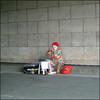
Cedric Jounot: "A clown meticulously applying his makeup by the Seine river in Paris."
Your perspective on the world: 21-27 August

Sam Blackie: "My brother enjoying the evening sunset on a recent sailing trip to Sardinia."

James Osborn: "Recently, I went up to Lake Kariba, Zimbabwe and captured this shot of an elephant grazing on the waters edge at sunset - it's a magnificent part of the world!"
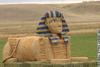
A hay sculpture titled "The Great Sphaynx" sits in a field near Utica, Montana, on Sunday. The sculpture is one of about 50 on display as part of the annual 'What the Hay' Contest.
Pigs Fly

Diving pig "Babe" flies through the air during a display of diving and racing pigs in Melbourne, Australia. [source]
Man Spends Eight Years on Quest for Perfect Swimming Hole
SPRINGVILLE, Calif., Sept. 18, 2004 - Somewhere out there in America right now is a man who spends his days driving the back roads and hiking remote trails.
His name is Pancho Doll, and he's looking for those hidden places where mountains, rivers and rocks come together to form a perfect swimming hole.
He spends his life in places with names like The Shoe Box, Rattlesnake Pool, Frenchman Falls and Death Hollow.
What he looks for are holes with clear, cool water, cliffs to jump from and naturally carved "buckets" for sitting, created by thousands of years of swirling water.
"The Holy Trinity of swimming hole quality is height, depth and privacy," he says.
Doll started his quest eight years ago when a friend took him to a California swimming hole. He liked it so much he went looking for a guidebook to swimming holes, and found that there was none.
A former reporter for The Los Angeles Times, Doll knew how to write, so he decided to write the guidebook himself.
So far, he's written three of them, Day Trips with a Splash, about swimming holes in California, the Southwest and the Northeast. You can find him, and his guides, on his Web site, www.swimholes.com.
Doll, 41, is tall, single and goes to work in a pair of Patagonia paddling trunks.
"You find these small little pockets, niches that have a sense of enclosure or surrounding that makes them special," he says.
The old swimming hole is something that lingers in the American imagination. It was where your great-grandfather went swimming. Norman Rockwell used them in his paintings of American life.
Doll grew up swimming on a small river near the family farm in the Ozarks. He wrote in the introduction to his first book, "Whether skipping stones, diving off logs or doing spectacular parabolic exits from a rope swing, wet was the only way to stay during humid Midwestern summers."
In a world of water parks and swimming pools, most people probably have never seen a swimming hole, but there are thousands of places more fun and more interesting to swim in than anything built by humans.
They're water parks built by nature. And they're free.
In Swimming Holes of California, Doll wrote, "Oddly enough, it's not the water that makes a swimming hole great; it's the rock. The best ones have an architectural quality."
Now, Doll lives in the camper back of a small Toyota pickup truck, traveling the country, using global positioning satellites and a computer to document hidden and forgotten places to swim.
He's a kind of transcendental humorist who wrote, "I'd even argue that swimming holes are the most complete trip to the mountains. Hiking alone isn't. There is always space between the hiker and the trees, always a separation between us and the ground we travel over. But water touches every part of the body with the perfect contact of immersion."
He writes in a casual and humorous style. Crowded spots are said to have "a high Volvo coefficient," and a bubbling bowl is called a "Sierra Jacuzzi."

Havasu Falls, a popular swimming hole northwest of Flagstaff, Ariz., is described by Pancho Doll as "a divine blue crystal." (Pancho Doll)
Here is what he wrote about "Captain's Tub," a hole in Northern California: "Not the place to hold a fraternity rush party or Labor Day picnic, but it's just fine for a couple."
Of "The Crack" in Arizona, he wrote: "A combination of rock and water that could make a poet out of a plowman."
And of "Frenchman Falls" in Maine: "A popular place that nobody can find."
But Doll found it. His directions are very specific, giving landmarks down to a tenth of a mile.
But keep in mind, we are talking about hiking in the wilderness. Even Doll occasionally gets lost following his own directions.
But it's summer, it is hot, and those swimming holes are out there. The journey is part of the fun.
By Brian Rooney
Mainers hope to transform potatoes into premium vodka
FREEPORT, Maine (AP) - A farmer looking to add value to his low-priced potato crop has launched a business partnership in hopes of turning humble Maine spuds into high-priced premium vodka.
Maine Distilleries Inc. plans to trade on the state's image of pristine water and traditional New England farms as it creates a niche product to compete with the Grey Gooses and Belvederes of the world.
It'll be produced in small batches, much like microbreweries that produce specialized beers, said Don Thibodeau, who is in now in the midst of his fall harvest of 525 acres of potatoes in Fryeburg.
"This is all going to be hand-crafted by the batch," said Thibodeau, who was encouraged to pursue the idea by his brother.
Maine Distilleries already has cleared its first hurdle with the town's project review board. It anticipates having federal and state regulatory approvals to start production this spring on U.S. 1, four miles south of L.L. Bean.
It would be Maine's first commercial distillery, officials say. White Rock Distilleries in Lewiston makes and markets a full line of spirits, but the alcohol used in White Rock products is imported.
The vodka concept originated with Thibodeau, who was frustrated by market conditions that have led to low potato prices.
His older brother, a neurosurgeon, signed on as an investor. The other partners are Bob Harkin, a former executive at American Skiing Co., and Christopher Dowe, a master brewer and consultant for microbreweries.
The idea is not necessarily new.
Maine farmers have tossed around the idea of distilling vodka to utilize Maine-grown potatoes for years, but the consensus was that it wasn't cost effective to produce large quantities at low prices.
Creating smaller batches of a premium product makes more sense, and potato farmers will be watching the project with interest, said Don Flannery, executive director of the Maine Potato Board in Presque Isle.
There's thought to be only one distillery in the United States that currently makes vodka from potatoes. In Rigby, Idaho, Silver Creek Distillers Inc. produces vodka carrying the Teton Glacier, Blue Ice and Zodiac labels.
Vodka is the most popular of the spirits, accounting for 26.2 percent of U.S. liquor consumption last year, according to the Distilled Spirits Council of the United States. Rum was second at 12.3 percent.
"It's definitely a growing market," said Shawn Kelley, the trade group's director of public relations in New York.
The robust growth is due to the popularity of high-priced super premium brands and flavored vodkas, along with a resurgence in the cocktail culture that has boosted liquor consumption in general, she said.
Maine Distilleries Inc. plans to start small with one or two batches - up to 500 bottles - each week, Harkin said. Each batch will use 4,000 to 5,000 pounds of potatoes grown by Thibodeau's Green Thumb Farms.
The company hopes to win regulatory approval from the federal and state government and purchase the equipment in time to begin production this spring. The goal is to be on the market by summer in Maine and New Hampshire.
From there, company officials plan to press deeper into the northeastern market, Harkin said. If successful, the company could end up buying potatoes from additional farmers in the state, he said.
The name and label for the vodka have been chosen, but they're closely guarded secrets, along with the water source.
Harkins returned last week from a trip to Europe to look at equipment. The company plans to invest several hundred thousand dollars in distillery equipment produced by company in Stuttgart, Germany.
The entrepreneurs view their efforts as similar to those of microbreweries that proliferated in the early 1990s and have taken market share from big brewers like Coors, Budweiser and Miller.
Like those microbreweries, Maine Distilleries sees demand for a premium brand - aiming even higher than Absolut and Stolichnaya to the "super-premium" brands like Grey Goose, Chopin and Belvedere.
The conventional wisdom is that vodka was created in Poland using potatoes. But Harkin says 99 percent of vodka sold today is produced from grains like barley, wheat and corn.
It's harder to produce vodka from potatoes, which produce a superior product, Harkin said.
The Maine product, he said, will target connoisseurs who are willing to pay for the best vodka martini. The brands targeted by Maine Distilleries cost about $25 for a 750 milliliter bottle.
Harkin knows it's a tough road ahead. Entering a crowded marketplace and competing with established brands will be no easy task.
But he remains optimistic. "We've got a good story, we've got a good concept and we're going to make a great product," he said. "I think there's a real opportunity for this."
By DAVID SHARP
Associated Press Writer
September 17, 2004
Sweet Bliss
Emeril Lagasse's Chocolate Cocoa-Buttermilk Cake with Chocolate Icing
Sept. 17, 2004 - Emeril Lagasse whipped up his amazing chocolate cake recipe to celebrate Good Morning America's five-year anniversary in New York City's Times Square studio.
You can celebrate your own anniversary, birthday or simply the weekend by whipping up his Chocolate Cocoa-Buttermilk Cake with Chocolate Icing for your friends and family.
Chocolate Cocoa-Buttermilk Cake with Chocolate Icing
- 14 tablespoons unsalted butter, softened
- 2 cups plus 2 tablespoons all-purpose flour
- 3/4 cup unsweetened cocoa powder
- 1 1/4 teaspoons baking soda
- 1/2 teaspoon salt
- 1 1/4 cups buttermilk
- 2 tablespoons brewed espresso or strong coffee, cooled
- 1 teaspoon pure vanilla extract
- 1 3/4 cups packed light brown sugar
- 2 large eggs
- Chocolate Icing, recipe follows
Preheat the oven to 350 degrees F. Butter two 9-inch cake pans with 2 tablespoons of the butter and lightly flour with 2 tablespoons of the flour, knocking out the excess flour.
Sift the remaining 2 cups flour, the cocoa, baking soda and salt into a large bowl. In a small bowl, whisk together the buttermilk, coffee, and vanilla.
In a large bowl, cream together the remaining 12 tablespoons butter and the sugar, beating about 3 minutes. Add the eggs one at a time, beating well after each addition. Alternating, add the wet and dry ingredients, beginning and ending with the flour mixture, beating at low speed just until combined, being careful not to overwork.
Pour the batter into the prepared pans and bake until the cake is just set and a tester inserted into the center comes out clean, 22 to 24 minutes. Cool the cakes in the pans for 15 minutes, then turn out onto a wire rack to finish cooling.
Set one cake on a cake plate or platter and top with about one-third of the icing, spreading evenly out to the edges. Top with the second cake and frost the top and sides with the remaining icing. Serve.
Chocolate Icing
- 1 pound confectioners' sugar
- 1/2 cup unsweetened cocoa powder
- 1 stick unsalted butter, softened
- 6 tablespoons milk
- 2 tablespoons brewed espresso or strong coffee, cooled
- 1 teaspoon pure vanilla extract
Sift the sugar and cocoa into a large bowl. Add the remaining ingredients and blend with a hand-held mixer on low speed until smooth and creamy. Use to frost the cake. Makes one 9-inch cake, 10 to 12 servings.
Recipe courtesy of Emeril Lagasse, copyright 2004.
Flower power turns up the volume
Green-fingered gardeners have long espoused the positive benefits of talking to plants.
Now a gadget developed in Japan is allowing flowers to answer back - with music.
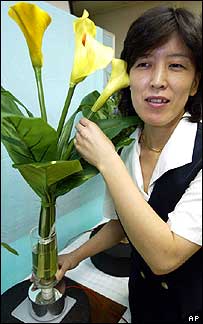
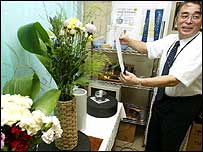
Called Ka-on, which means "flower sound" in Japanese, the gadget consists of a doughnut-shaped magnet and coil at the base of a vase.
It hooks up to a CD player, TV or stereo and relays sounds up through a plant's stem and out via the petals.
The speakers shoot sound in all directions, filling a room with music.
The idea is the brainchild of Let's Corp, a Japanese telecommunications equipment company.
It plans to develop a flower with a speaker phone to allow users to carry out conversations with their plants later this month.
As well as being a novel idea for flower table arrangements at weddings and reception desks, Ka-on is also being used for concerts in Japan.
The Ka-on vases and amplifiers come in various sizes, priced from £25 to £250.
President of Let's Corp Masumi Gotoh says that the system is also beneficial to the plants, keeping bugs off and helping them last longer.
"The plant is happy listening to music," he said.
"Gerberas and sunflowers work especially well as speakers," he added.
Surfers are responding to the musical flowers. Some 10,000 orders have been received via the internet and 3,000 have already been sold.
Addams maestro tackles Spider-Man
By Peter Bowes
In Los Angeles
Saturday marks the 40th anniversary of quirky sitcom The Addams Family's debut on US TV.
Based on a spooky cartoon family, the show starred memorable characters like Morticia, Gomez, Uncle Fester and Lurch.
Cartoonist Charles Addams created the dysfunctional family, first seen as drawings in the New Yorker magazine.
With a total of 64 episodes made, the show, with its snappy theme tune, has endured as a television classic.
And the 52-second Addams Family song is one of the most memorable parts of the show - instantly recognisable with its catchy intro and lyrics.
The tune was written and performed by songwriter Vic Mizzy. The series was already in production in 1964 when Mr Mizzy was hired to compose the theme by executive producer David Levy.
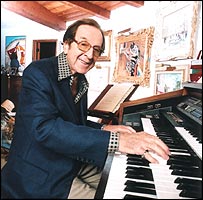
"My mind was clicking," recalls Mr Mizzy, now 82.
"They're creepy and they're kooky,
Mysterious and spooky,
They're altogether ooky,
The Addams Family."
The words apparently flowed easily but when it came to auditioning his song to the producers, Mr Mizzy says the studio was ill-prepared.
"The only piano was in a big storage room where all the sets were. I couldn't sit down. I stood up and just had to look busy," he explained.
"I went 'da-da-da-dum' and snapped my fingers. The minute I did that, they started smiling."
Mr Mizzy was also responsible for creating the show's opening sequence. "I told them the way it should be done. The lens should iris in on the cast and then separately."
The assembled executives were impressed but money was clearly in short supply.
"The studio didn't want to pay for singers. So I recorded it," he says. "I sang it and I overdubbed myself three times so it sounds like a group. When you hear the Addams Family on TV or any place, that's me singing it."
It is an achievement that Mr Mizzy is rightly proud of. Sitting in his luxury home in the upmarket Bel Air district of Los Angeles, the shrewd businessman reflects on the impact The Addams Family had on his life.
"First, it meant money,' he explains. "The second thing was money and the third thing was money."
Mr Mizzy never had an agent and always negotiated his own contracts - crucially holding on to the publishing rights for his work.
"The Addams Family is the number one song performed in the United States at sporting events - baseball games. I get performance money."
"The organist goes 'da-da-da-dum' and I get paid for that," he says, with a smile.
Now 40 years on from The Addams Family, Mr Mizzy has struck another potentially lucrative songwriting deal. Earlier this year, he was asked by film director Sam Raimi to compose a new theme tune for Spider-Man.
The lyrics, which are also performed by Mr Mizzy, obviously take a leaf out of the Addams Family songbook.
"Zoom-zoom, ba-da-ba-da-boom," goes to catchy hook to the chorus.
"Spider-Man, Spider-Man see him fly, Spider-Man,
See the sticky, icky goo that's shooting from his fingers,
He spins his silver web around the villain's sleazy zingers."
"They sent me a video cassette of the first picture, and just from looking at it I could see certain things that would be great," he says.
To Mr Mizzy's disappointment, the song did not appear on the soundtrack to the big screen version of Spider-Man 2 - but will be heard on the forthcoming DVD over a section featuring the film's outtakes and bloopers.
Once again, Mr Mizzy secured publishing rights. The Spider-Man 2 DVD is one of the year's most anticipated releases and is expected to sell well.
That will put another smile on Mr Mizzy's face.
The feisty 82-year-old is still composing songs and remarried three years ago.
He walked down the aisle to the tune of The Addams Family.
His first solo CD, released recently, features Songs for the Jogging Crowd and was inspired by elderly joggers he sees shuffling past his front door at the crack of dawn.
It also includes a comedic track, Name Dropping, which pokes fun at Hollywood.
"I've got a positive attitude and I'm always working, I'm always thinking," he says.
"I stay vibrant because I think young."
Titeuf storms French comic world
By Hugh Schofield
In Paris

(click to enlarge)
France's new comic-strip hero is an eight-year-old prankster with an ostrich plume for a hair-style and an obsession with the mysteries of his looming adolescence.
His name is Titeuf, and he is fast taking over from such classics as Asterix, Tintin and Lucky Luke as the must-have in every French school-child's collection.
The publication this month of the latest album - the tenth in 11 years - has broken all the records.
An initial print run of two million copies is bigger than for any other cartoon character - even the diminutive Gaul - while an ubiquitous publicity campaign has made the egg-head and quiff an inescapable feature of the urban landscape.
Overall, some 11m books have been sold since the appearance of the first album - God, Sex and Suspenders" - in 1993.
He has been translated into 15 languages - including Chinese - and in France the franchising has gone haywire, with everything from footwear to fish fingers stamped with the Titeuf logo.
For 37 year-old Swiss creator Philippe Chappuis - known to his readers as Zep - it is the unlikely conclusion to an adventure he first started in a fit of professional gloom.
"Nothing was working out for me, and no-one was taking my stuff. All the magazines said they wanted characters that were 'targeted on the market'. But I couldn't do that," he said in an interview.
"So to take my mind off things I started doodling, remembering my own school-days. At first it was supposed to be a kind of personal diary - just for me - but then Titeuf took on a life of his own."
Titeuf - the name means "little egg" - lives a life that is instantly familiar to millions of French school-children.
The landscape is urban - apartment blocks and grubby parks - and the cast includes extended family-members and the regular school assortment of chums, swots, bullies, teachers and attendants.
He spends his time indulging in puerile pranks, mainly centring on bodily functions, or suffering fits of embarrassment as a result of encounters with girls.
In one sketch, he and his friend Manu squirt toothpaste out of a train window to see if it will fly in the next - which it does of course onto a passenger's face. In another he urinates over the concierge's moped.
But Titeuf is more than just an urchin. He is fascinated but bewildered by the world of teenagers, which he knows he must enter soon.
Sex, pregnancy, condoms, periods, pornography and Aids are all within his radar - but he struggles to understand what they mean. He is drawn to his classmate Nadia but finds the act of kissing revolting.
"Titeuf's prime characteristic is that he is curious. He wants to understand. But he understands nothing," said Zep - who says he was heavily influenced by the British cartoonist Leo Baxendale, creator of the classic Bash Street Kids.
"He is more lost than the children who read him, so he asks questions they would like to but would never dare to, and tries out things they would like to but never dare to. He is like a lightning-rod - drawing the danger away," he added.
Some parents have expressed concern about Titeuf's language and behaviour, which are certainly less than exemplary. Indeed when he wrote the first album, Zep intended it for adults and the success with children took him by surprise.
But in a world where little in any case is hidden from the young, Titeuf clearly moves and acts in a way which they find easily recognisable. And for all his fits of giggles at the sight of a couple having sex in the bushes, he remains at heart an innocent.
"Every generation has to be a little bit 'punk'," said Zep. "There has to be a rebellion. It is important for the development of the child. That is what Titeuf is exploring. He is 'punk' in a gentle, easy way."
September 16, 2004
You meet the most interesting people at the cemetery
By PAMELA HODGDON
Showcase Correspondent
DOVER -- Meet Christine Otis Baker, who at three-months-old was carried away by Abenaki Indians in the Cochecho Massacre of 1689.

The Indians fled to Canada, where nuns in Quebec later raised her. Forty-five years later, she returned to the town of her birth and opened a house of public entertainment in Tuttle Square.
You'll hear the words of Baker and others recapture what life was like in times past in "Grave Yarns: The Cemetery Revealed." More than 60 noted and notorious Dover citizens will come to life beside their tombstones in a unique and one-of-a-kind tour in Pine Hill Cemetery.
"Grave Yarns: The Cemetery Revealed" will take place over two weekends, Sept. 18 - 19, and Sept. 25 - 26. The tours will take place on the pathways of Dover's oldest public burying ground, which dates back to the early 1700s.
From Dover's two New Hampshire governors, to the woman engaged to John Wilkes Booth, to famous sea captains and leaders of industry, "Grave Yarns" is a must see for history buffs and curious alike.
"We have everybody from the very religious Rev. Jeremiah Cushing, who was the minister of the First Parish Church for 52-years in the 1700s to the first man hanged in Dover for murder," said Cathy Beaudoin, who wrote all the scripts for the 21 different stops in the cemetery.
"Elisha Thomas was the convicted murderer hanged in Dover," said Beaudoin. "The murder didn't actually happened in Dover, but since Dover was the county seat at the time, he was hanged here."
As history has it, Thomas got in a fight in a bar and stabbed another man. "Back in 1788, you either murdered someone or you didn't. There were no degrees of manslaughter or accidental homicide."
Beaudoin, Dover Public Library director, is part of the "Grave Yarns" production team. "There are four of us in charge of recruiting actors and putting every aspect of this together. "Grave Yarns" is sponsored by the Dover Historical Society and Dover Main Street, in conjunction with the City's Cemetery Board.
Last July, the production team started recruiting actors, tour guides, costumers, script consultants, director's assistants, graphic artists, history buffs, and behind-the-scenes-helpers.
Each actor will re-enact his or her character and deliver a two-to-three-minute story or monologue to each touring group every 15-minutes. Some of the stops will have one character, some two, and others as many as five.
One of the actors is this year's Citizen of the Year, Bob Marston, who took over the role of Jonathon Sawyer, founder of the Sawyer Woolen Mills. Marston said that he picked Jonathon Sawyer because he wanted to be by himself. "It's not that I didn't want to want to share the stage - I didn't want to foul up anybody else's lines. The thing about a guy like Jonathon Sawyer is that I can say what I want and not stick to a particular script because I don't have to interact with anybody."
Marston, who is a member of the Dover Historical Society, said that the society has been doing a heritage walk for the last 25-years and this fall "Grave Yarns" is taking the place of the annual walk.
"I have taken part in every one of these walks and this is just another continuation," said Marston about the cemetery tours."
"I know who Jonathan Sawyer was and a bit about the mills. In fact, I can remember when the mills were still running," added Marston, who is 81-years-old.
"Grave Yarns" came about as a result of last spring's "Factory Revealed" tours through the Cochecho Millworks complex.
"The same people in this production team put together the factory tours," Beaudoin said. "It was so successful - we did 81 tours and everyone of them sold out. People were clamoring at the door for tickets."
"Since there was so such a good response to the factory tours and it was so successful in raising money for Dover Main Street, we thought: 'What else can we reveal?'"
So far, there have been over 300 tickets sold for "Grave Yarns" and Beaudoin anticipates the cemetery tours would be just as successful as the factory tours.
Working along with Beaudoin in the production team, Debra Morgan, executive director of Dover Main Street said that the factory tours raised about $14,000.
"We are expecting a similar response for "Grave Yarns," said Morgan. "Because it is an outside event some people are waiting to buy tickets to see what the weather will be."
The money raised from "Grave Yarns" will help Dover Main Street with their downtown revitalization activities, such as the upkeep of the flower barrels and historical markers, gift certificate program, working with existing business, as well as trying to bring in new businesses.
Morgan said that "Grave Yarns" would most likely not be revealed again next year. "We kind of like the idea of revealing something different every year. Dover has a long history, so we are lucky that there are still quite a few things that can be shown."
"Grave Yarns" is something that the whole family can enjoy. "It's appropriate for children. It's not a scary tour - nobody is popping out and yelling 'BOO,' and it's not at night," added Beaudoin
Pine Hill Cemetery is one of the most scenic spots in Dover, especially in the fall with the foliage turning. The cemetery tours will run on the quarter hour from 10 a.m. until 4 p.m., rain or shine, on Sat. and Sun., Sept. 18-19 and 25-26. Groups will depart with a tour guide, every 15-minutes from the Ricker Memorial Chapel at the cemetery. Each tour will last 90-minutes. Tickets are $10 per person and $5 for children under 12-years of age.
Advanced tickets may be purchased at the Dover Public Library or by calling the library at 603-516-6050. Tickets for any unfilled tours will be at the registration table in the cemetery on each day of the tours.
Parking is in the Care Pharmacy/Cleary's Cleaners lot. There will be a drop-off point for passengers at the cemetery's entrance and limited handicapped parking is available at the chapel. Wear comfortable shoes and participants are asked to arrive 10-15 minutes before their tour is scheduled to start.
Advance ticket purchases for "Grave Yarns: The Cemetery Revealed" are highly recommended as each tour does have a limited capacity.
Columbia shuttle fragment found in Texas
LUFKIN, Texas (AP) -- A large piece of space shuttle Columbia debris was found recently in southeast Texas, a NASA official said.
The 6-foot-long piece of the crew compartment was discovered two weeks ago in Newton County by a wildlife biologist, sheriffs officials said.
Bruce Buckingham, a Kennedy Space Center spokesman, confirmed Wednesday that the piece discovered two weeks ago was from the shuttle's crew compartment area and contains a hinged window.
NASA had not yet picked up the piece, which had bright green moss growing over one section of the window.
The biologist, Jason Sebesta, said he found it in a water runoff area near a lodge owned by his company.
The Columbia broke apart over Texas on Feb. 1, 2003, killing all seven astronauts aboard. Tens of thousands of pieces of the shuttle fell on Texas and Louisiana.
Terrific Toddler
Washington Boy, 3, Saves Mom, Brother in Same Week
Sept. 16, 2004 -- He's fearless and fast, and though he's just started preschool, he appears to have a bright future in emergency services.
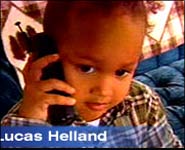
Lucas Helland, 3, of Whidbey Island, Wash., saved his mother and younger brother from danger within the same week.
The first accident occurred when Lucas' mother used a chair as a stepstool, which turned out to be a mistake. "I stepped off and when I did, I stepped wrong and snapped my ankle," Carla Helland explained to ABC News affiliate KOMO in Seattle. "I threw my head backward and hit my head and I passed out."
Lucas grabbed his mom's cell phone, scrolled through her saved numbers and called his older sister, brother and father. He can't read, but he knows what their names look like. The toddler left each family member a message, and within minutes, his dad called home and got help.
KOMO asked Lucas if he was scared, and he said yes. But that didn't stop him from more heroic acts just five days later.
He and his little brother, 2-year-old Logan, were playing next to their father's truck when an electrical problem sparked a fire. When their mom spotted the smoke coming from the truck, she ran to help -- only to find Lucas already saving Logan.
"He, at that time, was still pulling out his brother, who was kind of screaming, 'Leave me alone! Leave me alone!' " Carla Helland recalled in the KOMO interview. "But he pulled him away from the truck."
There's not much left of the truck, but both boys are fine.
Like most heroes, Lucas takes no credit. "It got burned up," was all he said.
But his mother is proud of him for saving two family members within days. "I think he was put on this Earth for something," she said with a laugh, "and maybe this was it, I don't know."
We're Not in Lake Wobegon Anymore
In These Times, August 26, 2004

How did the Party of Lincoln and Liberty transmogrify into the party of Newt Gingrich's evil spawn and their Etch-A-Sketch president, a dull and rigid man, whose philosophy is a jumble of badly sutured body parts trying to walk?
By Garrison Keillor
Something has gone seriously haywire with the Republican Party. Once, it was the party of pragmatic Main Street businessmen in steel-rimmed spectacles who decried profligacy and waste, were devoted to their communities and supported the sort of prosperity that raises all ships. They were good-hearted people who vanquished the gnarlier elements of their party, the paranoid Roosevelt-haters, the flat Earthers and Prohibitionists, the antipapist antiforeigner element. The genial Eisenhower was their man, a genuine American hero of D-Day, who made it OK for reasonable people to vote Republican. He brought the Korean War to a stalemate, produced the Interstate Highway System, declined to rescue the French colonial army in Vietnam, and gave us a period of peace and prosperity, in which (oddly) American arts and letters flourished and higher education burgeoned--and there was a degree of plain decency in the country. Fifties Republicans were giants compared to today's. Richard Nixon was the last Republican leader to feel a Christian obligation toward the poor.
In the years between Nixon and Newt Gingrich, the party migrated southward down the Twisting Trail of Rhetoric and sneered at the idea of public service and became the Scourge of Liberalism, the Great Crusade Against the Sixties, the Death Star of Government, a gang of pirates that diverted and fascinated the media by their sheer chutzpah, such as the misty-eyed flag-waving of Ronald Reagan who, while George McGovern flew bombers in World War II, took a pass and made training films in Long Beach. The Nixon moderate vanished like the passenger pigeon, purged by a legion of angry white men who rose to power on pure punk politics. "Bipartisanship is another term of date rape," says Grover Norquist, the Sid Vicious of the GOP. "I don't want to abolish government. I simply want to reduce it to the size where I can drag it into the bathroom and drown it in the bathtub." The boy has Oedipal problems and government is his daddy.
The party of Lincoln and Liberty was transmogrified into the party of hairy-backed swamp developers and corporate shills, faith-based economists, fundamentalist bullies with Bibles, Christians of convenience, freelance racists, misanthropic frat boys, shrieking midgets of AM radio, tax cheats, nihilists in golf pants, brownshirts in pinstripes, sweatshop tycoons, hacks, fakirs, aggressive dorks, Lamborghini libertarians, people who believe Neil Armstrong's moonwalk was filmed in Roswell, New Mexico, little honkers out to diminish the rest of us, Newt's evil spawn and their Etch-A-Sketch president, a dull and rigid man suspicious of the free flow of information and of secular institutions, whose philosophy is a jumble of badly sutured body parts trying to walk. Republicans: The No.1 reason the rest of the world thinks we're deaf, dumb and dangerous.
Rich ironies abound! Lies pop up like toadstools in the forest! Wild swine crowd round the public trough! Outrageous gerrymandering! Pocket lining on a massive scale! Paid lobbyists sit in committee rooms and write legislation to alleviate the suffering of billionaires! Hypocrisies shine like cat turds in the moonlight! O Mark Twain, where art thou at this hour? Arise and behold the Gilded Age reincarnated gaudier than ever, upholding great wealth as the sure sign of Divine Grace.
Here in 2004, George W. Bush is running for reelection on a platform of tragedy?the single greatest failure of national defense in our history, the attacks of 9/11 in which 19 men with box cutters put this nation into a tailspin, a failure the details of which the White House fought to keep secret even as it ran the country into hock up to the hubcaps, thanks to generous tax cuts for the well-fixed, hoping to lead us into a box canyon of debt that will render government impotent, even as we engage in a war against a small country that was undertaken for the president's personal satisfaction but sold to the American public on the basis of brazen misinformation, a war whose purpose is to distract us from an enormous transfer of wealth taking place in this country, flowing upward, and the deception is working beautifully.
The concentration of wealth and power in the hands of the few is the death knell of democracy. No republic in the history of humanity has survived this. The election of 2004 will say something about what happens to ours. The omens are not good.
Our beloved land has been fogged with fear?fear, the greatest political strategy ever. An ominous silence, distant sirens, a drumbeat of whispered warnings and alarms to keep the public uneasy and silence the opposition. And in a time of vague fear, you can appoint bullet-brained judges, strip the bark off the Constitution, eviscerate federal regulatory agencies, bring public education to a standstill, stupefy the press, lavish gorgeous tax breaks on the rich.
There is a stink drifting through this election year. It isn't the Florida recount or the Supreme Court decision. No, it's 9/11 that we keep coming back to. It wasn't the "end of innocence," or a turning point in our history, or a cosmic occurrence, it was an event, a lapse of security. And patriotism shouldn't prevent people from asking hard questions of the man who was purportedly in charge of national security at the time.
Whenever I think of those New Yorkers hurrying along Park Place or getting off the No.1 Broadway local, hustling toward their office on the 90th floor, the morning paper under their arms, I think of that non-reader George W. Bush and how he hopes to exploit those people with a little economic uptick, maybe the capture of Osama, cruise to victory in November and proceed to get some serious nation-changing done in his second term.
This year, as in the past, Republicans will portray us Democrats as embittered academics, desiccated Unitarians, whacked-out hippies and communards, people who talk to telephone poles, the party of the Deadheads. They will wave enormous flags and wow over and over the footage of firemen in the wreckage of the World Trade Center and bodies being carried out and they will lie about their economic policies with astonishing enthusiasm.
The Union is what needs defending this year. Government of Enron and by Halliburton and for the Southern Baptists is not the same as what Lincoln spoke of. This gang of Pithecanthropus Republicanii has humbugged us to death on terrorism and tax cuts for the comfy and school prayer and flag burning and claimed the right to know what books we read and to dump their sewage upstream from the town and clear-cut the forests and gut the IRS and mark up the constitution on behalf of intolerance and promote the corporate takeover of the public airwaves and to hell with anybody who opposes them.
This is a great country, and it wasn't made so by angry people. We have a sacred duty to bequeath it to our grandchildren in better shape than however we found it. We have a long way to go and we're not getting any younger.
Dante said that the hottest place in Hell is reserved for those who in time of crisis remain neutral, so I have spoken my piece, and thank you, dear reader. It's a beautiful world, rain or shine, and there is more to life than winning.
Garrison Keillor is the host and writer of A Prairie Home Companion, now in its 25th year on the air. This adapted excerpted from Keillor's new book, Homegrown Democrat (© 2004) was reprinted in In These Times by arrangement with Viking, a member of Penguin Group (USA) Inc.
France tackles 'bad' cafe culture
The owners of France's 60,000 bars, brasseries and cafes have said poor service is driving customers away, and have promised to do better.
"Customers are right to complain of a poor or non-existent welcome... and a lack of basic courtesy and reactivity," an industry spokesman said.
The number of cafes and customers has been dwindling as the number of complaints has been growing, he added.
Also, busy customers have less time and do not drink as much, observers say.
The number of French cafes has dropped from 150,000 to 60,000 in 15 years, said Andre Daguin, president of the French hotel and catering industry's main trade association, UMIH.
"Every year there are fewer people in the cafes and more and more complaints," he said.
"We have to take criticisms into consideration and react, other the haemorrhage will continue."
After a particularly difficult summer, the industry has decided to work hard at attracting customers.
It will set up a new institute to tackle the problems and a charter of quality to improve service, comfort levels, products and hygiene.
The project will be presented to the tourism minister next month.
September 15, 2004
German radio starts Klingon service
The German international broadcaster Deutsche Welle (DW) is celebrating 10 years of its online service by adding a new language to the 30 it already publishes - Klingon.
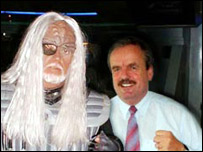
The Klingon ambassador dropped into Deutsche Welle's office
The language was developed for the Star Trek television and film series and is spoken by a warrior race of alien bad-guys from the planet Qo'noS.
In a futuristic leap, the Klingon pages appear on DW's web site under the date "September 2379", and describe Germany and the radio station at the start of the 21st Century.
The Berlin Wall has fallen, the Cold War has ended and Klingons - once the sworn enemies of Star Trek hero Captain Kirk - are now accepted as allies in the new world order.
And it is in this spirit that DW has launched its Klingon service.
The Klingon pages also have a serious side, publicising forthcoming additions to DW's web presence, such as a much-expanded Arabic service and an international weblog competition.
The pages describe Germany as a nation of car lovers and football fans, and "underline the station's philosophy of multicultural, intergalactic openness", according to DW director Erik Bettermann.
"We should celebrate our 10-year presence in the online universe with a cross-border language. This should help users from other galaxies get an impression of Germany."
The language was created in 1984 by linguist Marc Okrund for Paramount Pictures, and has caught the imagination of science fiction fans.
The works of Shakespeare and the Bible have already been translated into Klingon. There is even a Klingon Language Institute (www.kli.org).
Guido Baumhauer, head of DW's Online services, told the BBC that although the pages were initially published as a joke by DW engineers in their spare time, he has been taken aback by their popularity.
Star Trek fans and linguists "have taken it very seriously", he said, "and we have even been complimented on our use of the 'High Klingon' dialect."
He declined to give a quote for Klingon readers, saying only "tlhIngan Hol vIjatlhlaHbe'" - "I do not speak Klingon".
For non-Klingon speakers, the pages in the Klingon language also appear in English and German.
BBC Monitoring, based in Caversham in southern England, selects and translates information from radio, television, press, news agencies and the internet from 150 countries in more than 70 languages.
By Alistair Coleman, BBC Monitoring
September 14, 2004
Star Wars: the Canadian angle
When the DVD version of Star Wars goes on sale Sept. 21, it will be snatched up by millions of fans who have been waiting years for what may well be the final word on the 1977 film.
Many of those devotees will immediately switch on the director's commentary track, hoping to hear George Lucas divulge those last tidbits of arcane trivia that have somehow not yet become public knowledge in the 27 years since the film was released, launching film history's most popular space saga.
For Canadians, one scene in Star Wars is of particular interest. As the movie's hero, Luke Skywalker, prepares to rescue Princess Leia from the Death Star, the roguish Han Solo informs him where she is to be found in the bowels of the space station's prison.
"We gotta find out which cell this princess of yours is in. Here it is: 21-87," the mercenary pilot of the Millennium Falcon barks.
On the surface, the line appears to be a throwaway bit of dialogue, just more of the clunky exposition for which Lucas is infamous. What diehard Star Wars buffs in this country will be wondering as they watch this sequence, though, is "Is Lucas going to mention Arthur Lipsett?"
Who is Arthur Lipsett? And why would Lucas be talking about him on the Star Wars DVD?
The short answer is that Lipsett is the blockbuster movie's Canadian connection. The longer answer begins with the fact that Lipsett was a filmmaker with the National Film Board of Canada in the 1960s. His best-known piece of work is the 1964 abstract short 21-87.
That's right – Princess Leia's cell was named after an obscure film made by an avant-garde filmmaker from Montreal. Lucas included the detail as an homage to 21-87, which made a deep impression on him when he saw it as a film student at the University of Southern California, before he became a director and founder of the Lucasfilm movie empire.
"It seems to capture something," Dennis Mohr says of 21-87. Mohr, a Toronto producer, is currently working on a documentary about Lipsett – tentatively titled Arthur Lipsett: Poet of Film – that is slated to appear on the Bravo specialty channel next year.
According to Mohr, Lipsett's film is a standard part of the USC film curriculum. "They show 21-87 as an example of film grammar and structure. And it's kind of based on the fact that Lipsett was a collage artist who made these compilation-type films," he explains.
It's easy to see how the short, which runs nine minutes and 33 seconds, would stick in the mind of an aspiring cineaste like Lucas, whose first love was experimental filmmaking. The movie is striking, a densely packed collection of unrelated images and sounds that appear seemingly at random.
In one shot from 21-87, a robot arm manipulates a vial of liquid. In another, a carnival horse leaps off a diving board. In yet another, city dwellers gaze blithely into the camera as they step off an escalator. On the soundtrack, a gospel singer is heard, then a disembodied woman's voice talks about the Book of Revelation, then nothing but heavy, laboured breathing. All of these disparate elements are connected by innumerable quick, effortless jump cuts. It's an example of montage in its purest form.
The film, in Mohr's opinion, bridges "art and film technique and some kind of dour emotion that appeals to people who probably think the world is a little messed up in a way, but there is hope."
What's harder to see is what 21-87 has to do with a movie about Jedi Knights, droids and an intergalactic rebellion. In terms of style, 21-87 has more in common with THX 1138, the first feature Lucas made. But closer inspection shows that the same passionate concern that Lipsett had with the basics of filmmaking is also present in Star Wars.
Just as 21-87 is tightly edited, so is Star Wars. In fact, there is so little extraneous footage in Star Wars that viewers get the impression the story takes place in a single day. And just as Lipsett delighted in playing with sound, so did Lucas. He made an enormous effort to make the universe of Star Wars "sound" like an alien culture, going so far as to invent languages for creatures like the Jawas and Wookies.
What unites Lipsett and Lucas, Mohr says, is this love of film, this appreciation of film for film's sake.
"[Lucas] really thinks that, of all the people, Lipsett is probably the greatest abstract filmmaker," he notes. Mohr's documentary will include an interview he did with Lucas in which the director speaks at length about his affection for 21-87. It will also debunk some of the rumours surrounding the Lipsett-Lucas connection.
For starters, at no time did Lucas make a serious attempt to recruit Lipsett. "He didn't really care about Lipsett the man so much as his films," says Mohr. "He never did try to hire him or find out more about Lipsett personally."
In addition, Mohr says the rumour that Lucas considered coming to Canada to work for the NFB is unfounded, although it's true he had a great deal of respect for the agency.
Mohr says he has no reason to believe that Lipsett was aware 21-87 had been referenced in Star Wars. Lipsett liked the movie, but Mohr's research hasn't turned up any evidence to suggest that Lipsett knew Lucas had symbolically tipped his hat in the Canadian's direction.
"It's so small," Mohr says of the homage. "It probably just went over most people's heads until the '80s." And by that time, Lipsett was losing a battle with mental illness. He committed suicide in 1986, just two weeks shy of his 50th birthday.
Even among some Star Wars fans, the 21-87 reference isn't common knowledge.
Wes Johnson, 36, describes himself as a lifelong fan of the movie, but he was unaware of the Lipsett connection until now. "I don't think I've ever heard anyone mention that before," he says, adding that it doesn't surprise him that Lucas would have included such an obscure allusion: "He really was interested in the idea of film."
"It doesn't surprise me that he would do something like [acknowledge Lipsett]. It surprises me that he's moved away from doing clever little things like that," he says.
In Johnson's view, Han Solo's directions to Luke Skywalker in the Death Star prison sequence are a reminder that Lucas has become too caught up in the moneymaking potential of his creations and lost sight of his art.
All of which raises the question: why don't more people know about Lipsett's influence on Lucas, especially in Canada?
"I think it's that anti-Americanism that we have," Mohr says. "We look at Lucas and we think 'Oh, he's a sell-out, he's a jerk.' He's a great filmmaker, first and foremost, and for him to recognize Lipsett is pretty interesting."
Lipsett's talent was recognized very early in his career. He was recruited out of art school by the NFB's Colin Low, and his first effort, a film called Very Nice, Very Nice, was nominated for an Academy Award in 1961 in the live-action category for short films. It even caught the eye of another legend-to-be, Stanley Kubrick.
Kubrick wrote to Lipsett and asked him if he would cut the trailer for Kubrick's latest film, a black comedy about nuclear war called Dr. Strangelove. Mohr believes Lipsett turned down the offer because he wasn't familiar with Kubrick.
Mohr theorizes that Lipsett may be another example of a Canadian artist who must first be recognized outside Canada in order to secure a place in this country's history. "That's part of it, but I also think that his life is clouded by his suicide," he says.
"He's kind of a tragic figure, but at the same time … he was a very lively character."
By Dan Brown, CBC News Online | September 8, 2004
Comoros seeks sweet smell of success
Not for nothing are the Comoros known as the Perfume Isles.
They export around 80% of the world's supply of ylang ylang essence, an essential oil that is the main ingredient of most expensive perfumes.

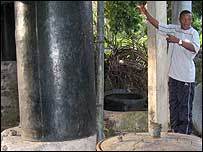

Originally from the Philippines, the ylang ylang plant was introduced to the Comoros by the French in the late nineteenth century.
Like vanilla and cloves, which are also grown in the Comoros, ylang ylang is a potentially lucrative crop that is subject to volatile markets.
Even while still growing on the tree, the yellow flower has a strong, sweet fragrance which will eventually be used in perfumes, soaps and other toiletries.
Walking through the fields with your eyes closed is like walking past a perfume counter in a big department store.
The flowers are picked three times a month, giving distilleries an income all year round.
The flowers are placed in a vat and steamed.
The steam rises into a pipe and is fed into a condensing chamber where it cools.
The perfume essence is then collected at the bottom of the chamber.
It takes 100kg of flowers to produce three litres of essential oil and the distillation process alone goes on for 18 hours.
In the treatment room, the oil is checked for impurities before it is put into barrels to be exported to France.
The distillery does not just deal with its own crop of ylang ylang flowers.
It buys quantities from small, independent farmers on all the islands of the Comoros, combining their lesser yields into a larger crop.
The exportation of essential oils and spices is a closed market and every exporter must be licensed for each crop, with separate permits for the export of ylang ylang, vanilla, cloves and pepper.
Hassan Assoumani, manager of the Comore Vanille et Plantes distillery and export business in Mbeni on the main island of Grande Comore, says small-scale farmers do not have the money or expertise to distil the essence.
"Exporting essential oils is very different from distilling them. You have to have some know-how. You need expensive equipment to distil the oils and make sure that they are all to a very high standard."
Maintaining high standards is important, but this does not make life any easier for the small-scale essence producers of the Comoros.
Abderramane Amada is the son of an ylang ylang farmer near the town of Iconi on Grande Comore.
The family has its own traditional wood-fired distillery and makes money by selling bottles of essence to tourists.
"It's not a lot of money but I will continue making it," he said. He may be struggling but at least Mr Amada is not dependent on the international popularity of expensive French perfume for a sweet-smelling future.
September 13, 2004
Iris ID
Biometrics Use Voice-Printing, Retinal Scanning and Fingerprinting to Make Transactions Secure
Sept. 13, 2004 -- For Paul Kapioski, owner of a Thriftway gourmet grocery store franchise in Seattle, paying for groceries has gotten a lot easier ? and a lot more secure.
Now, instead of using his credit or debit card to pay for his food, he uses the index finger of his right hand, which he places in a fingerprint reader at the register. After punching in his access code, the register asks him from which account he would like to pay - checking, credit card or debit card. Without pulling out his wallet, he indicates his choice. The amount is properly debited and he gets a receipt.
If this sounds like a scenario from the future, think again. It's one of the many ways a new technology called "biometrics" is reshaping the way consumers will do everything from paying for groceries to securing their financial transactions at the bank or online.
"I don't have to reach into my pocket and pull out my wallet and find the card I want to use," Kapioski says, adding some 4,000 of his customers have also opted to pay for their groceries the same way since 2001. "I don't even need to have my wallet and the whole process takes about two minutes."
Biometrics is the term for the technology used to capture and encode any human characteristic in order to identify people during financial or other transactions, or when people wish to access secure places.
Readings can be taken from fingerprints, the eye's iris, the sound of the voice or the shape of the face and hands. In the future, DNA may even be used, experts said. In the next few years, such technology may be used at bank ATMs instead of cards, or in lieu of a password and I.D. for online banking.
"The place that consumers will likely see biometrics in next couple of years from financial services is at the ATMs and branches," said Ryan Kalember, a senior security consultant for VeriSign Inc., an E-commerce security and communications company based in Mountain View, Calif.
Kalember added customers "would have to do so voluntarily," because biometrics is still a significant privacy issue, requiring people to submit to some sort of examination to record their biometric information in the first place.
While still in its infancy, biometrics is a growing market. Companies across all industry sectors are expected to spend about $800 million on biometric technology in 2004, according to research firm Celent Communications, based in Boston. That number is expected to leap to $4.3 billion by 2006.
"The use of biometrics by financial institutions has continued to increase," said Christine Barry, a Celent analyst. "But more than half of the biometric revenues are being generated by the government for use at airports and borders."
Here are the main ways biometric technology is being used today, primarily in pilots, internally at corporations or within various branches of the federal government.
- Fingerprint scanning: As crime investigators already know, each person has unique fingerprints. Fingerprint biometric technology makes a map of key points of the lines and whorls of an index finger or thumb, then encodes that information into numerical bits and bytes. A live reading is taken when customers place their finger on a fingerprint scanner, and that reading is checked against the digitized map. As with all biometric technology, the encoded fingerprint map can be used to positively identify a person, but it cannot be "reverse engineered" into the actual fingerprint.
- Voice authentication: The sound of the voice is also individual to each person. Voice biometrics is considered by many experts to be the least expensive and least invasive of biometric technologies, since customers need only speak over the phone to be identified in most instances. Similar to fingerprint biometrics, voice authentication makes a digital map of the peaks and valleys of your voice then cross checks it against your real voice.
- Facial scanning and hand geometry: In these scenarios, digital maps are made of the shape of the face or the shape of the hand. In order to be identified in the first instance, customers stand in front of camera that reads the points of the face and compares them to digital information stored in a computer database. In the second example, customers would grasp an object that reads the shape of their hands and similarly compares that to encoded hand shapes in a database. Experts said these forms of biometric technology can be among the least effective since the shape of the face and hands can easily change.
- Iris scanning: In this instance, a digital map of the shape of the iris is made. A customer stands in front of a camera that takes a quick snapshot, or uses a laser to read the iris, comparing the shape to the digitized information already stored. Considered to be the most accurate of the biometric technologies, it is also considered the most invasive, since it involves the eyes.
While all this may seem same way out and perhaps a bit Big Brother-ish, experts said consumers are likely to cross paths with such technology on an increasing basis, particularly as financial institutions wish to secure customer transactions and cut down on financial fraud.
"My view is that we will probably see some 70 percent of consumer transactions utilize one or more versions of a biometric technology within three years time," said Tom Manning, a senior partner at Bain & Co Inc., an IT strategy and management consulting firm based in Boston.
Manning added that consumers might first see easier to use biometrics like voice authentication, with a more gradual implementation of more costly and accurate technologies like iris scanning in the near future.
"I don't think consumers will go through a week without interacting with biometrics," Manning added. "Let's face it, September 11th put biometrics on the map, creating an immediate recognition of how critical security has become in our connected society."
Hampton toll booth tragedy becomes inspirational story
HAMPTON (N.H.) -- Burned beyond recognition in a horrific accident at the Hampton tolls when he was almost two, Joel Sonnenberg has overcome much in the last 25 years.
On Tuesday, he will bring his inspirational message to the Seacoast.
Since being burned over 85 percent of his body as an infant, Sonnenberg has had to learn life's skills without the use of fingers and toes. His facial features have been scarred for so long that he no longer remembers looking otherwise.

Joel Sonnenberg
Sonnenberg's message, which is found a his new book "Joel," is one of developing unique abilities and gifts. It chronicles his experiences, from the accident up to his graduation from college.
In a telephone interview from his parent's home in North Carolina, Sonnenberg, now almost 27, said he felt "compelled" to write the book because of all the questions people have had throughout his life. "Joel" shares the lessons he has learned.
Sonnenberg, also says it was a privilege to be able to sit down, gather different perspectives and write the book from his perspective on life.
Of his injuries, Sonnenberg said he grew up not knowing he was any different. "I was burned at such a young age. I really don't remember having fingers and toes, and I don't remember anything about the accident," he said.
Sonnenberg plans to visit the Hampton Toll Plaza on Tuesday at 10:30 a.m. - almost 25 years to do the day when his life changed forever. He will receive a special proclamation on overcoming adversity from state Sen. Russell Prescott, R-Kingston.
On Sept. 15, 1979, Sonnenberg, his father Mike, and an uncle were at the toll plaza when an 18-wheel truck, driven by Reginald Dort, crashed into the line of cars.
The impact of the crash turned Sonnenberg's car seat upside down where it remained in the flaming car. Sonnenberg's father and uncle got out, but without the infant. A Good Samaritan rescued the infant, who was still in his car seat. Sonnenberg was burned over 85 percent of his body including hands, fingers and skin covering his skull. He was taken to Exeter Hospital, later transferred to Boston's Children Hospital and ultimately sent to the Shriners Hospital for burn victims. He had to endure more than 40 surgeries to repair the damage to his body but has been left with permanent scars.
The truck driver, Dort, fled to Canada to avoid prosecution. He was caught in 1997 during a stop at a weigh station in Illinois. In December 1998, he pleaded guilty to one count of second-degree assault and was sentenced to two to seven years in prison with the maximum sentence suspended. In September 1999, he was deported to Canada. Sonnenberg documents the trial and his reaction to it. He preferred to keep some of those details under wraps. He said he does not have any resentment toward Dort.
Regarding Dort's sentence, he said "It's nothing that I can change. I've moved on."
Sonnenberg said it was through the help of his parents, teachers and administrators who went out of their way to minimize the fact that he looked different from other people. "Kids accepted me, knew what happened to me and still liked me anyway."
Sonnenberg said he remembered having to live with physical pain and discomfort, which was more of an annoyance than anything. He adapted to not having fingers through trial and error.
"Kids are very resilient and very adaptive to that sort of thing," he said. "It was a blessing I was burned so young."
In the book, Sonnenberg describes how - before he went to school - people would speak to his fellow students, telling them about their new classmate and why he was different.
As a result, "I was more like a celebrity coming to school, rather than a monster," he said.
Initially, parents and administrators were afraid of him because they did not know what kind of attention or medical care he would need.
"They really didn't want me there. It was a process of letting them express their fears, addressing their fears, finding solutions to those fears and finding that I was capable of something just like any other kid," he said.
He said once people understood what had happened, it was not too difficult adjusting.
"Everybody has strengths and weaknesses. Mine just might be a little more obvious than others," he said. "Some of the difficulties were trying to find my niche and trying to find what my gifts were." Just like any child would practice writing or vocabulary, Sonnenberg also had to practice his skills. His parents got him a computer at a young age to help him. He can now type about 90 words per minute.
Rather than letting his differences get in the way, Sonnenberg said he tried new things.
"I opened up doors for me to succeed. People expected success, rather than expecting failure," he said. "I tried everything."
Sonnenberg said he got involved with Boy Scouts and later became an Eagle Scout. He was active in his high school's student government, serving as president of his freshmen class, student body treasurer, and student body president.
He also tried the school band. "I was the drummer and I didn't have any fingers. I did that for a year. I did all right, but I didn't think that was my gift," he said.
He continued his musical pursuits by joining chorus. Sonnenberg even played soccer, becoming team captain.
A stick shift doesn't even stop him. "Driving a car was a natural progression from walking. People didn't think I could walk or play soccer," he said. "People didn't think I could write, let alone do well in school."
Upon graduating from high school in 1996, Sonnenberg attended Taylor University in Indiana and studied communications. He continued his involvement in student government and served as president of his sophomore class and vice president of the student council senior year.
He was a Big Brother. He also had a long list of speaking engagements and served as a counselor at burn camps.
While at Taylor University, he took an acting class, just for fun. Apparently, someone from that class was impressed with his acting ability and later encouraged him to get on a television show. This led to a guest role on an episode of the Pax series "Sue Thomas F.B.Eye," which is about a deaf woman who is an FBI agent. Because he had some deep questions about why things happen to individuals, he decided to pursue a master's in theology at Columbia International University. People have often sought advice from him.
"The more we understand suffering, the more we understand ourselves. I think there can be joy that is brought through the suffering. You can have joy in the midst of hurting."
For now, Sonnenberg has a full schedule promoting the book and catching up with old friends. He will be traveling to the Shriners Hospital on Wednesday and visiting with doctors and nurses who helped him. That night he will be speaking at a youth rally at 7 p.m. at First Baptist Church in Hampton Falls. On Thursday, he will be doing some radio interviews and speaking at another service at First Baptist Church at 7 p.m. On Saturday at noon, he will be signing books at Sam's Club in Seabrook. For more information about Sonnenberg can be found on his Web site at www.joel.cc
Rare sighting of wasp north of Arctic Circle puzzles residents
IQALUIT - Southern Canadians wouldn't take a second look at a yellowjacket wasp circling around their picnic, but the discovery of the insect far north of the Arctic Circle has entomologists, well, buzzing.
Noire Ikalukjuaq, the mayor of Arctic Bay, found a specimen of Vespula intermedia, or yellowjacket wasp, outside the community recently. Arctic Bay is on the northern tip of Baffin Island, at more than 73 degrees latitude.
Noire Ikalukjuaq, mayor of Arctic Bay, photographed this wasp at the end of August.
"I didn't know what that was at the time I saw it," recalled Ikalukjuaq, who managed to take a picture of the insect. "It didn't look scary to me, but I'll know better next time I see one."
Ikalukjuaq said he had no word for it in Inuktitut.
The mayor sent his picture of the wasp to the Nunavut Research Institute, where it was mailed to Canadian entymologist Brian Brown, an associate curator of entomology at the Natural History Museum in Los Angeles.
Brown said the insect is widespread across North America, but it has never been seen above the Arctic Circle.
The wasp could be a freak occurrence or a sign the climate and environment is changing, Brown said.
"I think it's pretty interesting and it's part of the reason why we need to continue our surveillance of insects in the north and various other types of animals to find out what's happening with our world," he said.
Ikalukjuaq said other people in the community have also told him they've seen wasps this summer.
He also warned the community of 700 not to touch a wasp if they see one.
'Batman' protest at queen's palace
LONDON, England (CNN) -- A fathers rights campaigner dressed as Batman has evaded tight security to stage a dramatic protest on a Buckingham Palace balcony.

Police, facing their second security breach in four months after the group pelted Prime Minister Tony Blair with flour-filled condoms, tried in vain on Monday to talk the protester down from Queen Elizabeth's London residence.
The campaign group Fathers 4 Justice said police had threatened to shoot a would-be accomplice dressed as comic hero Batman's sidekick Robin. Police declined to comment on the incident.
Neither the queen nor other members of the royal family were at the palace at the time of the protest, the palace said.
"There is an intruder," was all a palace spokeswoman would say to CNN. "It is a matter for the police."
Fathers 4 Justice said protester Jason Hatch had been on the palace balcony -- which is used by the royals for ceremonial occasions -- since midday BST.
Hutch, standing on a ledge to the right hand side of the balcony, unfurled a banner that read: "Super dads of fathers 4 justice."
Also on the banner are the words: "Fighting for your right to your kids."
Darly Westell, a spokesman for the protest group, told Reuters: "We created a diversion at the front gates of the palace to allow Batman and Robin to walk up to the side with long ladders and climb over the fence.
"Police threatened to shoot Robin unless he got down from the fence -- which we think is unacceptable because this is a peaceful, non-violent protest. But Batman was able to continue.
"He is a very resilient man and he is desperate. He has supplies to last him for several days."
Royal security was reviewed after a Daily Mirror reporter got a job at Buckingham Palace as a servant before U.S. President George W. Bush stayed there during a state visit in November last year.
Stand-up comedian Aaron Barschak also highlighted lax security by gate-crashing Prince William's 21st birthday party at Windsor in June last year.
Fathers 4 Justice, which says Britain's courts are biased against fathers in divorce cases involving child access, are notorious for their publicity stunts.
The attack on Blair in the House of Commons four months ago caused a massive security alert, closed the chamber and prompted changes to access rules for parliament.
'Dream centre' of the brain found
Scientists believe they have located the part of the brain where people's dreams are created.
A team from the University Hospital of Zurich, Switzerland, made the discovery after treating a woman who stopped dreaming after she had a stroke.
It had affected an area deep in the back of the brain - and they suggest this is the area controlling dreaming.
The researchers, writing in the Annals of Neurology, say the finding offers a new focus for dream research.
The 73-year-old patient lost a number of brain functions, mostly related to vision, with her stroke.
Most came back after a few days - but she then stopped dreaming. Before her stroke, she had dreamt three or four times a week.
The loss of the ability to dream - along with visual disturbances - following damage to a specific part of the brain, is called Charcot-Wilbrand syndrome, named after the eminent neurologists Jean-Martin Charcot and Hermann Wilbrand, who first described it in the 1880s.
The syndrome is quite rare, especially cases that lack symptoms other than dream loss.
The Swiss researchers decided to monitor the patient to try to discover which part of the brain was affected in people with the condition.
They monitored the woman's brainwaves for six weeks as she slept.
Her sleep was not disrupted, and she continued to have REM (rapid eye movement) sleep as normal.
This is significant, because dreaming and REM sleep occur together, although research has pointed to different brain systems underlying the two.
The researchers say their findings appear to confirm that dreaming and REM sleep are driven by independent brain systems.
Scans of the patient's brain showed the stroke had damaged areas located deep in the back half of her brain.
Other studies have shown that some of this region is involved in the visual processing of faces and landmarks, as well as the processing of emotions and visual memories, a logical set of functions for a brain area that would generate or control dreams.
After around a year, the patient did begin to have occasional dreams, but no more than one per week.
She reported that her dreams were less vivid and intense than they were before the stroke.
Writing in the Annals of Neurology, Dr Claudio Bassetti, of the Department of Neurology at the University Hospital of Zurich in Switzerland, who led the research, said: "How dreams are generated, and what purpose they might serve, are completely open questions at this point.
"These results describe for the first time in detail the extent of lesion necessary to produce loss of dreaming in the absence of other neurological deficits.
"As such, they offer a target for further study of the localisation of dreaming."
He added: "Further conclusions about this brain area and its role in dreams will require more studies analysing dream changes in patients with brain damage."
Cot death babies 'dreaming of womb'?
Some babies who die from cot death may have stopped breathing because they are dreaming about being back in the womb, says a new theory.
A new book from Australian brain researcher George Cristos says that the dream may be so convincing that the baby's body functions revert to a pre-birth state.
In the womb, a baby is suspended in fluid and all its oxygen is supplied from the mother - there is no need for the baby to breathe.
However, cot death experts in the UK say they are "not aware" of any evidence pointing to this as a cause.
The rate of cot death has plummeted in many countries following the introduction of safety advice for parents, including the need to lay babies on their backs to sleep.
However, in approximately half of all sudden infant deaths, the cause of death has yet to be uncovered.
The majority of cot deaths occur before the baby is six months old.
There are many theories as to why these babies may be vulnerable.
Dr Christos, a lecturer in mathematics and physics at Curtin University of Technology, who also has a research interest in learning and memory, puts forward his theory in a book, "Memory and Dreams: The Creative Human Mind".
He points to research in the US in which people reported stopping breathing when dreaming about swimming underwater.
He said that babies had up to eight hours of "rapid eye movement" sleep - the type associated with dreaming in adults - a night.
He writes: "What could a baby dream about? Well, it could dream about its life in the womb."
He said that his theory could help explain why babies who sleep face down might be at higher risk - because they would adopt a more "foetal" position which might be more likely to trigger dreams of their time in the womb.
It may prove difficult to prove such a theory - little is known about the dreaming of infants, and some experts have suggested that they may not have dreams in the conventional sense in their earliest months.
Dr Robin Campbell, a lecturer in psychology from the University of Stirling, whose research interests include dreaming in children, described the theory as "potty".
He says that research suggests that classic "acting out" dreams - in which a person believes that he or she is at the centre of events - do not start to happen until years after birth.
He told BBC News Online: "You simply can't say that babies have dreams in the same way adults do.
"There is no evidence to support this theory at all."
The Foundation for the Study of Infant Deaths said that parents should take heed of existing, effective ways to lessen the risk.
A spokesman said: "No one knows what causes cot death.
"It is likely to be a number of factors coming together at a particularly vulnerable stage of a baby's development.
"FSID is not aware of any research evidence for a "dreams" theory.
"If parents want to follow research-proven advice on how to help reduce the chances of cot death, they should sleep babies on their back, don't smoke, and don't let them get too warm."
The Lucas world, pre-'Star Wars'
A return to 'THX 1138'
SAN RAFAEL, California (AP) -- In his most soothing voice, George Lucas has these important messages to share: Work hard. Prevent accidents. Increase production. Buy more. And most important, be happy.
Those mantras come from 1971's "THX 1138," Lucas' comparatively unknown first film, which he reintroduced to audiences with a limited theatrical release Friday, to be followed by its DVD debut Tuesday.
In a way, Lucas views this as the true premiere of "THX 1138," a dark sci-fi satire starring Robert Duvall as the title character, struggling to escape a dehumanized society whose inhabitants are mere numbers to a government that preaches boundless consumerism and keeps the population happy through mandatory sedatives.
"It's almost like it's a new movie, because a lot of people don't know about it," Lucas told The Associated Press over lunch at his 2,600-acre Skywalker Ranch. "And I think this time in terms of the way the release is going, it's much more the kind of release that it should have had in the first place, which is mostly for college students. It's kind of an arty film."
In 1971, distributor Warner Bros. did not have a clue about how to handle Lucas' avant-garde flick, so the studio hacked a few minutes out of it then dumped the movie into theaters, where few saw it. Warner gave it a rerelease in the late 1970s to take advantage of Lucas' "Star Wars" fame, but "THX 1138" still failed to find an audience.
Most who have seen it caught it on television or videotape in a bad full-screen format that spoils the effect of Lucas' carefully crafted wide-screen images. The new version is a director's cut restoring the footage Warner took out and giving the film a thorough digital restoration.
The two-disc DVD set has terrific background material about "THX 1138" and the era of young Hollywood lions from which it emerged.
The first film from Francis Ford Coppola's American Zoetrope studio, "THX 1138" sneaked into Hollywood during the transition between the old movie-mogul days and the rise of corporate-run studios.
"Easy Rider" had proven there was a viable youth market, but studios had no idea how to exploit it. Without any real understanding of the projects, studios simply began tossing money at promising new filmmakers.
" 'THX' was as strange then as it is today, and I think if I took this same movie in to anybody today, they would look at me and roll their eyes," Lucas said. "When I did 'American Graffiti' a few years later, they thought that was a far-out movie and that it was too avant-garde to be shown on the screen, so you can imagine what they thought about this one."
Through Coppola's bullheaded persuasiveness, Warner agreed to back Zoetrope, and Lucas was left alone to make the film he wanted to make. The early communal optimism at Zoetrope, nicely captured in a documentary in the DVD package, was dashed when Warner executives screened "THX 1138" and came out totally befuddled.
Much of the film is told without conventional dialogue, the soundtrack filled with mechanical human voices and machine noises that Lucas calls a sort of "techno-poetry." The film's middle passage is set in an endless, snow-white expanse without sets. The characters, women included, have shaved heads. (The DVD has archival footage of co-star Maggie McOmie, who plays THX's roommate, wincing tearfully as her long hair is shaved off.)
Instead of a traditional three-act structure, the film essentially tells the same story three ways. Duvall's character breaks society's mold in each section, first when his self-aware roommate cuts off his drug sedatives, second when he escapes from a prison for defective citizens, third when he makes a high-speed run from his underground city for the forbidden planet's surface.
Rather than a portrait of a grim tomorrow, Lucas intended "THX 1138" as a future-is-now metaphor of '60s complacency and mass consumption. The film came years before the prevalence of Prozac and other antidepressants, and it presents a twist on the drug war, with citizens subject to prosecution for "criminal drug evasion" if they fail to take their sedatives.
The themes are more relevant now than ever, Lucas said.
"George Orwell was right. There's no greater genius as far as I'm concerned in terms of understanding human nature," Lucas said. "I think that a lot of people just believe anything you tell them, and no matter what it is, they just go along with the program.
"They're perfectly happy to take their pill every day and do what they're told, and work and buy things, and work and buy things, and stay out of any complex emotional situations. And whatever the authorities tell them to do, they do, and whatever the authorities say is the truth, they believe is the truth."
"THX 1138" was based on a short film Lucas made as a student at the University of Southern California. While the feature-length version has a reputation as a dour, sober film, it is actually laced with wicked humor. When people open their medicine cabinets, a concerned voice barks cheerily, "What's wrong?" Laborers are lauded by an announcement that their team has had fewer workers "destroyed" in accidents than a competing sector. Rather than stereotyped menacing heavies, the silver-faced robots that police the city are gentle giants that speak in cooing voices.
"We always thought of it as being very humorous, but everybody else took it to be very serious," Lucas said. "It came out, 'Oh, this is a very dark and serious thing,' but it was really more of an ironic look at the way we were living, and we thought parts of it were very funny."
The title alone packs some whimsy. THX's roomie calls him "Thex," a rhyme with sex, one of the liberating forces he discovers after his medications wear off. The "1138" was chosen graphically to support that, Lucas said, the "11" representing masculine straightness, the "38" symbolizing feminine roundedness.
After "THX 1138," Lucas knew that if he wanted financial backing, he would have to do something more populist. Coppola challenged him to try a comedy.
" 'I dare you to do something that's warm and fuzzy,' " Lucas said Coppola told him. "'Why don't you just do a regular funny movie? I bet you can't do it.' I said, 'Well, uh, I think I can do it.' "
Lucas had an idea for a nostalgic car flick about cruising, which grew into "American Graffiti." The success of that movie gave Lucas the clout to launch one of the most enduring movie franchises ever.
That series concludes next summer with "Star Wars: Episode III -- Revenge of the Sith," the last of his six films chronicling the saga of the Skywalker clan.
Once he lays "Star Wars" to rest, Lucas wants to return to the point he was at right after "THX 1138" and make any stories he likes, without regard to their commercial prospects.
"Basically, what I've done is I've set up a situation where I have a fund that I've developed myself that is just for me to do whatever I want to do," Lucas said. "So now I can go back and do the 'THXs' of the world and not worry about whether they're going to be released or whether anybody's going to like them or they're going to play in 20 theaters, and I'll go to this film festival, and that'll be it.
"And everybody will go, 'Oh, what a failure he's become.' I've earned the right to be a failure and not be making mega-hits anymore."
September 12, 2004
In Honor Of ...
Soldiers Killed in the Line of Duty
The following are the U.S. military personnel who have been killed in Operation Iraqi Freedom.
September 11, 2004
Loch Ness-like monster now fair game
STOCKHOLM, Sweden (Reuters) -- Sweden's Great Lake Monster, the mythical inhabitant of Storsjon lake, will soon be fair game for hunters and curio seekers as its protected status is about to be lifted, local authorities said Wednesday.
An artist's drawing of Sweden's Great Lake Monster.
Named after the stretch of water it inhabits ("Storsjon" means Great Lake), the monster is Sweden's answer to Scotland's Loch Ness Monster, Norway's "Selma" and Argentina's "Nahuelito."
The legend dates back at least to the 1600s and tells of a huge black serpent with a cat-like head. But a snake-like beast is also depicted on a Viking rune-stone from hundreds of years earlier on an island in the middle of the lake.
Now the law protecting the beast, in place since 1986, is to be lifted after a request from a local man for permission to collect its eggs forced local authorities to acknowledge they lack scientific evidence that it is a valid species.
"We do not question the Great Lake Monster's existence -- of course we believe it exists," Peter Lif, head of legal affairs for the region of Jamtland told Reuters. "But we find ourselves forced to lift its protection."
Government to pay thousands for luggage claims
WASHINGTON (AP) -- The Transportation Security Administration said Friday that it will pay an average of $110 each to 15,000 airline passengers who claim their possessions were lost, stolen or damaged when their bags were screened for bombs and weapons.
The TSA began inspecting all checked bags at the end of 2002, a security measure ordered by Congress after the September 11, 2001 terrorist attacks.
The requirement created a new chain of custody for checked bags that goes from the airline to the TSA back to the airline. Previously, the airlines had sole responsibility for bags once they were checked.
Airline passengers have since been caught between the TSA and the airlines, who have failed to agree on who would compensate them for missing or damaged items.
TSA spokesman Mark Hatfield said the agency took the initiative to come up with an agreement, but the airlines thwarted the effort.
"We still believe there's a way to divide this responsibility with the airlines, but until that agreement is met passengers deserve satisfaction on their claims so we will move unilaterally to settle their claims," Hatfield said. "It's time to get through the backlog."
Air Transport Association spokesman Jack Evans said the airline group is disappointed that an agreement couldn't be reached.
"At this point it looks like we can only urge the government to settle these claims as quickly and expeditiously as possible with our customers," Evans said.
The TSA settled 1,800 claims in the last 22 months.
Now it will pay a total of $1.5 million to another 15,000 travelers, out of 18,000 whose claims have been settled.
Hatfield said 38 percent will be fully reimbursed, 32 percent will get half what they claimed and 12 percent will receive less than half. Three thousand people will not be reimbursed because missing items were either prohibited or didn't belong to them in the first place.
Air Travelers Association president David Stempler said he's been flooded with passenger complaints about missing or damaged possessions. Many people don't even bother to make claims anymore because the process is so slow, he said.
"A lot of people are just throwing up their hands," he said.
Stempler said the TSA failed to anticipate the problem when it began screening checked bags.
"We had warned them about this problem when they started inspecting bags outside of the view of passengers," he said. "We told them to be prepared but they weren't."
Hatfield said 51 percent of the claims were for damage and 49 percent for possessions lost or stolen.
Two dozen screeners in New York; New Orleans; Detroit; Spokane, Washington; and Fort Lauderdale, Florida, have been charged with stealing from checked bags.
Lost, stolen or damaged items include watches, jewelry, suits, prescription drugs, computers, cash and underwear.
September 10, 2004
Disney cartoon legend dies
Legendary animator Frank Thomas, who worked on such Disney greats as Snow White, Bambi and Pinocchio, has died at the age of 92.
Frank Thomas, left, and Ollie Johnson formed a career-long bond
He also animated the memorable scene of two dogs romantically nibbling a single spaghetti strand in Lady and the Tramp.
Mr Thomas, one of Disney's original "nine old men" who helped build the studio into a powerhouse, suffered a brain haemorrhage some months ago.
He died at his home in Flintridge, California, a Disney spokesman said.
"Frank was a giant in our field, and he meant everything to me and to all of us who loved the art of animation," John Lasseter, creative head of Pixar Animation Studios and a former Disney animator, said.
"Beside being one of the key guys to help elevate animation from a novelty to an incredible art form, he was so generous in passing along his knowledge and experiences to the generations that followed."
Mr Thomas graduated from Stanford University, where he studied art, drew cartoons for the school newspaper and met Ollie Johnson, with whom he formed a lifelong working partnership.
The pair began work for Disney in 1934 and were on the team that created the first full-length feature, Snow White and the Seven Dwarfs.
Mr Thomas was known for emotional scenes and romance but in the late 1940s switched to villains.
Both men were known for their humour and ability to create warm, believable characters who could be loving, threatening or both.
Mr Thomas worked on some of Disney's best-loved films
Other Thomas credits include Fantasia, Song of the South, Cinderella, Captain Hook in Peter Pan, 101 Dalmatians, The Jungle Book, Aristocats and the animated sequences in Mary Poppins.
He also created the scene where Bambi and Thumper, skated on ice, and drew the I've Got No Strings musical number in Pinocchio.
In 1995, Mr Thomas and Mr Johnson were the subject of a documentary, Frank and Ollie, written and directed by Theodore Thomas, the animator's son.
Film critic Leonard Maltin said: "Frank helped to invent animation as an art form and took it to incredible new heights."
Mr Thomas is survived by his wife of 58 years, Jeanette, their children and grandchildren.
September 09, 2004
Scientist keeps light years ahead of the competition
Ben Eggleton's latest invention - a photonic wire - is too small to see with the naked eye. In fact, it is 100 times smaller than an existing optical fibre, which is only as thick as a human hair.
But it will revolutionise the communications network, helping link the globe through light, quickly and cheaply.
The wire itself guides light in the same way a copper wire guides electricity, and is part of Professor Eggleton's wider research into light.
His team at the University of Sydney is also working on new ways to slow down light and store it, and one of his pioneering experiments was to control the flow of one light beam with another. "[This] is an incredibly fast process that offers the potential to increase commun-ication bandwidth by many orders of magnitude," he said.
Last night Professor Eggleton was named Physical Scientist of the Year at a ceremony in Parliament House in Canberra for his work in optical physics.
He likened the present state of optical communication to the earliest days of computers in the 1940s, but believed the technology would yield great things. Just as it would have been difficult to imagine that computers the size of rooms would lead to the internet and laptops, it is hard to predict what will flow from the light-based systems that deliver massive amounts of information quickly.
However, some of the benefits might include cheap and disposable superfast computers and high-definition movies via cable on demand.
Professor Eggleton, 34, who was lured back to Australia from a senior position at Bell Laboratories in the US with a Federation Fellowship in 2003, said Australia was a leader in light communication.
He also believed there was an information divide between rich and poor countries. The city of London, for example, had more internet ports than the whole continent of Africa.
"I think our technology will help change that. And the view of the United Nations is that that would be good for peace."
It is worth noting that during the six years the former Balgowlah Boys High student spent at Bell Laboratories the amount of data that can be trans-mitted using optical fibres increased a thousand-fold, thanks, in part, to his invention.
Professor Eggleton attributed his success to having worked with outstanding scientists and meeting challenges head on. When big life decisions had to be made, he said, "I always tried to take the harder path, the one that was higher risk".
By Deborah Smith, Science Editor
September 8, 2004
Floppy disk nears obsolescence
ATLANTA, Georgia (AP) -- When Michael McCreary bought three new computers for his company, he had no need for one of the oldest and most common computer technologies, the floppy drive.
But like many computer customers, he ended up buying floppies anyway. After all, they're cheap and he still has a few of the 3.5-inch disks lying around.
"As long as I need those files, I need a floppy drive around. Then I can toss them," said McCreary, the president of an eight-employee Atlanta-area real estate management company. "The next computers I buy probably won't even have a floppy."
Long the most common way to store letters, homework and other computer files, the floppy is going the way of the horse upon the arrival of the car: it'll hang around but never hold the same relevance in everyday life.
And good riddance, say some home computer users. The march of technology must go on.
Like the penny, the floppy drive is hardly worth the trouble, computer makers say.
Dell Computer Corp. stopped including a floppy drive in new computers in spring 2003, and Gateway Inc. has followed suit on some models. Floppies are available on request for $10 to $20 extra.
"To some customers out there, it's like a security blanket," said Dell spokesman Lionel Menchaca. "Every computer they've ever had has had a floppy, so they still feel the need to order a floppy drive."
A few customers have complained when they found their new computers don't have floppy drives, but it's becoming uncommon as they realize the benefits of newer technologies, Menchaca said. Almost all new laptops don't come with a floppy.
More and more people are willing to say goodbye to the venerable floppy, said Gateway spokeswoman Lisa Emard.
"As long as we see customers request it, we'll continue to offer it," she said. "We'll be happy to move off the floppy once our customers are ready to make that move."
Some people may hesitate to abandon the floppy just because they're so comfortable with it, said Tarun Bhakta, president of Vision Computers outside Atlanta, one of the largest computer retailers in the South.
At his store, the basic computer model comes with all necessary equipment, but no floppy.
"People say they want a floppy drive, and then I ask them, 'When was the last time you used it?' A lot of the time, they say, 'Never,"' Bhakta said.
But plenty of regular, everyday computer users don't want to let their floppies go.
"For my children, they can work at school and at home. I think they're a pretty good idea," said shopper Mark Ordway.
"I just want something simple for me and my husband to use," said Pat Blaisdell.
The floppy disk has several replacements, including writeable compact discs and keychain flash memory devices. Both can hold much more data and are less likely to break.
Even so, floppies have been around since the late 1970s. People are used to them. They were the oldest form of removable storage still around.
"There's always some nostalgia," said Scott Wills, an electrical and computer engineering professor at Georgia Tech who has held on to an old 8-inch floppy disk. "It's a technology I'm glad to be rid of. I'd never label them, and I never knew what any of them were until I put them in and looked."
In a sense, it's amazing floppy disks have hung around for this long.
They only hold 1.44 megabytes of space -- still enough for word processing documents but little else. By comparison, CDs store upward of 700 megabytes, and the flash memory drives typically carry between 64 and 256 megabytes.
And it's been a long time since floppy disks were even floppy. They used to come in a bendable plastic casing and were 5.25 inches wide, but Apple Computer Inc. pioneered the smaller, higher density disks with its Macintosh computers in the mid-1980s.
Then Apple become the first mass-market computer manufacturer to stop including floppy drives altogether with the release of their iMac model in 1998.
"It's not officially dead, but there's no question it's a slow demise," said Tim Bajarin, principle analyst for Creative Strategies, a technology consulting firm near San Jose, California. "You had a few people ... who were screaming, but in a short time, they adjusted."
It may not be too many years before floppy disks are joined by DVDs. Microsoft founder Bill Gates recently predicted the DVD would be obsolete within a decade.
In a secret Paris cavern, the real underground cinema
Police in Paris have discovered a fully equipped cinema-cum-restaurant in a large and previously uncharted cavern underneath the capital's chic 16th arrondissement.
Officers admit they are at a loss to know who built or used one of Paris's most intriguing recent discoveries.
"We have no idea whatsoever," a police spokesman said.
"There were two swastikas painted on the ceiling, but also celtic crosses and several stars of David, so we don't think it's extremists. Some sect or secret society, maybe. There are any number of possibilities."
Members of the force's sports squad, responsible - among other tasks - for policing the 170 miles of tunnels, caves, galleries and catacombs that underlie large parts of Paris, stumbled on the complex while on a training exercise beneath the Palais de Chaillot, across the Seine from the Eiffel Tower.
After entering the network through a drain next to the Trocadero, the officers came across a tarpaulin marked: Building site, No access.
Behind that, a tunnel held a desk and a closed-circuit TV camera set to automatically record images of anyone passing. The mechanism also triggered a tape of dogs barking, "clearly designed to frighten people off," the spokesman said.
Further along, the tunnel opened into a vast 400 sq metre cave some 18m underground, "like an underground amphitheatre, with terraces cut into the rock and chairs".
There the police found a full-sized cinema screen, projection equipment, and tapes of a wide variety of films, including 1950s film noir classics and more recent thrillers. None of the films were banned or even offensive, the spokesman said.
A smaller cave next door had been turned into an informal restaurant and bar. "There were bottles of whisky and other spirits behind a bar, tables and chairs, a pressure-cooker for making couscous," the spokesman said.
"The whole thing ran off a professionally installed electricity system and there were at least three phone lines down there."
Three days later, when the police returned accompanied by experts from the French electricity board to see where the power was coming from, the phone and electricity lines had been cut and a note was lying in the middle of the floor: "Do not," it said, "try to find us."
The miles of tunnels and catacombs underlying Paris are essentially former quarries, dating from Roman times, from which much of the stone was dug to build the city.
Today, visitors can take guided tours around a tightly restricted section, Les Catacombes, where the remains of up to six million Parisians were transferred from overcrowded cemeteries in the late 1700s.
But since 1955, for security reasons, it has been an offence to "penetrate into or circulate within" the rest of the network.
There exist, however, several secretive bands of so-called cataphiles, who gain access to the tunnels mainly after dark, through drains and ventilation shafts, and hold what in the popular imagination have become drunken orgies but are, by all accounts, innocent underground picnics.
The recent discovery of three newly enlarged tunnels underneath the capital's high-security La Santé prison was put down to the activities of one such group, and another, iden tifying itself as the Perforating Mexicans, last night told French radio the subterranean cinema was its work.
Patrick Alk, a photographer who has published a book on the urban underground exploration movement and claims to be close to the group, told RTL radio the cavern's discovery was "a shame, but not the end of the world". There were "a dozen more where that one came from," he said.
"You guys have no idea what's down there."
Jon Henley in Paris
Wednesday September 8, 2004
The Guardian
September 03, 2004
The Giraffe Women
Tradition of Neck Stretching Is Centuries Old, But Is It a Cruel Custom?
Sept. 3, 2004 -- Far from the glitz of Bangkok, in Thailand's remote northeastern region, tourists are lured by a spellbinding image -- women and girls who've undergone a bizarre body enhancement.

They have been called Giraffe Women, because as young girls they have heavy collars of brass wound around their necks. The effect is surreal. Their heads appear as tiny dots above a golden stalk. And once they're adults, the collar never comes off: -- not when they bathe, not when they sleep, and for many, not even when they die.
They call themselves the Kayan, and they lived in Karenni state in Burma, also called Myanmar. Then a 20-year civil war and the Burmese military dictatorship forced some 100,000 refugees to flee across the border to Thailand.
But while most have landed in primitive camps, the long-necked women -- 200 or so -- live in more comfortable villages. That's because they attract paying tourists -- up to 200,000 a year -- and support themselves from their share of the entrance fees -- a monthly salary just for wearing the rings. They also earn money from the sale of dolls, weavings, postcards and from posing for photos with tourists.
Nante, 47, earns her income through the rings on her neck.
"She is supporting our whole family, and also my youngest brothers study in high school because of her," said her daughter Mubi.
Ma Da, 23, is the village star. She has been wearing the rings since she was 5. She says it gets hot wearing the rings, but she doesn't mind.
It may be just a matter of getting used to them. Teen girls in the village seemed comfortable with their collars, even played volleyball.
One of the women, Ma Na, said she has some back and shoulder pain, but nothing serious. She boasted that she made a five-day trek when she fled Burma, and was not at all slowed down by the 10 pounds of metal wrapped around her neck, not to mention the brass ornaments she wears on her legs.
A doctor from the hospital in nearby Mae Hong Son said that despite the way it looks, the rings don't elongate their necks. Rather, they force the collarbone down, just making the neck seem very long.
It's not clear how the custom originated. According to one legend, the rings made the women look like the dragon from which the tribe descended. Another says the rings protected women from the teeth of a tiger. Still another version says the rings were meant to show off a family's wealth and once were made of gold.
But in this culture with no written history, no one knows. And few question a tradition dating back hundreds of years. Mubi is a rare rebel.
At 7, her fling with the rings ended abruptly. "I told them, 'If you [do] not remove these, I will just cry all the time,' " she said.
Today, at 26, Mubi has no regrets about her decision. She has adopted the speedy pace of a student activist, living in town and promoting self-determination for her people. She doesn't want to be on display.
"I don't like the tourists to come," she said.
Not all little girls will wear the rings. It's up to the family. But most want to look just like their mothers. 20/20 watched as 7-year-old Mu Ho got a second set of rings to keep pace with her growing body.
Ma Na, the village expert, unwound Mu Ho's brass coil for the first time in four years. Surprisingly, the little girl's neck was fine, although a bit discolored from the metal, and she could move her neck without pain.
But astoundingly, the girl wanted the new rings to go on right away because without them, she felt ugly.
Ma Na skillfully shaped the coil around Mu Ho's neck so it won't interfere with her ability to move or swallow. After nearly half an hour, it was done. Mu Ho eagerly counted her rings.
A few more had been added this time, making it a cherished rite of passage.
It's also insurance. With her ringed neck, she'll continue to attract tourists and earn her salary. But that's the conundrum: The rings that enable survival today are inevitably tethering the Kayan women to the past.
Tom Eady and Nick Sargeant, who teach at a village middle school, say a girl's future is limited if she puts on rings.
"I believe it's restrictive and sad," Eady said.
"A good example is Miori," Sargeant said. "She's by far the brightest, the most interested, student. I think she's actually going to go to high school in camp, but after that, what can she do?"
Like women everywhere, the Kayan want to look their best. And maybe we shouldn't look at other cultures through our North American eyes, said tourist Phil Blustein.
"What do you think the long-necked women would say if they came to the United States and saw that women have breast implants, liposuction, cosmetic surgery? And foot surgery so they can fit their feet into spiky shoes," he said. "I can't figure out which one's more culturally bizarre."
Cancer gene controls nerve growth
Scientists have discovered that a key cancer gene also plays a role in repairing damaged nerve cells.
The Cancer Research UK team hope their finding could lead to new treatments for spinal injuries.
They also hope that their work will provide vital clues about the development of cancer.
The gene regulates a protein called c-Jun, found at high levels in many different forms of cancer, including skin, liver and Hodgkin's lymphoma.
Scientists have been studying c-Jun to try and understand its function both in healthy tissue and in tumours.
Lead researcher Dr Axel Behrens, of the Cancer Research UK Mammalian Genetics Laboratory, said: "We are studying this gene because the c-Jun protein is present in several forms of cancer at far higher levels than in healthy tissue.
"This implies an important role for c-Jun in the development of cancer."
He said it was important, if the team was to gain a greater understanding of the role of c-Jun in cancer, that they also studied its effect in non-cancerous tissue.
It was already known that the protein was produced at high levels when nerve cells are damaged.
When these cells are damaged - for instance in an accident - a chain of chemical reactions - known as the axonal response - is set in train, and culminates in the re-growth and recovery of the nerve.
The scientists examined the axonal response in mice that did not have c-Jun in their central nervous systems.
They found that, in comparison with normal mice, their nerves were far less likely to recover following injury - suggesting that c-Jun is a major regulator of the axonal response.
The scientists say their results could have far-reaching consequences for understanding nerve regeneration.
Dr Behrens said: "This could be of real relevance to research into spine and nerve injuries, where the nerves cannot grow back.
"Now we know more about the role of c-Jun in repairing the central nervous system, scientists can look for ways to use this knowledge to stimulate the reconnection of injured nerves to the muscles they are supposed to control.
Dr Lesley Walker, Cancer Research UK's Director of Science Information, said: "Science can be full of surprises - you never quite know what you'll discover.
"We know that studying this particular gene will eventually further our understanding of its role in cancer, which will help us to develop new therapeutic and preventative strategies.
"The neurological findings are an unexpected bonus."
John Cavanagh, of the charity Spinal Research, said any work that could potentially yield a new therapy for people with nerve damage would be good news.
He said: "Although scientists may work in different fields, it just shows how closely linked topics can be at the end of the day."
Professor James Fawcett, chairman of the Cambridge University Centre for Brain Repair, said other researchers had attempted to use c-Jun to repair damage to brain cells without success.
"This might be significant, but experiments have been done in this area, and they have not been successful," he told BBC News Online
Rare books in German library fire
Thousands of irreplaceable books are believed to have been damaged or destroyed in a fire at a library in the town of Weimar, Germany, officials say.
The blaze in the 16th Century palace housing the Duchess Anna Amalia library raged for two hours on Thursday night.
Workers forming a human chain managed to retrieve some 6,000 valuable works - including a 1534 Bible owned by Reformation-era monk Martin Luther.
Officials are worried about water and smoke damage to many remaining books.
The area worst affected by the blaze housed some 12,000 to 13,000 volumes, the library's director, Michael Knoche said.
The cause of the fire is not yet known.
Germany's culture minister visited the site of the fire on Friday morning and said, "A piece of the world's cultural heritage has been lost forever."
The library was established in 1691 and holds several rare works spanning the 16th to the 18th centuries - a period when Weimar was home to German literary legends Johann Wolfgang von Goethe and Friedrich Schiller.
Its total collection - scattered around several sites in Weimar - numbers some one million volumes, the majority of which were in the building affected by the fire.
Many of the books were impossible to replace and therefore had not been insured, Mr Knoche said.
Space signal studied for alien contact
LONDON, England (Reuters) -- An unexplained radio signal from deep space could -- just might be -- contact from an alien civilization, New Scientist magazine reported on Thursday.
The signal, coming from a point between the Pisces and Aries constellations, has been picked up three times by a telescope in Puerto Rico.
There are other explanations besides extraterrestrial contact that may explain the signal. New Scientist said the signal could be generated by a previously unknown astronomical phenomenon or even be a by-product from the telescope itself.
But the mystery beam has excited astronomers across the world.
"If they can see it four, five or six times it really begins to get exciting," Jocelyn Bell Burnell of the University of Bath in western England told the magazine.
It was broadcast on the main frequency at which the universe's most common element, hydrogen, absorbs and emits energy, and which astronomers say is the most likely means by which aliens would advertise their presence.
The potentially extraterrestrial signals were picked up through the SETI+home project, which uses programs running as screensavers on millions of personal computers worldwide to sift through the huge amount of data picked up by the telescope.
The Non-Expert: Accents
Experts answer what they know. The Non-Expert answers anything. This week Rosecrans Baldwin tells us aboot how something as simple as a fake accent, old bean, can get you out of any old jam, ain't that right?
Question: How do I fake a British accent? - Tim L.
Answer: A bloody great question, Tim.
Who doesn't appreciate a well-faked British accent? Besides the Brits, of course, and that's only because when they visit the States they're constantly being pressed to say "shagadelic." So except for those wankers, doesn't the world love hearing people grind up melodic regional phrases for the sake of B-grade comedies? At least, don't we Americans love to try out funny sounds?
A fake accent - British, Swedish, Turkish, any of ?em - can be handy in a lot of cultural jams, especially since the entire world hates us right now. Say you're in Kingston, Jamaica, and you're afraid the cab driver will charge you triple if he finds out you're a tourist. Could a well-dropped "mon" get you local rates? Or maybe a quick jaunt to Slough has you surrounded by British lorry-drivers, ready to knock your head off if one Yankee vowel slips your lips? Fake accents can save your pocketbook and your life.
(It's also wise to have a few accents under your belt for conversation purposes. That way, when you're acting out your favorite scenes from Indiana Jones and the Last Crusade, people know you're Sean Connery and not Harrison Ford when you say, "Goose-stepping morons like yourself should try reading books instead of burning them." Or, as Connery puts it, "Goosh-schtepping morrrhanz like yuhrshelf should try reedenk booksh instead of bayrning them.")
Unfortunately, fake accents don't impress for long. You can live abroad all your life and still never be taken, after a few minutes' conversation, for someone born in the land. In today's lesson, we will concentrate on accents for emergencies: for example, enough to convincingly order a Guinness in Belfast, but not with a "packet of crisps" on the side.
So here we go - the luck o' the Irish to ye!
Accent: English
Scenario: A young lady you fancy has asked you up to her Islington flat for a lager and a bit of poke and tickle. She mentioned earlier she "bloody hates" Americans and how they're so boring they make her feel "knackered." Somehow you've managed to be completely silent until this point.
Tricks & Tips: In order to get in the door, your reply must be affirmative but not forceful, a bit droll yet self-effacing, and still include a dollop of self-hating pride.
Pause as much as possible between words. Stuff confusing, broken phrases into the gaps: "yes, well no," "actually, very much," "p'raps rather not," "extremely sorry," "right then," or "do you mind?very?" You will be John Cleese, Emma Thompson, and, above all, Hugh Grant, rolled into one. In terms of your voice register, all sentences should have a minimum of seven peaks and four valleys. If emergency strikes, apologize and go find a queue to stand in, saying you'll "text" her later. Then go find out what that means.
Response: "Actually Priscilla - I mean, well, it's right polite to have us up and all but down at the pub see, well, Priscilla, it's not that I shouldn't but my mates and all, I mean, Bob's your uncle, love, or he's not and still - no, sorry, yes I'm sorry - but you don't mind much, but no of course, well gosh, silly me, yes - well goddammit Priscilla why yes, yes, oh excellent."
Accent: Canadian
Scenario: During a weekend trip to Ottawa you decide to stop for a cheeseburger. The restaurant looks distinctly pro-Canada - i.e., plain. With anti-American sentiment being what it is in the world right now, you figure it's best to blend in while ordering lunch.
Tips & Tricks: You saw Fargo three times but never realized it was secretly cast entirely with Canadian actors - so keep that in mind. Be polite, even docile. Clip your phrases with a sharpened hockey stick. Pretend you've got one of the world's greatest secrets under your hat (national health care, Vancouver, Glenn Gould, etc.). Don't overuse the "eh" but make sure to swap "zed" for "z." If you're tired, say you need to "catch some zeds." If it's cold outside (it will be), then the hat on your head is called a "tuque" (rhymes with "duke").
Response: "Hey there, eh, get oot one of them double cheeseburgers eh, but no elk! And how about some of them French fries, they're real good eating, hey? And hey there, eh, how aboot that space-arm? Good going, yah?"
Accent: American, The South
Scenario: A North Carolina state trooper pulls you over for doing 108 in a 55. Unfortunately, that kind of speeding means reckless endangerment, which may get you your license repealed. You can tell in the rear-view that Mr. Trooper is an old-school good ol' boy, the kind who's happy to send a Yankee home on a bus, or even better, in a shoebox.
Tips & Tricks: Speak slowly and melodically and do be charming. Let sentences roll to a stop. You're in the land where manners and family - or, more to the point, money and breeding - do matter. As with the Canadian "eh," be conservative in spitting out "y'all," but don't be afraid of colloquialisms; even an aristocratic Southerner will be charmed with country wisdom. Above all, be polite, address elders as "sir" or "ma'am," and assume a look of gentle surprise when people seem less than pleasant - the poor things just weren't raised right.
Response: "Why good afternoon officer, I'm headin' down to Rolly right now, must've gotten carried away there - now hey, d'you see them Heels play last night, or don't tell me you're a State fan, why my pa went to State and my mama, well she was at Carolina and I'll you what, we got ourselves a real wolfpack now, you know what I'm sayin'?"
Accent: American, New England
Scenario: On vacation in Bar Harbor, Maine, with your husband, you decide to stop for lobster rolls. Rumor has it the locals get the claw and tail meat, and the cheapest prices, while the green gunk and leg bits are reserved for out-of-staters.
Tips & Tricks: There are a number of accents in New England, from Boston's "cah tahk" to Connecticut's vanilla-Peter Jennings impressions, but it's Maine where the tones are clearest and most extreme. Be forthright, clear spoken, and in no way hokey. Say less wherever possible, and never assume an acquaintance. Pretend you ate granite for breakfast - not that you're bragging. Phrases have a start, middle, and finish. In terms of the melody's cadence, your phrase starts at the bottom of a short mountain and must end up on the other side. A correctly pronounced "de-yah" (for "dear") or "a-yuh" (for God only knows what) can win you points on the coast, but you're better off communicating by saying nothing; locals will appreciate your modesty.
Response: Nod toward the sign that says "LOBSTER ROLLS." Hold up two fingers. Nod again, shuffle feet.
Accent: Irish
Scenario: After a short Dublin breakfast, it's time for a drink. You find a pub suitably Irish without an obvious thing for tourists. Local contractors on their coffee break watch your entrance. The bartender nods and asks what you'd like.
Tips & Tricks: The Irish accent is one of the world's most beautiful, and nobody knows it better than the Irish. Frankly, you don't stand a chance of sliding by. Your best bet is to impersonate Colin Farrell on a bender and punch out the whole crowd.
Response: Don't even try it. They will kill you.
Accent: New Zealand/Australian/South African White/Nomadic Dutch
Scenario: Staying at a youth hostel somewhere in the world (it doesn't matter where, they're everywhere), you run into an extremely friendly and gregarious New Zealander/Australian/South African White/Nomadic Dutch who wants to split a joint with one of her countrymen and then bash American environmental policies.
Tips & Tricks: To the untrained American ear, it's almost impossible to tell the difference between all these accents. Flatten your vowels and always remain upbeat, preferably aggressively open-minded. When possible, pronounce your statement as a rhetorical question with a rising tail, ending with "yeah?"
Response: Smile and throw a hang-ten sign. Even if your new friend doesn't surf (very unlikely), she knows surfers are always down to talk about climate change, and most likely are carrying some really dank stuff in their nug sacks.
September 01, 2004
Coming Soon: Robo-Greeter
Automation Is Streamlining Services and High Tech -- But At What Cost?
Sept. 1, 2004 -- In 19th-century England, craftsmen donned masks and rioted to force the destruction of textile machines that were stealing their jobs. The rebellion was crushed and the followers of Gen. Ned Ludd -- or Luddites -- have come to be viewed as hapless rubes standing in the way of progress. But they had a point: Automation causes unemployment.
The wave of automation now crashing onto the economy looks especially broad and powerful. Although its full impact is unclear, it could cause worker dislocation on a scale not seen since the Industrial Revolution, experts say. Eventually, technology creates more jobs than it takes away, they add. But in the short term, it's affecting more sectors of the labor market than in past eras of rapid technological change.
Technology's effect on job loss is "very significant," says Sandra Polaski, an economist and senior associate at the Carnegie Endowment for International Peace in Washington. "It's not just the same old thing that's been going on forever? [It's] a very big pulse of new energy, of new ways of doing things."
Take industrial robots. Over the past 10 years, companies have spent some $100 billion installing them. Nearly 1 million robots are now on the job. The investment has proven spectacularly effective. The productivity of these machines has risen about seven percent a year for the past decade.
But the human cost has been immense. Automation has eliminated some 10 million jobs, mostly in manufacturing, over the same time period. And the traditional advice to workers -- join the computer-based "knowledge economy," or move to the service sector -- looks suspect.
These havens aren't safe anymore. "Smart systems," computers that can do relatively routine tasks well, are beginning to gobble up jobs ranging from check-out clerks at Home Depot to airline ticket agents and hotel desk clerks -- even to insurance underwriters and software customer support staff.
"Machines are having greater success at things like writing software," says Harvey Cohen, president of Strategy Analytics, a research and consulting firm in Boston. "And yet 10 years ago, the government was advising people that the future was in areas like software."
Policymakers must focus on this shift and its impact on society, Mr. Cohen says. They have to figure out what steps are needed to mitigate its ill effects. In the long term, he argues, America in particular has more to fear from automation than the outsourcing of jobs overseas.
Cohen concedes that he can't back up his claims with solid numbers -- yet. "We just don't have data yet on how [automation] will affect the job market over the next decade," he says. But a look at the recent past suggests a not-too-rosy future.
When the seven "Baby Bells" emerged from the 1984 breakup of AT&T, the companies embarked on a crash course of modernization from analog to digital technology. Over the past two decades, they also shed about half of their jobs. Today's phone companies use computer-controlled, highly automated systems that often diagnose and even repair themselves.
"One could argue that 300,000 to 400,000 jobs, some of the best the country has ever created, have disappeared from the telecommunications sector," Cohen says. "And the benefit we got was lower phone bills."
Similar trends are showing up in the service sector. "It's not unlike the industrialization that took place in manufacturing a century or so ago," says Uday Karmarkar, a professor of technology and management strategy at the University of California at Los Angeles. Businesses have found "you can shift many things to the customer. You can shift many things to a computer."
With the advent of e-mail, the letter-delivery business is going to disappear, he predicts. FedEx and the U.S. Postal Service are "more and more in the small package business now. We'll see kiosks replacing people, whether it's at airline counters or anything else. We already have gasoline pumps that take credit cards. You'll see some replacement in grocery stores. Travel agents. Tellers in banks. People who do accounting services."
It's already happening. Kinetics Inc., a maker of self-service kiosks, has delivered some 4,000 check-in stations to major airlines across the United States including Continental and Northwest since 1996. Airlines say as many as 70 percent of fliers now check in at unmanned kiosks. Not only can the machines quickly issue boarding passes (average time: about 1 minute), they're constantly being upgraded to do more, meaning fewer times when customers need to seek out a live ticket agent.
High-value jobs are also being cut. For example, in recent years, mergers and acquisitions, as well as the increasing reliability of computer systems, have led corporations to consolidate their computer systems. In the process, they've winnowed out some highly paid positions, says Andrew Efstathiou, business and IT services program manager at the Yankee Group, a research firm in Boston. "Three or four years ago, those people were extremely well paid. [Now] there are fewer jobs in that space, and they're not quite as well paid as they used to be."
Job-stealing technology has crept in elsewhere in the computer world. Already, an e-mail to AOL asking for help likely will be "read" and answered, at least at first, by an automated system, which is never offended by an angry customer, Cohen says.
Even in a creative field like journalism, an automated system could follow set formulas and write routine articles, such as traffic reports and obituaries. "That would increase the productivity of the newspaper, but at the same time it subtly eliminates particularly the entry-level jobs," he says.
If American workers feel anxious about automation, they've got plenty of company overseas. Today's wave of new technology has twinned with another powerful development -- the collapse of the cold-war socialist economic bloc -- to create unprecedented pressure on jobs worldwide, says Polaski of the Carnegie Endowment.
Automation has cut jobs just as millions of Chinese, Indian and former Eastern bloc workers have come into more direct competition with American workers, partly because of improved telecommunications. These factors have caused an "historically unprecedented skewing" of the relationship between employer and worker, she adds.
So far, though, automation doesn't appear to have had a deep impact on job loss. For example, despite its airline kiosks and a tough travel economy, Continental says it has seen only a 4 percent decrease in ticket agents since 9/11. Kinetics is also running a pilot program at 55 McDonald's restaurants, where customers can order food at kiosks. Some restaurants have actually had to increase employment in the kitchen because of the faster customer turnover out front, says Jim Brown, a spokesman for Kinetics in Lake Mary, Fla.
Home Depot, which has 850 stores with self-checkout lanes, has put people who had run registers "in the aisles, helping people find the stuff in the store, allowing them to upsell [customers] to a better-quality product for the job," says Greg Buzek, president of the IHL Consulting Group in Franklin, Tenn., which studies retailers. Publix supermarkets is using freed workers to upgrade their bakery and deli departments and take groceries to customers' cars, he adds.
Job losses at service counters have been minimal so far, says Mr. Efstathiou. But eventually, automation will have an extensive effect, he adds. Even more significant for retail jobs will be the movement of commerce online, from banking to retailing to moviegoing, reducing the need for people to visit bricks-and-mortar stores.
For workers caught in the change, "It's a painful process," Professor Karmarkar says. New technology becomes irresistible to businesses because it boosts productivity: That's bad for workers who lose jobs, but good for consumers who receive faster service and better products at lower prices.
And it's perplexing for lawmakers. "There's going to have to be a multifaceted approach to this problem," he says, "and it's not going to be easy to get a bead on it."
By Gregory M. Lamb
Heaven in a Glass
Sept. 1, 2004 -- New York City's Serendipity 3, Manhattan's beloved ice cream parlor, is celebrating its upcoming 50th anniversary by releasing the recipe for its famous Frozen Hot Chocolate Blend.
The Serendipity-sized serving is perfect for sharing. Enjoy!
Frozen Hot Chocolate Blend
- 6 half-ounce pieces of a variety of your favorite chocolates
- 2 teaspoons store-bought hot chocolate mix
- 1 1/2 tablespoons sugar
- 1 1/2 cups milk
- 3 cups ice
- Whipped cream (recipe below)
- Chocolate shavings
Chop the chocolate into small pieces and place it in the top of a double boiler over simmering water, stirring occasionally until melted.
Add the cocoa and sugar, stirring constantly until thoroughly blended. Remove from heat and slowly add 1/2 cup of the milk and stir until smooth. Cool to room temperature.
In a blender place the remaining cup of milk, the room temperature chocolate mixture, and the ice. Blend on high speed until smooth and the consistency of a frozen daiquiri. Pour into a giant goblet and top with whipped cream and chocolate shavings. Enjoy with a spoon or a straw. . . .or both!
Whipped Cream
- 1 cup heavy cream, very cold
- 1 teaspoon vanilla extract
- 1 1/2 tablespoons light corn syrup
Combine the cream and vanilla and mix well. With an electric mixer with a whisk attachment, start whipping the cream on medium speed. Add the corn syrup slowly while beating. Whip until the cream holds soft peaks. Slather, drop and dollop onto whatever your heart desires. Makes 2 to 2 1/2 cups, enough for 1 to 8 persons, depending on if you feel like sharing.
Recipes for other desserts shown on Good Morning America from Seredipity 3 can be found in the new recipe book Sweet Serendipity by Stephen Bruce
Recipe from Sweet Serendipity: Delicious Desserts and Devilish Dish, Universe publishing, © 2004.
Perplexing Figures
So I've noticed a puzzling link that seems to be doing the rounds lately, and it's a mind-boggler, based on what I've seen.
http://www.blessa.com/64-equals-65.gif
And "seen," as it turns out, really is the operative word. Puzzled, out of answers, checked the pockets, nothing of help to be found there. Tried out a graphic calculator, realized I didn't know how to operate one. Stared at the ceiling for a while, then gave up. Which is where my father, the genius, the mathematician, the guy who probably thought he was the helpful co-pilot on my high-school calculus homework, but must not have realized he really was actually flying the plane, has the answer. And here it is:
- The 8x8 square is divided into two congruent large right triangles with legs of length 3 and 8 and two congruent trapezoids. The trapezoids are each composed of a rectangle with sides 3 and 5 and a small right triangle with legs 2 and 5.
- The 5x13 figure can only be constructed from these components if the larger 3-8 triangles are geometrically similar to the smaller 2-5 triangles, that is, the angles of the large triangles must be the same as those of the smaller triangles. That is only true for right triangles if the leg ratios 3:8 and 2:5 are equal, which they are not. This we learned in Euclidean Geometry.
- Conversely, if the 5x13 figure was cut into components, where all the triangles were indeed similar, then you couldn't build the 8x8 square from them. But you could probably fake it like they did.
I'm still confused, but I do love that man.
[ original article ]