July 25, 2004
Cocoa passion on oil-rich island
The island of Principe, off the west coast of central Africa, has struck gold... black gold. But amid the frenzied drilling for their new-found oil riches, one Italian man is determined to restore the island's reputation for producing the best cocoa in the world.
For the cocoa growers of Principe, monkeys, not dogs, are a man's best friend.
They provide quality control for new plants and, in the eyes of a plantation owner like Claudio Corallo, they are more than welcome.
"Monkeys are good at choosing only the best cocoa pods, which they open and then strip off the beans inside," he explained as we stomped through the tropical undergrowth.
"They stuff their mouths until their cheeks swell but all they want is the sweet mush on the outside of the bean.
"Once they have sucked them dry they spit them out all at once and they germinate on the ground. If I see a cluster of seedlings out in the jungle I know they must be top-quality plants straight from a monkey's mouth."
Overhead the foliage shuddered and branches cracked but all I saw of a group of mona monkeys was some fast-moving shadows.
We ploughed on through the bush, Claudio looking as cool and relaxed as you would expect of a well-to-do Tuscan born in Florence, and me simply looking sweaty and clumsy.
Principe lies almost plum on the equator off Africa's west coast and is covered in dense primary rainforest, kept lush by temperatures and humidity levels more akin to a pressure cooker.
It was formed by undersea volcanic activity and was never actually part of Africa so, like the Galapagos Islands off the Americas, it has its own unique ecosystem rich in birds, orchids and other flora.
Some of the birds have wonderful sounding names like Dohrn's Thrush-babbler and I was half hoping to catch a sight of one. But when my glasses steamed up for the umpteenth time I gave up and concentrated on what Claudio was saying.
"Now here you see a cocoa plant and just look at the size of the stem," he said enthusiastically.
It looked pretty big to me, about the width of a telegraph pole, and was heavy with the red, orange and yellow pods that grow - rather bizarrely to my eye - straight out from the trunk.
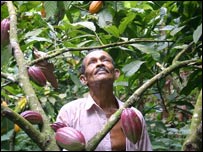
"This is why this place is so special," Claudio was whispering. "These cocoa plants pre-date all modern hybrids of today's mass market.
"This is an ancient plant producing cocoa with a taste more authentic than any other in the world."
I am no chocolate connoisseur but in the cool of Claudio's hi-tech factory - an old shipping container with air-conditioning - my first experience of his chocolate was unforgettable.
The Corallo family does not yet have shiny wrappers or packaging and instead I was offered a few chippings from a solidified pat at the bottom of a plastic tub.
Presentation might have been poor but the taste was sensational - a deep, rich chocolate flavour garnished, in this case, with tiny nuggets of ginger.
And what is more, my amateur enthusiasm is shared by some of the world's best chocolatiers.
The buyer for Fortnum and Mason in London's Piccadilly raves about Claudio's work to revive a plantation set up almost 200 years ago by Portuguese colonists.
Back in the 19th Century, the Portuguese built "rocas", or plantations, all over Principe and Sao Tome on a scale that beggars belief.
Some of them were the size of Versailles with manor houses, schools, churches, clinics, offices, even cobbled streets.
But it was all done on the back of slave labour, so brutal these little islands almost sparked a war between Britain and Portugal in the 1800s.
When the islands won independence in 1975, the cocoa price collapsed, production fell, and the jungle swiftly moved to reclaim the terraces.
For Claudio it has taken years to restart production at the Terreiro Velho plantation.
Principe is so economically backward that until the mid-1990s the only means of transport was a fleet of tractors, and so remote that to travel there from the African mainland took several days' sailing.
It has been a labour of love to just make the two-storey plantation house habitable.
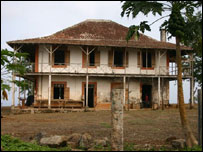
"The undergrowth reached almost to the first floor and we had been working three months before we found a 30-foot staircase in the garden reaching down to a terrace," he said, as he prepared coffee on a rickety Chinese oil burner.
Claudio's wife, Bettina, has recently recovered from cerebral malaria.
The driers - crucial to cocoa production - had to be imported piece by piece from Italy; even now, nine years later, Claudio is camping on a homemade bed in a room with no windows and only part of a roof.
But with a workforce of 30 local labourers who are - thanks to the plantation - earning a wage for the first time in decades, Claudio has clear plans to turn what is now a modest cottage industry into something bigger.
Only then will he worry about putting the roof back on the house.
There is an old wives' tale on the islands about a lucky goblin found deep in the forest known as a gou-gou.
If you are fortunate enough to meet a gou-gou you must catch him - so the story goes - feed him well, and he will make endless wealth for you; a bit like the golden goose story of my childhood.
The gou-gou myth seems to me a pretty accurate description of the oil fever which is gripping the islands right now.
If any oil revenue comes it will be a long time in the future.
Better, in my opinion, to rely on cocoa and Claudio's tree-top troop of monkey helpers.
From Our Own Correspondent was broadcast on Saturday, 24 July, 2004 at 1130 BST on BBC Radio 4.
Getting back into the groove
Queen Victoria, Abraham Lincoln, Florence Nightingale and other characters from history may soon be able to speak again, as scientists perfect techniques to recover the sound from recordings that are far too delicate to be played.
In the corner of a California university laboratory, two men are battling against time to perfect a machine that will read old recordings - using special microscopes to scan the grooves - and software that can convert those shapes into sound. Their work could bring history to life.
The dulcet tones of movers and shakers from an earlier age could soon be heard once again, thanks to scientists Vitaliy Fadeyev and Carl Haber, who usually work with subatomic particles at the Lawrence Berkeley National Lab. They are now planning to use that technology to give a voice to the great and the good down the annals of history.
Haber says the idea came to him by accident after he heard a radio report about the problems archivists have in preserving and accessing the voices and music of the past. He says a lightbulb went on in his head.
Why not adapt the precision techniques he and Fadeyev are using in a European-led project on particle physics, and apply it to old recordings? Made perfect sense to him.
"We stumbled on the idea and kind of made a connection," explains Haber.
"To us, it's a wonderful way forward where basic research in the physical sciences can be made to work for another field of research or culture, which you might naively think was unrelated to particle physics.
"Of course these are all the human endeavours and it's wonderful they can benefit each other. "
Russian-born Fadeyev agrees: "It's great that our very technical field can give benefits to other humanitarian activities."
Their first experiments involved extracting high quality sound from old shellac discs from the 1950s.
The two scientists programmed a precision optical metrology system normally used to inspect silicon detectors, to map and photograph the undulating grooves etched on these old recordings.
The result was a digital reproduction with all the scratches, bumps, dust and wiggles ironed out. Those images were then transferred to a computer and turned into a sound file to produce a clean version of the original.
The beauty of this technique is that nothing ever has to touch the actual recording, thereby avoiding any further damage to it.
"It's like a fancy Xerox machine," quips Haber.
Early success in reviving The Weavers' 1950 rendition of the classic Huddie Ledbetter song Goodnight Irene suggested the two scientists were on to something.
And the US Library of Congress, in Washington, DC, backs that view.
It has given the scientists funding to perfect their technique and technology in the hope it can be used to access a huge archive. The library's files include 128 million items in formats ranging from tape to disc and from wax cylinders to tin foil cylinders.
In the past, the library has said that America's audio heritage is in danger. At least half of the wax cylinders used to record sound before 1902 are gone, because no one bothered to preserve them or because they weren't properly stored.
Fungal mould and insects have been the main culprits in silencing the voices of Americans from legendary eras such as the Civil War, the conquest of the western states, and the early days of slavery.
"They have lost as many cylinders to the mould as to breakages and other causes, so mould is definitely one of the major destructors of this old media," says Fadeyev.
In the corner of another Berkeley lab, two men are battling against time to perfect a machine that will read old cylinders using special microscopes to scan the grooves and software to convert those shapes into sound.
In an early successful experiment, scientists John McBride and Christian Maul from Southampton University helped retrieve data from a well worn 1912 cylinder recording of a sentimental tune called Just Before the Battle, Mother. In Berkeley, it was translated into a sound file.
Haber says, "A stylus measures a groove by one point, essentially where the stylus sits. The data we take is taken at least a factor of ten if not at a higher sampling or resolution than the stylus measures. So if you have ten times as much information, you have that much more of a chance to recover something. And we could even maybe go 20 or 30 times and increase our chances even more so."
Both men are excited at the possibilities in being able to give voice once again to cylinders that are said to contain recordings of Queen Victoria, poets Alfred Tennyson and Walt Whitman, nurse Florence Nightingale, actress Sarah Bernhardt and Germany's WWI leader Kaiser Wilhelm.
Unconfirmed rumours abound that Abraham Lincoln even made a recording during the Civil War in 1863.
"History is something that everyone shares. When you can see it or hear it, that real time experience of it happening in front of your can awaken a whole other dimension for people," says Haber.
Vitaliy believes breathing new life into recordings that have been thought unplayable might also change the way we view the past.
"I think it's hard to quantify, but it's certainly a great cultural and emotional imprint. The very first sample that we reconstructed was the Goodnight Irene song. It's thought of as a lullaby these days, but if you listen to the lyrics it's about adultery, murder and some other things. That immediately gives you the feeling for the cultural change between the 1930s, 40s, 50s, and these days."
Freak waves spotted from space
The shady phenomenon of freak waves as tall as 10 storey buildings had finally been proved, the European Space Agency (Esa) said on Wednesday.
Sailors often whisper of monster waves when ships sink mysteriously but, until now, no one quite believed them.
As part of a project called MaxWave - which was set up to test the rumours - two Esa satellites surveyed the oceans.
During a three week period they detected 10 giant waves, all of which were over 25m (81ft) high.
Over the last two decades more than 200 super-carriers - cargo ships over 200m long - have been lost at sea. Eyewitness reports suggest many were sunk by high and violent walls of water that rose up out of calm seas.
But for years these tales of towering beasts were written off as fantasy; and many marine scientists clung to statistical models stating monstrous deviations from the normal sea state occur once every 1,000 years.
"Two large ships sink every week on average," said Wolfgang Rosenthal, of the GKSS Research Centre in Geesthacht, Germany. "But the cause is never studied to the same detail as an air crash. It simply gets put down to 'bad weather'."
To prove the phenomenon or lay the rumours to rest, a consortium of 11 organisations from six EU countries founded MaxWave in December 2000.
As part of the project, Esa tasked two of its Earth-scanning satellites, ERS-1 and ERS-2, to monitor the oceans with their radar.
The radars sent back "imagettes" - pictures of the sea surface in a rectangle measuring 10 by 5km (6 by 2.5 miles), which were taken every 200km (120 miles).
Around 30,000 separate imagettes were produced by the two satellites during a three-week period in 2001 - and the data was mathematically analysed.
Esa says the survey revealed 10 massive waves - some nearly 30m (100 ft) high.
"The waves exist in higher numbers than anyone expected," said Dr Rosenthal.
Ironically, while the MaxWave research was going on, two tourist liners endured terrifying ordeals. The Breman and the Caledonian Star cruisers had their bridge windows smashed by 30m waves in the South Atlantic.
The Bremen was left drifting for two hours after the encounter, with no navigation or propulsion.
Now that their existence is no longer in dispute, it is time to gain a better understanding of these rogues.
In the next phase of the research, a project called WaveAtlas will use two years' worth of imagettes to create a worldwide atlas of freak wave events.
The goal is to find out how these strange cataclysmic phenomena may be generated, and which regions of the seas are most at risk.
Dr Rosenthal concluded: "We know some of the reasons for the rogue waves, but we do not know them all."
Japan Panel OKs Human Cloning for Research
Japan Science Council Votes to Adopt Recommendation Allowing Limited Human Cloning for Research
TOKYO July 24, 2004 — The government's top science council has voted to adopt policy recommendations that would permit limited cloning of human embryos for scientific research in Japan, an official said.
Japan banned human cloning in 2001, but has permitted researchers to use human embryos that aren't produced by cloning.
The recommendations, approved Friday, would let researchers produce and use cloned human embryos, but only for basic research, said Tomohiko Arai, an official at the Cabinet's Council for Science and Technology Policy. The cloning won't be allowed for use in treating human patients.
Many scientists back human embryo cloning to obtain stem cells that can be used to reproduce damaged body tissues or organs. Stem cells are the building blocks from which all organs are formed.
The council, headed by Prime Minister Junichiro Koizumi, will now ask the ministries to come up with specific guidelines, said Arai, who declined to speculate on how long that might take.
Britain and South Korea allow therapeutic cloning. The United States prohibits any kind of embryo cloning and has lobbied strongly against it.
Too young for technology?
Parents, scholars reconsider tech for youngsters
NEW YORK (AP) -- Amanda Cunningham started her daughter on computers at 2 1/2 with "Reader Rabbit" software and Web sites like Sesame Street. Like any parent, she was proud Madeline could master the mouse so young.
But Cunningham soon realized Madeline, now 4, wasn't really learning anything. She just kept clicking, dragging and playing the same games over and over. Now, she's in no rush to get her 1-year-old son, Liam, on computers or the Internet.
"I just don't see an advantage (to) starting early," said Cunningham, a former teacher who now creates reading software for elementary schools.
There's no shortage of sites and software aimed at very young kids and even toddlers. Noggin.com has games and virtual coloring books for preschoolers. A Crayola licensee makes handheld video games, including one where kids race in a crayon-shaped car, for 3 and up. KidzMouse Inc. makes computer mice for small hands.
But there's growing debate over whether children should be exposed to technology so early. Some parents and scholars see no benefit, and a handful even warn of a hindrance to child development.
"Mental ability is gained from manipulating the three-dimensional world at that age and (from) managing your own mind and not having it managed by an electronic machine," said Jane M. Healy, author of "Failure to Connect: How Computers Affect Our Children's Mind."
Healy said computers take children away from other developmental activities more appropriate for their brains and can "easily become a habit for both parent and child."
According to a 2003 survey by the Kaiser Family Foundation, 31 percent of children age 3 and under are already using computers. Sixteen percent use them several times a week, 21 percent can point and click with a mouse by themselves and 11 percent can turn on the computer without assistance.
Healy recommends kids stay off computers until age 7. Others suggest 3 is OK to start. The American Academy of Pediatrics recommends no screen time before 2, worried youngsters may get discouraged if they talk to a computer monitor and get no response.
David Elkind, professor of child development at Tufts University, is concerned that kids are overdeveloping visual senses at the expense of touch or sound. "Children miss out on all these basic learning experiences if they are so attuned to the virtual world," he said.
Lapware
Yet some researchers as well as developers of the Web sites and software aimed at young kids see nothing wrong with exposing children to technology early -- as long as it's done in moderation.
"Kids need a good balance in their lives and a mix of experiences," said Peter Grunwald, whose consulting firm specializes in kids and technology.
In other words, don't force technology on children and don't turn it into a babysitter while cooking dinner. Through common sense use, Grunwald said, computers can help kids develop hand-eye coordination and other skills.
Yong Zhao, a professor of educational psychology at Michigan State University, bought his daughter an iMac before she turned 1 and had her simply bang on the keyboard. Eventually, he said, his daughter picked up on how the banging led to changes on-screen.
Young kids should be supervised while surfing the Web anyhow, so early Internet use offers a chance for "spending time with your kids and seeing what they react to," said Regina Lewis, consumer adviser for America Online Inc., which has "KOL Jr." section for ages 2 to 5.
Developers of the kids site Googles.com -- not to be confused with the search engine -- say their games and songs promote self-esteem. Scholastic Inc. says its Clifford products teach reading and music -- not to mention computing.
Others say they can't possibly quell their kids' curiosity for a machine their parents -- and older siblings -- are using so much.
"The same way that every little kid who's starting to walk goes into the kitchen and takes pans out of the cabinet, they see their parents doing things and they want to do them, too," said Jim Robinson, an advertising executive who created Kneebouncers.com initially for his then-9-month-old daughter.
The site -- one of a number of so-called lapware for toddlers to toy with on parents' laps -- has Flash-animated games with lots of noise and bright colors. Robinson said he gets e-mail of thanks from parents of kids as young as 5 months old.
Beyond the home, computers are increasingly creeping into daycare and preschool environments, in turn pressuring parents to get computers as soon as their child is born, said Peggy Meszaros, director of Virginia Tech's Center for Information Technology Impacts on Children, Youth and Families.
"Parents today are so obsessed with giving children every academic advantage, they've been persuaded that if they wait a minute to introduce children to computers and technology, that somehow their children will be behind," she said.
But if those same parents talked to teachers, they'd learn that kids pick up keyboarding and mouse skills easily even if they wait, said Patricia Cantor, chairwoman of Plymouth State University's education department.
More research is needed, proponents and skeptics agree.
"What's happening is the market is proceeding at a faster pace than the research," said Kathryn Montgomery, a communications professor at American University. "It's taken awhile for the academics to reach a point where they are addressing these questions. The marketers, they were clearly on the case 10 years ago."
Yoda 'speaks like Anglo-Saxon'
Star Wars character Yoda's sentence structure is similar to old Anglo-Saxon, a linguistics expert has said.
Author David Crystal also says a number of characters in the Lord of the Rings are excellent examples of non-standard English for children to study.
In his book The Stories of English, the academic even discusses the effect on pronunciation of the BBC and on vocabulary by the Sun.
He said he wanted to attack purists who would not tolerate non-standard English
Mr Crystal, a professor of linguistics at Reading University for 20 years, said Yoda - a Jedi master in the Star Wars films - was a good way to get children interested in how preferences in English word order changed from the Anglo-Saxon era to that of Middle English.
He told BBC News Online: "It is a nice example if you want to persuade kids and get them interested - if you say Yoda did it they are all ears.
"It is a clever little trick on George Lucas's part to get an effect. He reverses the order: 'full of the force I am'. The end of the sentence comes at the beginning."
The author also contrasted the standard English spoken by some of the characters in Lord of the Rings, such as Bilbo and Frodo Baggins, with the non-standard English, containing slang and dialect, spoken by others.
"Normally in fantasy and science fiction you don't get variety of English.
"The devil speaks standard English, the fairies do, everybody does. In sci-fi, you go out to a different planet and you meet aliens, but they speak standard English.
"Sam Gamgee speaks non-standard English, Gollum speaks a weird non-standard English. Tolkien is special."
Mr Crystal said his mission was for non-standard English to be recognised.
"The history of English is a history of the non-standard language.
"The people I'm attacking are the purists who say language should never change and be 'like it was when I was a lad'. The message should be that we welcome diversity."
July 21, 2004
Feeling Is Believing?
Alien Abductees Reveal How Emotion Can Cloud Reality
By Lee Dye
July 21, 2004 ? Researchers at Harvard University called on aliens from outer space to help them solve a problem that surfaces frequently in everything from therapeutic sessions to criminal trials, or even just chatting with a friend.
How do you know if someone is telling the truth when he or she recalls memories of childhood abuse, or being raped by satanic cults, or some other traumatic insult?
One clue that many of us rely on is the emotional reaction of the person telling the story. If the victim breaks out in sweat and becomes extremely emotional while recalling those memories, it's more difficult to dismiss them as false.
But all that really means is the person truly believes his or her memories are true, not that they really are, according to the researchers.
"The person really believes something happened," says Richard McNally, a clinical psychologist and professor of psychology at Harvard, lead author of a study in the July issue of Psychological Science. "But that doesn't necessarily mean it did."
True or False?
Deciding which memories are true, and which are false, is a real tough problem for therapists and law enforcement officials, and sometimes friends. That's especially true when long-buried memories suddenly surface involving traumatic events that may have occurred years ago. McNally has struggled with the problem for years, moving from combat traumas to memories of childhood sexual abuse.
He says that even a seasoned therapist can be influenced by the emotional state of the person recalling the memories.
"A therapist is more inclined to credit the account as authentic if it's accompanied by really intense emotion," he says. "The therapist thinks 'my goodness, something must have happened.' "
Years of research have convinced him that even false memories can stimulate a lot of emotion, but how do you prove that in the lab? That's where the aliens from space come in.
If someone claims to have been sexually abused years ago, it's almost impossible to prove those memories false. What the researchers needed was a group of people who sincerely believed memories of something that clearly never happened.
So they put an ad in newspapers asking for people who had been abducted by aliens from space.
Emotions Cloud Truth
They got a lot of weird phone calls, including some from people claiming to be aliens, but in time they had their subjects, six women and four men who believed they had been abducted by alien beings. Their average age was 47. Seven women and five men who had not been abducted also participated in the study.
The "abductees," as they came to be known, were interviewed and recorded as they told brief stories about their abduction, as well as other stressful, happy and neutral tales. All of the participants were wired so the researchers could monitor for heart rate, sweat production, and facial muscle tension, three strong indicators of emotional stress.
The emotional reaction among the abductees soared while listening to the stories of stress and abductions. But it was much weaker while listening to happy or neutral narratives.
The 12 participants who had never been abducted barely responded to any of the stories.
The verdict was clear, McNally says. The emotional reaction, which can be so convincing, had nothing to do with the veracity of the memories of the folks who believed they had been abducted.
Why did they believe so strongly in something that is so implausible? In answers to a questionnaire, the abductees scored high on personality traits that make them a bit different. For example, just because an idea seems magical doesn't necessarily mean it isn't true.
People with those traits tend to have "a rich fantasy life, and to endorse unconventional beliefs," the researchers say in their report.
And the stories they told were anything but conventional, yet they had much in common, McNally says.
"I would ask them, how did this all begin," McNally says. "And they would typically say 'I was lying in bed one night, and a few hours before dawn I suddenly woke up. I tried to move over and I realized I was completely paralyzed. It was absolutely terrifying. I felt electrical sensations coursing through my body, I heard humming noises, I saw lights flashing, and I felt myself levitating off my bed when suddenly I saw these strange beings, these strange figures coming up towards the bed. And then I blanked out. Later, I woke up and had no idea what had happened.' "
Some time later, McNally says, while in therapy, the memories came back.
"'I was taken up into a spaceship, medically probed, met alien beings, met my hybrid children,' " the participants told him. They frequently said they had sex with the aliens.
To the abductees, that meant they were something special.
All described the abduction as terrifying, but when McNally asked them if they wished it had never happened, they all said it was worth it. The abduction proved there were other beings out there who cared for us, and for our planet, and even wanted to mate with humans to ensure continued survival of life on Earth.
"Their experience with these alien beings ultimately becomes sort of a spiritually deepening one for them," McNally says.
Most of the participants came from traditional religious backgrounds, but had drifted away.
"These individuals have strong spiritual needs that are not being met by conventional religions," McNally suggests.
Whatever the cause, the research shows clearly that to these people, the memories are real, even though it's safe to say the events never happened. But there's no point in trying to convince them.
Even if he could explain to them exactly why they thought all this happened, and show convincing reasons why the memories are false, "I strongly suspect they would not buy it," he says. "A naturalistic explanation robs the universe of its magic," he says.
View-Master Turns 65, Still Going Strong
No Plans to Retire View-Master As Iconic Toy Turns 65, Still Transcends Generations
EAST AURORA, N.Y. July 21, 2004 ? With the pump of a finger, the View-Master has given generations a 3-D look at everything from man's first moonwalk to the adventures of SpongeBob SquarePants.
The iconic toy occupies a place in the National Toy Hall of Fame, alongside Barbie and Mr. Potato Head, and has inspired many a Web site. This year, it achieves another mark of success, its 65th anniversary.
For the uninitiated, View-Master is the handheld gadget that resembles a squarish pair of plastic binoculars. It spins a circular reel a notch each time the user pushes down its arm to reveal new 3-D images, which are often sequenced to tell a story.
"People who grew up in the '70s think it's a '70s thing," collector Eddie Bowers said, "and people who grew up in the '50s think it's a '50s thing. It's their childhood."
Jim Silver, publisher of the Toy Book, an industry magazine, said parents' fond memories and an effort to keep the reel subjects current has lent to its success. "Parents love to buy things for their children that they had when they were young and that they loved," he said.
The public got its first good look at View-Master at the 1940 World's Fair in New York, a year after its creator, amateur stereo photographer William Gruber, introduced it in Portland, Ore. By 1941, more than 100,000 stores were carrying it.
The military adopted it during World War II for training reels, and the 1950s saw an abundance of reels of national parks and other scenic attractions, intended as souvenirs for adults. For kids, View-Master obtained licensing to use Disney characters in 1951 and those and other movie and television favorites have been mainstays of the line ever since.
More than 1.5 billion reels have been issued since 1939.
Most appealing to collectors is that any one of those white paper reels, with their 14 thumbnail film images, will work in any View-Master viewer. The reels' size and shape have never changed.
"The first reel that was produced in 1939 would still work in our newest viewer that came out today," said Mike Sullivan, marketing manager for View-Master at Fisher-Price. The East Aurora toy maker took over View-Master in 1997 after Tyco Toys, which had owned it since 1989, merged with Fisher-Price parent Mattel.
The company has experimented with higher tech View-Masters, like one that used cartridges instead of the reel. It found it best not to stray from the classic. "Anytime we don't use the reel, we don't have the success," Sullivan said.
Bowers, just back from a 3-D convention in Portland that attracted a subset of View-Master collectors, said the non-talking, reel-using models are the only ones he wants in his collection of 50 or so viewers and hundreds of reels.
"To me, that's what a View-Master is," said the Dallas collector. Bowers later picked up a stereo camera and now makes his own reels from family events, including his sister's wedding.
For the 65th anniversary, Fisher-Price has produced a box set with compilation reels from each decade. Viewers can click their way from a 1930s view of the Golden Gate Bridge through a shot of pop singer Brandy in concert.
Hawking: Black Holes Mangle Matter, Energy
Astrophysicist Stephen Hawking Unveils Theory That Black Holes Mangle Matter and Energy
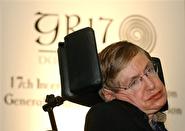
DUBLIN, Ireland July 21, 2004 ? Famed astrophysicist Stephen Hawking said Wednesday that black holes, the mysterious massive vortexes formed from collapsed stars, do not destroy everything they consume and instead can fire out matter and energy "in a mangled form."
Hawking's radical new thinking, presented in a paper to the 17th International Conference on General Relativity and Gravitation in Dublin, capped his three-decade struggle to explain an elemental paradox in scientific thinking: How can black holes destroy all record of consumed matter and energy, as Hawking long believed, when subatomic theory says such elements must survive in some form?
Hawking's answer is that the black holes hold their contents for eons but themselves eventually deteriorate and die. As the black hole disintegrates, they send their transformed contents back out into the infinite universal horizons from which they came.
Previously, Hawking, 62, had held out the possibility that disappearing matter travels into a new parallel universe within the black hole the very stuff of most visionary science fiction.
"There is no baby universe branching off, as I once thought. The information remains firmly in our universe," Hawking said in a speech to about 800 physicists and other scientists from 50 countries.
"I'm sorry to disappoint science fiction fans, but if information is preserved, there is no possibility of using black holes to travel to other universes," he said.
"If you jump into a black hole, your mass energy will be returned to our universe, but in a mangled form, which contains the information about what you were like, but in an unrecognizable state," he said with a smile, sparking laughter from the audience.
Hawking added, "It is great to solve a problem that has been troubling me for nearly 30 years, even though the answer is less exciting than the alternative I suggested."
In a humorous aside, Hawking settled a 7-year-old bet made with Caltech astrophysicist John Preskill, who insisted in 1997 that matter consumed by black holes couldn't be destroyed. He presented Preskill a favored reference work "Total Baseball, The Ultimate Baseball Encyclopedia" after having it specially flown over from the United States.
"I had great difficulty in finding one over here, so I offered him an encyclopedia of cricket as an alternative," Hawking said, "but John wouldn't be persuaded of the superiority of cricket."
Later, Preskill said he was very pleased to have won the bet, but added: "I'll be honest, I didn't understand the talk." Like other scientists there, he said he looked forward to reading the detailed paper that Hawking is expected to publish next month.
Hawking pioneered the understanding of black holes the matter-consuming vortexes created when stars collapse in the mid-1970s. He has previously insisted that the holes emit radiation but never cough up any trace of matter consumed, a view that conflicts with subatomic theory and its view that matter can never be completely destroyed.
Hawking, a mathematics professor at Cambridge University, shot to international fame with his best-selling book "A Brief History of Time," which sought to explain to a general audience the most complex aspects of how the universe works.
Despite being virtually paralyzed and forced to rely on a wheelchair with amyotrophic lateral sclerosis since his mid-20s, Hawking travels the world on speaking engagements. He communicates by using a hand-held device to select words on his wheelchair's computer screen, then sending them to a speech synthesizer.
The slow process of constructing answers meant that, in the press conference that followed his paper, Hawking was able to answer only two questions in a half-hour. The final questioner asked him what problem he intended to tackle next, now that he had solved the paradox of the black hole.
"I don't know," Hawking quickly replied, bringing the house down with laughter.
photo credit and caption:
Professor Stephen Hawking presenting his findings on 'Black Hole Theory' at GR17, the 17th International Conference on General Relativity and Gravitation at the Royal Dublin Society, Ballsbridge Dublin Wednesday July 21, 2004. (AP Photo/ John Cogill)
Living memory and the distant past
At the time of the D-Day commemorations in June, Kevin Connolly asked BBC radio listeners for their personal links to the past. Your stories made extraordinary reading.
When I wrote a few weeks ago about the anniversary of D-Day, I made the point that World War II - even as we continue to sorrow and to celebrate - is becoming a different kind of history.
It's less and less a story we hear from brothers and fathers who went away to fight or the sisters and aunts and mothers, who drove fire engines and built bombers and darned rationed clothes while they were gone.
Increasingly it is that drier, colder kind of history that comes from textbooks and from re-runs of ageing television documentaries.
The dates and the diplomatic deals and the tallies of the dead are there, of course, but the passion and the pain - which allow us to pick out our own family threads in the tapestry of a great event - well, they are going.
In the course of all this, I happened to mention that I had once met the oldest human who ever lived - a woman called Jeanne Calment from Arles in the south of France.
This is a sign that I am entering what should be called my anecdotage - a stage of life journalists reach where they constantly start referring back to people and places in their past.
There were many noteworthy aspects to Madame Calment's life, of course.
She'd seen them digging the foundations for the Eiffel Tower, for example, and, like all good French citizens, had decided immediately that it would definitely never catch on.
But it particularly stuck in my mind that she'd met Vincent Van Gogh who spent part of his life in Arles and, whenever I see or read anything about him now, I feel a curious irrational surge of pride to think that I met someone who met him.
It might sound a bit daft but it struck a chord because dozens of people wrote to me, as I asked, to describe similar distant but personal links with history.
My puzzled thanks go to the two people who thought this was a short story competition, especially if they were expecting a prize.
I can also report an urban myth in the making, since several people wrote to me about an interview they thought had been broadcast in the 1970s with someone who met Cardinal Richelieu, the French statesman who died in 1642.
Now by my calculations, even if you - as a newborn baby - met Richelieu on the day of his death, you'd still have been 235-years-old on the day the first sound recording equipment was patented in 1877.
So while - I suppose - you never know, it does seem on balance unlikely.
The question was how far can you go back into history in two steps: eg a great-granny you distantly remember who passed on tales told to her by her own grandmother.
The answer seems to be, more or less, the early years of the 19th Century with one or two stretching back just a little further.
My colleague Allan Little, for example, remembers interviewing an elderly Russian emigree in Broughty Ferry in Scotland who as a child was brought out of revolutionary Archangel by her mother.
She could remember an old family nursemaid whose mother had tended wounded soldiers from Napoleon's Grande Armee in the retreat from Moscow.
There was one listener whose grandfather's great-uncle had served as a master-at-arms in Nelson's navy, and several who offered memories from the 1820s and 1830s.
There were, curiously, a number of direct links with Nelson - usually involving his daughter whom he modestly christened Horatia.
Top prize in that section goes to a couple whose wedding in the early 1960s was attended by an elderly relative who was Horatia's god-daughter.
Most of the many letters I received touched on meetings long ago with old people who remembered Waterloo - a reminder of how, until World War I, that battle was remembered as the decisive moment in the saving and making of the nation.
There was a sort of historical dead heat for the longest leap back in time.
One listener's daughter had an elderly music teacher who remembered his grandmother telling first-hand stories of the French Revolution.
Another, in America, recalled a great-grandmother whose own great-grandmother grew up in Tennessee having arrived by boat from Holland, where she had been born in the 1790s.
I hope you're impressed because our shared sense of wonder is the only prize awaiting Tamera Waltman of Michigan and Dr Taylor of Leicestershire.
Having prompted such a fascinating debate, I feel I should end with a sort of confession - especially now that Jeanne Calment is safely in heaven and therefore clearly out of reach of legal advice of any kind.
She told me - and a string of other interviewers - that she knew Van Gogh pretty well, remembering him as an ugly, smelly, bad-tempered drunk.
Over the years, though, I've noticed in the cuttings that the link between the two came originally simply from some sharp-eyed local hack noticing that their dates in Arles overlapped.
In the course of a good many interviews the relationship began to take on a life of its own, in a way that didn't do Vincent any favours - even if he would have appreciated her somewhat impressionistic way with a story.
Now it could be, of course, that Madame Calment's memory just began to improve after she hit 120 but I prefer to see it as a kind of warning not to embellish the truth as I slip further into my anecdotage.
My thanks to all of MY own correspondents - who were factual and fascinating - and, of course, have given me something to tell the grandchildren.
By Kevin Connolly
BBC correspondent in Ireland
From Our Own Correspondent was broadcast on Saturday, 17 July, 2004 at 1130 BST on BBC Radio 4.
July 20, 2004
Miner digs up 182-carat gem -- and trouble
There's lucky: Finding a diamond when you're a young miner sweating it out in the west African forests of Guinea. And there's too lucky: finding a 182-carat stone that everyone -- starting with the government of Guinea -- wants a piece of.
Result: the stone -- four times the size of the famous Hope diamond -- was tucked away Monday deep in the vaults of Guinea's Central Bank. No pictures, please.
And the 25-year-old miner who found it, if not exactly in hiding, was making himself scarce. No interviews, please.
State radio in impoverished, mineral-rich Guinea announced the find last week. Guinea mining industry officials confirmed Monday that the newly dug-up stone -- though not flawless -- was a fortune in the rough.
"It's a quite brilliant diamond, of good enough quality despite having numerous veins. One thing is certain -- it's worth millions of dollars," a top official with the Aredor mining company, Guinea's biggest diamond operation, told The Associated Press.
The Guinea gem is 4 inches by 1.2 inches high -- roughly the size and shape of your average computer mouse.
The Hope diamond, by contrast, is 45.52 carats.
The largest diamond ever found, the Cullinan, was a gaudy bowling-ball size beauty at 3,106 carats in the rough.
Freelance discoveries of big diamonds in west and central Africa typically touch off fierce, fast-buck feeding frenzies, pitting the finders and first-round buyers against would-be moneymakers higher up the food chain.
Finders, terrified, have been known to flee into the bush rather than dare bring their find to market.
In Congo in 2000, the government confiscated a 265-carat stone and jailed its local buyer for a month, freeing both only after massive public protests. That stone eventually went at auction in Israel for an industry-estimated, unconfirmed $13 million to $20 million.
Industry officials and diplomats in Guinea on Monday would discuss the find only on condition of anonymity.
The miner, who was not identified, struck his shovel on the stone at a dig in southeast Guinea, bordering Ivory Coast and Liberia.
Authorities gave few other details of the diamond's first hours and days in the light. It was clear, however, that the rock's time with its discoverer was brief.
By Monday, the gem was in the capital, Conakry, behind steel doors at the guarded Central Bank.
The young miner had no choice, a Western diplomat said -- he might have been killed if he hadn't turned it over to the authorities.
An Associated Press reporter, visiting the area of the find, was unable to locate the young miner.
Diamonds, along with aluminum ore and gold, are among the top exports of Guinea, a resource-rich but virtually undeveloped country whose people live on less than $1 a day.
The Aredor mining company, using heavy equipment in high-dollar operations, turns up an average of 30,000 carats each year.
Small-scale miners like the 25-year-old, with no more overhead than the cost of a spade, produce 300 to 400 carats a year here.
The 182-carat stone came from a site owned by the government, and leased to miners.
Miners are believed to slip many smaller finds into their pockets, taking the stones out for smuggling and avoiding the government and any cuts it would take.
Especially since it was found on government land, the gem's discoverer may have believed bypassing Guinea's officials too risky in this case, experts said.
Authorities were to inspect the stone later this week and offer an official estimate. The finder -- if luck holds -- would likely receive an undetermined percentage of that, industry officials said.
Schoolboys create mobile seeker
A mobile phone detector developed by a team of six New Zealand schoolboys has attracted international interest.
The boys, pupils at St Thomas of Canterbury College in Christchurch, developed the cheap device as part of a business competition for school pupils.
They have also had interest, and orders, from schools and universities in New Zealand.
A mobile detector lets you know when phones are being used surreptitiously and can cost hundreds of pounds.
The gadget was deemed to be the best product in the local sector of the Young Enterprise competition.
"It's grown outside the Young Enterprise thing," said Adam Manley, one of the 17-year-old managing directors of StopCom, the name the students have given to their company for the competition.
The pupils have sold all 20 of the first models of the detector that they are building, and are developing their next generation product.
The detector, which they have called CellTrac-r, works by picking up the bursts of radio frequency activity that emit from a mobile each time it sends or receives a call or a text message.
The device can detect these bursts of electro-magnetic energy up to a radius of 30 metres. It can also measure the amount of the energy to determine the distance of the mobile.
The detector then lights up light-emitting diodes - when four LEDs are lit, a mobile is in use close by. Just one lit LED means that the phone is being used at a distance of 25 to 30 metres.
Local company Tait Electronics has helped guide the students through the process of building a business.
The boys have also been able to call on a technical advisor from the electronics firm, helping ensure both a robust business model and a robust product.
"At the technical level, it's [CellTrac-r] got good integrity," said the boys' mentor, Tait's intellectual property manager Frik de Beer.
"It's designed for mass manufacture if they have to get to that point.
"The product is not a toy. It's relatively simple. Because of that the cost is reasonably low."
The first version of the product has sold for just NZ$39.95 (£15), but if the boys develop an upgraded version, perhaps adding in a buzzer, and increasing the detection range, it would sell for around $100.00 (£35).
The low price is probably part of the lure for would-be buyers as mobile phone detectors can sell for much more.
"We wonder why they sell it for so much," said Mr Manley.
"We've worked it out how much you should sell it for and these ones are selling for nearly $1,000 (£350). It's crazy."
Linda Roberts, who helps organise examinations at the University of Canterbury, plans to trial three of the detectors at this year's end of term exams.
"Some of these phones are very smart and very small. People could be texting away in an exam of 400 people and it would be hard to detect," she said.
"We've had an increasing number and [longer] duration of toilet visits in exams and with the technology these days, we have no way of knowing what's going on."
The local prison service is also planning to test one of the school boys' products.
"We are certainly having a look at it to assess its value for us," said Tony Coyle, national crime prevention coordinator for the public prison service.
"Prisons are difficult places because they are quite large and cellphones are very small."
Future plans
This year, these would-be entrepreneurs will not be reaping any riches as a portion of any profits from the boys' efforts will go to the charity that the school supports in Tanzania.
But the enterprising students may set up a private company once the school year and the competition ends.
"It is something we have thought about but we are not finalising it all yet," said Manley. First, there is the school to finish and exams to pass and a competition to win.
The results of Young Enterprise competition are due to be announced at the end of October.
By Kim Griggs
In Wellington, New Zealand
July 17, 2004
Small print, big picture
Getting a book on the big screen is a hard enough task, writes Richard Jinman, so what chance of starting from scratch with the latter in mind?
In September 1994, Derek Hansen was an author in search of a movie deal. Setting out to write his third novel, Sole Survivor, he decided to do everything he could to make the book attractive to filmmakers.
His motivation was simple. "A movie deal is an imprimatur," he says. "If you get a film made, it says it's a good book because there's a blind faith in movies. So I kept the cast small, set it in one location and made the props fairly minimal."
True to his word, the former advertising copywriter chose a remote island off the coast of New Zealand as his location. The book had only three main characters: two male hermits and a woman whose arrival on the island turns their isolated world on its head. Major "props" were limited to a Sunderland flying boat, a patrol boat and a trawler.
The plan appeared to work. In 1997, Hansen - then aged 53 - was in New Orleans when his American agent, Jillian Manus, called. "Derek," she gushed. "When you wrote Sole Survivor, you must have realised you'd written a major movie."
Manus was about to strike an extraordinary deal. Kathleen Kennedy and Frank Marshall, a Hollywood production team whose credits include Schindler's List, Cape Fear and Twister, were prepared to pay a $US60,000 up-front fee to option the rights to the book. Hansen would receive a further $US200,000 to write the screenplay and another $US700,000 the day the cameras started rolling.
The author was ecstatic. Names such as Susan Sarandon, Anthony Hopkins and Sean Connery were bandied about. He began work on the screenplay and must have daydreamed about strolling up the red carpet at the premiere.
Seven years later, Sole Survivor remains unproduced. Despite his producers' reassurance that "this ship is gonna leave port" it was ultimately torpedoed and sunk by the 2000 Tom Hanks film Cast Away. Hanks's tale of island survival was deemed too similar to Hansen's story. "Once that [Cast Away] went into production, my producers got cold feet," he says. "Sole Survivor went from being the hottest property to dead."
So his plan failed? Well, yes and no. Hansen reckons his book's adventures in Hollywood have earned him at least $400,000 to date. Sole Survivor still attracts regular interest from US producers and each time a screenwriter takes a shot at adapting it, Hansen receives half the fee.
"It's been a rollercoaster ride," says Hansen, who now questions the tactics he used to make his book enticing to filmmakers. When he read the coverage - a one-page synopsis used to describe the book's strengths and weaknesses to film companies - there was no mention of his efforts to keep cast and props to a minimum.
Kennedy and Marshall were also oblivious to Hansen's attempts to woo them. "They didn't see it as a cheap movie," he says. "They saw it as a $US40 million movie from the word go."
Hansen's conclusion - there's no formula to landing a movie deal. "You have to write a book that appeals to yourself, that you believe in," he says. "If other people see it as a movie, fabulous. But you have to use your own judgement."
But does anyone really know why some books provoke a bidding war among filmmakers, while others are deemed "unfilmable"? Do some authors imagine actors playing the lead roles in their stories as they're writing or construct key scenes through an imaginary viewfinder? And is it possible to deliberately write a book that will send producers, open chequebook in hand, scurrying to snap up the film rights?
Many writers and book lovers will hope not. For them, the notion of writing a novel to land a movie deal would seem cynical or even heretical - a betrayal of literature and the traditions underpinning it.
Shane Maloney, the Melbourne author of the Murray Whelan novels, is hostile to any suggestion a film or television adaptation validates the written word. He's had two of his books adapted as Seven Network telemovies starring David Wenham but says the fact the films were written by his friend and fellow Melbourne writer, John Clarke, excited him more than any attendant publicity.
"People often ask ... if there's a plan to make this [book] into a movie," he says. "By all rights, I should be offended by such a question. Any author should be. It's like people saying you've managed to complete a second-order task. Do you think it will ever be turned into something proper?"
Luke Davies, 41, the Sydney author of Candy, a novel about the junkie life, considers the idea of pandering to the needs of filmmakers a "doomed proposition".
"It's poisonous to your creative process to write with those kinds of ends in mind," he says. "The duty of the writer is to abdicate from a sense of audience. The moment you start to write from a sense of who's this for, how's it going to work, it's all over. You have to stick to your creative guns and let the rest work itself out."
It's an interesting perspective because Davies's writing is a magnet for filmmakers. Working with the theatre director Neil Armfield, he's written the screenplay for a film version of Candy that is set to star Heath Ledger and begin shooting next year. His second novel, Isabelle the Navigator, has been optioned by the actor Toni Collette and a screenplay is in the works.
Davies insists he had no inkling either book had movie potential. "Candy took me completely by surprise," he says. "And Isabelle the Navigator was sprawling, literary. Again, I didn't think there was a film in it. I'm working on a third novel now and there's no way in the world it could be a film."
Oddly enough, Candy's co-producer, Margaret Fink, agreed with him at first. An Australian film pioneer whose best-known productions - films such as 1975's The Removalists and 1979's My Brilliant Career - have mostly been based on "known works" rather than screenplays, Fink loved Davies's first novel, but didn't think it was a film.
She gave a copy of the book to Armfield to demonstrate Davies's potential as a screenwriter. Armfield loved it and decided the story's "sense of possibility, loss and humour" could be translated to the big screen.
Fink says she nearly always finds it easier to gauge a writer's talent from a novel or play rather than a screenplay. When she read Miles Franklin's My Brilliant Career in 1965, for example, she was immediately struck by the gutsy heroine Sybylla Melvyn.
"Novels are easier to read than screenplays," she says. "And the thing with a known work is that you can refer back to it if you get in a fix, rather than floundering around. It provides a sound basis [for a film]."
A book may provide a solid foundation for a film, but Australian literature - the inspiration for so many great movies during the local film industry's renaissance in the 1970s - isn't as popular with today's filmmakers. That's mostly down to money. Brian Rosen, the Film Finance Corporation's chief executive, has stated his belief that filmmakers should be telling the big, ambitious stories often associated with literature but concedes the relatively high cost of making such films is prohibitive.
Most contemporary Australian films are based on original screenplays, not book adaptations. But adaptation isn't a lost art. The Australian Film Commission says about a dozen books by local and overseas authors are in the development process.
Phil Noyce is working on a version of Tim Winton's Dirt Music and Bruce Beresford is adapting The Fortunes of Richard Mahoney, Henry Handel Richardson's autobiographical portrait of Australian life in the early 20th century. Film adaptations of David Malouf's An Imaginary Life, Mandy Sayer's Dreamtime Alice: A Memoir and Patrick White's The Eye of the Storm are also in the pipeline.
It's highly doubtful any of the above were written with one eye on a movie deal. Kate Richter, an agent at Sydney-based HLA Management - a company that represents Australian directors including Jane Campion, Gillian Armstrong and Gregor Jordan - warns that authors trying to "write a movie" should probably go straight to a screenplay. Most directors aren't interested in filming a literal translation of a book, she says. They're looking for a great character, a brilliant story - anything that fires their imagination. But they don't expect the film to be handed to them on a plate.
"Books and films are totally different," Richter says. "I don't think you can ever know what story will appeal to someone. A book gets into your psyche and lets you make up your own world."
Having your book optioned by a filmmaker sounds exciting, but as Derek Hansen discovered, the journey from option to lights, camera, action, can be long, winding and prone to derailment.
Up to 100 books are optioned for every one made into a film, says Rachel Skinner, an agent at Rick Raftos Management, a Sydney agency representing about 120 writers. Options typically last for 12 months with an option for two renewals. If the producer wants to shop an idea around at an industry market such as Cannes, the agreement can last as little as six months.
Authors who order a new Ferrari the day their book is optioned may be jumping the gun. The fee depends on factors such as the author's reputation, book sales and the number of literary prizes on their mantelpiece. Rival bidders can spice things up but in Australia, at least, options are modest.
"If the book's not that well known you can put in offers from about $1000," says Skinner. "The most I've ever done is $35,000 for a year."
The moment the cameras start rolling, the author receives an assignment of rights payment calculated as a percentage of the film's budget. It's time to pop the champagne cork but considering the average budget for an Australian movie is $2.6 million, local authors might opt for domestic bubbly instead of the imported stuff.
"You need to look at it as your holiday fund, not your retire-to-the-Bahamas fund," Skinner warns.
The Sydney author Dave Warner, 50, has had three of his novels optioned, although one of those has now lapsed. None of his books has made it to the screen yet but Louis Nowra has written a screenplay treatment of his first novel, City of Light. Warner knows the journey from book to film is protracted and fraught with difficulties. The deal can fall over at any time, so he takes a relaxed attitude to the process.
"For an Australian writer, the really difficult thing is to buy time to write your own original work," he says. "So, if a [film] option can help you do that, why not? The options paid aren't huge but they can roll over."
Are things radically different in America?
It can seem like that, considering the six-figure deals commanded by literary superstars like John Grisham and Stephen King. But unless a producer is attached to a studio, their pockets may not be much deeper than their Australian counterparts, says Skinner.
Jonathan Tropper is one of the fortunate American authors who have struck a lucrative movie deal early in their careers. His second novel, The Book of Joe, is being adapted to the screen by Plan B, a production company set up by Hollywood stars Brad Pitt and Jennifer Aniston.
Like Hansen, the 34-year old Tropper set out to score a movie deal. His first novel (coincidentally called Plan B) was primarily designed to get him a literary agent but he also loaded it with "cinematic possibilities" in the hope Hollywood would sit up and take notice.
Plan B is about group of friends who kidnap one of their circle - a famous movie star - to rid him of his cocaine habit. There's plenty of sex, drugs and twentysomething angst. The book reads a bit like a The Big Chill for the Kurt Cobain generation; you can almost hear the soundtrack playing as you read it.
Plan B got Tropper an agent, but Tinseltown was unmoved. He realised his efforts to pander to filmmakers had compromised his writing and refocused on his literary instincts. The result was The Book of Joe, a novel about an author called Joe Goffman who writes a thinly veiled and deeply insulting biography of his home town. The book is a bestseller - it's even made into a movie starring Leonardo DiCaprio - but when Goffman's father has a stroke, he's forced to go home and face the angry inhabitants of Bush Falls.
"I had tremendous anxiety that I was writing a book that wouldn't have commercial appeal," says Tropper, who was convinced the book's heavy reliance on flashbacks and back-story made it an unlikely film. "I was always second-guessing it. When I gave it to my agent, I said, 'the writing's better, but I'm not sure if it's a sexy sell."'
Pitt and Aniston disagreed, outbidding 20th Century Fox to secure the rights. A screenplay is now being written by the Pulitzer Prize-winning playwright Doug Wright and Miguel Arteta, the director of Aniston's 2002 drama The Good Girl has signed on to direct. Tropper won't say how much he's been paid - "way more than I thought I was worth" - but admits the cash and kudos have already transformed his career.
"The sad truth is that publishing cannot offer the money or exposure that Hollywood can," says the author, who lives in Westchester County, New York. "[A movie deal] is a tremendous advertisement for the book and, as a writer starting out, you dream of any big push that will take you from struggling author to household name. That's the truth but some people don't like to admit it. When I write, it's 100 per cent my type of fiction, but sometimes I do stop and think, 'Does this idea have any attraction for a movie deal?"'
Like Hansen, Tropper says authors who deliberately try to woo filmmakers are almost certain to fail.
"It might work if you write thrillers," he says. "But if you do it with contemporary fiction, it's a problem. You do have to stay true to a literary imperative. But when you've had a deal from Hollywood, it's hard to get it out of your head when you write the next book."
So hard, in fact, that Tropper forced himself to rewrite 60 pages of his third book when he found himself questioning "the purity of my motives".
The message appears to be simple. If you can't get the silver screen out of your head when you put pen to paper, you might want to consider a screenplay. Authors are usually better off honouring their muse, not the movie producer's chequebook.
Shane Maloney puts it this way: "The cinema has a very high impact on people. It's a very strong and powerful medium. But I'd like to think that books allow people to make their own movies."
Roy, HG leave Fatso home
He was one of the biggest stars of the Sydney Olympics, but Fatso the wombat has been cruelly dumped from Channel Seven's Athens coverage.

Fatso, as he appears at Homebush now
Four years ago, he was feted by the likes of Michael Klim, Susie O'Neill and Grant Hackett, and described as the unofficial mascot of the Games.
But the fat fellow will spend this year's Games watching the action on television, from the glass box where he is kept in the North Sydney office of Seven executive chairman Kerry Stokes.
While HG Nelson and Roy Slaven, who introduced Fatso to an adoring audience on their show The Dream in 2000, are Athens bound, they have decided to leave their furry friend at home.
The pair have declined to comment on their reasons for ditching Fatso, whose Olympic involvement will be limited to appearing in Seven's promotional campaign for the Games.
Roy and HG will introduce a new mascot for Athens, but will not reveal its identity until they unveil The Dream at the Games in August.
It's a far cry from the heady days of the Sydney Olympics when Fatso's popularity outstripped that of the official Games mascots Millie, Ollie and Syd.
The rise of the marsupial with the oversized behind attracted the ire of the Australian Olympic Committee, which had purchased the rights to the boxing kangaroo from Alan Bond, and spent a fortune promoting Millie, Ollie and Syd.
At one point, there were suggestions that Fatso was under threat from the International Olympic Committee, forcing IOC director general Francois Carrard to publicly announce that the wombat was quite safe.
Fatso's popularity showed no signs of waning post-games. He was one of the Olympic stars in contention to give his name to Sydney's new SuperCat, along with Ian Thorpe, Cathy Freeman and Susie O'Neill.
Fatso was eventually auctioned by Seven as part of a charity fund-raiser and bought by Stokes for $80,450, raising almost as much as Ian Thorpe's iconic FastSkin suit which sold for $100,000.
While Fatso has lived a reclusive life since his moment of Olympic glory, his legacy lives on at Sydney Olympic Park where an effigy of the wombat has been mounted as part of the Games Memories tribute to those who left their mark on Sydney 2000.
[original article]
By Rachel Browne
July 18, 2004
The Sun-Herald
Designer babies dispute flares over screening laws change
Britain's fertility watchdog is expected to provoke bitter controversy this week by relaxing the regulations governing so-called designer babies.
It is considering allowing parents to screen IVF embryos solely for "desirable characteristics" and not just to weed out serious genetic diseases.
The review by the Human Fertilisation and Embryology Authority follows pressure from parents who want to combine IVF and genetic screening techniques to create babies whose umbilical-cord blood could save the life of a sick sibling.
Mohammed Taranissi, a leading fertility doctor who was invited by the authority to submit a test case licence application for the technique, said on Friday: "I have been told informally that they are very likely to change their minds."
Ethics and legal experts at the authority are understood to be keen for a change. They believe that existing policy, which allows some couples to create donor siblings using IVF but bans others, is inconsistent.
Anti-abortion campaigners argue, however, that a U-turn would open the door to a disturbing new era of eugenics.
The decision is expected at a time when the future of the authority is in doubt. UK Health Secretary John Reid will announce next week whether it is to be scrapped in a cull of health quangos.
If the rules are relaxed, the first couple to benefit could be Joe and Julie Fletcher of Moira, Northern Ireland. Their two-year-old son, Joshua, suffers from the blood disorder Diamond Blackfan anaemia and needs a transplant of stem cells from a matching donor.
Dr Taranissi has applied for permission to screen embryos created during IVF so that the couple's next child would be a suitable donor.
[original article]
By David Derbyshire in London
July 18, 2004
The Sun-Herald
Election movies: Why are none of them Canadian?
"Starring Alan Alda as Jack Layton"
It's easy to make a list of movies that are about political campaigns in the United States. For starters, there's Bob Roberts, The Candidate, Primary Colors, The Seduction of Joe Tynan and Wag The Dog. If you expand the list to include those feature films that aren't specifically about campaigns but touch on U.S. politics in some way, you can also add the likes of Air Force One, The American President, Dave, Election and Mr. Smith Goes To Washington. There have been many movies about American politics, and even a few great ones.
In Canada, however, there is little evidence of a similar tradition. It's true that two years ago the CBC aired Trudeau, a miniseries based on the life of the late prime minister, but that's about as close as this country has come to producing the Great Canadian Political Movie. Unlike Americans, Canadians don't seem to be interested in watching - or making - dramas about their leaders. In other words, it's more likely that this year's campaign will be turned into a Heritage Minute than a motion picture.
There are many reasons why this is the case. To begin with, Canadians are less willing to make the imaginative leap necessary to enjoy a movie about domestic politics. Where our neighbours to the south are willing to envision, say, Harrison Ford as the commander-in-chief, someone like Kiefer Sutherland would not be accepted in the role of prime minister.
"We just wouldn't buy it," says Kady O'Malley, a freelance reporter who covers Parliament Hill.
With the exception of Trudeau, O'Malley says that Canadians don't think of their politicians as glamorous - and are therefore not used to seeing them portrayed by glamorous performers.
"We are perfectly happy with one nebbishy looking wonk versus another nebbishy looking wonk," she explains. "We prefer politicians who let their ideas speak for them instead of their shirts and their suits. I think that translates into making it very difficult to come up with a Canadian version of The West Wing."
O'Malley adds that Canadian elections are more complex since they are fought on actual issues, like health care, which means they are much harder to dramatize. American campaigns, on the other hand, are often based on the personalities of the candidates; John Kerry's bid for the White House, for instance, has been built on his status as a war hero rather any specific policy the Democrat is proposing.
This explains why there isn't a huge market of film consumers who are hungering for a Canadian election drama. But what about the people who make films in this country? Aren't they interested in Canadian politics?
"American filmmakers are far more political than Canadian filmmakers. Canadian filmmakers tend to be, I think, apolitical," says Andrew Clark, the author of Stand And Deliver, a history of Canadian comedy.
Clark believes that part of this reluctance to tackle politics may stem from the fact that Canadian filmmakers get a large portion of their funding from government agencies. This may make them uneasy proposing projects that cast Ottawa in a negative light.
Clark points out that a film like Bob Roberts - which depicts Republicans as evil, not merely bad - was made by a very politically motivated filmmaker. The reason it got made in the first place is because Tim Robbins used his star power to make a point. Canadian directors and producers have other concerns, Clark says.
"I think the reality is that Canadian filmmakers are not politically engaged. They're worried about where their next meal is going to come from, not who's prime minister."
And simple economics of moviemaking may also be a deterrent. Producing a feature about a pivotal event in Canada's history, like a landmark election, would be an expensive proposition.
"We've never made a good movie about Louis Riel, we've never made a good movie about the conscription crisis, we never made a good movie about the Winnipeg general strike, and on and on. So I just think that there's a reluctance to handle those kinds of issues," he says.
Which isn't to say that Canadians have no interest in politics. Canadian audiences just seem to prefer a different format from the Hollywood blockbuster.
"We're more down and dirty and I think the documentary captures that more," says O'Malley, who notes that American political events - even something as simple as a news conferences - are more staged, which makes them easier to adapt to the big screen. Canadian politics, meanwhile, are more freewheeling.
"We like the reality. We like the awkward silences, we like the jostling," she says. "It would be very difficult to convince Canadians to accept a substitute for reality in terms of analyzing an election." O'Malley predicts that half a dozen great documentaries - equivalent to the classic U.S. doc The War Room - could emerge after this year's federal vote.
But what if the unlikely were to happen? What if some brave director decided to make a movie out of the current election? Who would get cast in the lead roles?
In O'Malley's view, someone like Paul Newman would be perfect to play Paul Martin. She picks Dave Foley for Stephen Harper, and a moustached Alan Alda for Jack Layton. Gilles Duceppe is harder, but she agrees that an actor like Saturday Night Live's Darryl Hammond might be able to pull it off.
Clark, who is more satire-minded, thinks Tommy Smothers would make a good Martin, Bill Pullman should be cast as Harper and Mr. Show alumnus David Cross - because he does earnestness well - would be suitable for Layton. As for Duceppe, he also picks a comic actor: Triumph the Insult Comic Dog.
by Dan Brown, June 4, 2004
Space-Age Messages in Bottles
Want to get something off your chest? Or do you have a message that you think should be proclaimed to the highest heavens for all eternity? Paul Forte has established a Web site called EndlessEchoes.com just for you.
"[It] allows users to broadcast any message that they'd like into space where it will travel at the speed of light for all eternity," he says.
How it works is fairly simple. Users pay $24.95 for a 14-digit code and a toll-free telephone number they can call from any phone. The line is connected to "voice preparation center," where users punch in the code to access a massive radio tower in Pennsylvania.
Once users are connected, "They state their message and then once they're done they press the [No.] 3 button [on the dialpad] and the message, 30 seconds later will be broadcast up into space," Forte says.
Messages can be up to one minute in length and contain anything a person may want to say.
"We don't listen to the messages," says Forte. "They're private and we respect that."
And since these messages are broadcast out into space, they can literally go on forever.
"Even at the speed of light, it would take seven and a half years for the messages to get to the closest star," he says.
For an additional $9, EndlessEchoes will burn the message onto a CD and send it back to the caller.
Forte says he came up with the idea as a way to say "goodbye" to his deceased grandfather. And he says based on customer testimonials, many others have used his service for those kind of personal messages.
"Lot of people never had a chance to say goodbye [to loved ones]," says Forte. "And there are an awful lot of 'I Love Yous' sent this way. And these are 'I love yous' that you can't take back."
July 16, 2004
Musical CSI spoofs hit crime series
Fans of the CSI: Crime Scene Investigation TV series can take a break from the programs' sombre forensic detectives in favour of a three-act musical spoof of the hit show now playing in Edmonton.
Winnipeg resident Jim Van Dusen wrote CSI Moose Jaw: The Country Cases, which premiered in Winnipeg last spring and is now playing at the Jubilations Dinner Theatre in the West Edmonton Mall.
The premise of the musical is a crime convention set in Moose Jaw ? chosen because the small city would be unlikely to host any gory murders to distract the investigators. Predictably, chaos ensues and the detectives must solve a mystery, with the characters occasionally bursting into song.
Van Dusen said he picked the show because of its popularity and Moose Jaw because of its "instantly recognizable" status as a Canadian city.
"Plus, sometimes just the word Moose Jaw is funny," he told the Moose Jaw Times-Herald.
Early blindness attunes pitch: study
People who lose their sight before age two are more likely to develop the superior hearing needed to detect changes in pitch.
Talented musicians such as Ray Charles and Stevie Wonder both went blind at an early age, and many piano tuners are blind.
People who are blind are known to be better at orienting themselves by sound compared to sighted people.
Until now, it has been difficult for scientists to show some blind people are indeed better at hearing differences between notes.
Psychology Prof. Pascal Belin of the University of Montreal and his colleagues designed an experiment to test the link, taking into consideration when people became blind.
The researchers compared 26 blind and sighted people aged 21 to 46 who were asked to judge if a series of two sounds were rising or falling in pitch.
Half of the blind subjects were either born blind or lost their sight by age two.
They found those who lost their sight at any early age performed better at pitch recognition tests than sighted people, even when the speed of change was 10 times faster.
Those who became blind after age five, however, showed no difference compared to the sighted control subjects, the team said in Thursday's issue of the journal Nature.
Earlier experiments may have showed conflicting results because the researchers didn't take into account the age factor, Belin's team suggest.
They say their findings support the theory of brain plasticity, that is, the brain is more adaptable early in development.
Al-Jazeera cleared for Canadian viewers
Canadian viewers might soon be able to watch the Arabic Al-Jazeera network, after the federal broadcast regulator on Thursday approved the network's distribution by cable companies.
In its ruling, the Canadian Radio-television and Telecommunications Commission said distributors of Al-Jazeera in Canada will be required to guard against the broadcast of "any abusive comment," which could discourage cable companies from picking it up.
The network, known as the CNN of the Arab world, is already being watched by some Canadians using "grey-market" technology that the CRTC considers illegal.
Critics of the network, including the Canadian Jewish Congress, say Al-Jazeera broadcasts anti-Semitic programs.
The White House has criticized the network's coverage in the war in Iraq, saying its inaccurate and has an anti-American bias.
Several authoritarian Arab governments have also slammed its coverage and have shut down the channel's offices in several countries.
The network, which broadcasts 24 hours a day from Qatar on the Persian Gulf, regularly receives video and audio tapes said to have come from al-Qaeda leader Osama bin Laden.
Recently, the network has received videos of hostages in Iraq shown being held or killed by their captors.
This week, Al-Jazeera issued a code of ethics, saying it would distinguish between news, analysis and commentary to avoid "falling in the trap of propaganda and speculation."
It also promised to "acknowledge any mistake as soon as it is made and take the initiative to correct it and avoid repeating it."
The network was founded in 1996 in Qatar.
Its equipment and most of its journalists came from the BBC after it closed down its Arabic-language division.
Japan Detains Ex-Chess Champ Bobby Fischer
This article paints a portrait, not of an eccentric, but of a highly disturbed man. Not surprising, as genius and madness are frequently connected, ...but sad. - K
Japanese Immigration Officials Detain Former World Chess Champ Bobby Fischer at Tokyo Airport
The Associated Press
TOKYO July 16, 2004 ? Former world chess champion Bobby Fischer, wanted since 1992 for playing a tournament in Yugoslavia despite U.N. sanctions, was detained in Japan for an apparent passport violation and will be deported to the United States, media reports said.
Fischer, was stopped at Tokyo's Narita International Airport on Tuesday as he tried to go to the Philippines, an airport official said on condition of anonymity.
The Kyodo News agency said he was detained for allegedly using an invalid U.S. passport. Kyodo and the Asahi newspaper reported officials were preparing to deport him to the United States.
The U.S. Embassy in Tokyo said it knew Fischer had been detained but refused to comment further, citing privacy concerns.
Fischer became a Cold War hero in 1972 when he defeated Boris Spassky of the Soviet Union to become the first American world chess champion. But the chess prodigy, long know for his eccentric ways, stunned the chess world by refusing to play again, and had slipped mysteriously in and out of public view in the years since.
He forfeited the title in 1975, and resurfaced for a dramatic rematch against Spassky in Yugoslavia in 1992, beating him 10-5 to win $3.35 million.
U.S. authorities accused him of violating U.N. sanctions imposed against Yugoslavia by playing the match. The sanctions were imposed on Yugoslavia for provoking warfare in neighboring Bosnia-Herzegovina.
Fischer, indicted by a grand jury in 1992, managed to elude authorities and left a tantalizing trail that included radio broadcasts from the Philippines and sightings in Japan.
In radio interviews, he praised the Sept. 11 terrorist attacks, saying America should be "wiped out," and described Jews as "thieving, lying bastards." His mother was Jewish.
Fischer, now 61 years old, became grandmaster at age 15. He announced that he had abandoned chess in 1996 and launched a new version, "Fischerandom," a computerized shuffler that randomly distributes chess pieces on the back row of the chess board at the start of each game.
Fischer claimed it would bring the fun back into the game and rid it of cheats.
SA crime-stoppers use 'evil eye'
Residents in the South African city of Cape Town are trying to reduce crime by staring at suspected criminals such as prostitutes and drug dealers.
Three nights a week a group of up to 30 people from Sea Point go out, stand on the pavement and give wrongdoers "the evil eye".
Sea Point is notorious for crime and has a sleazy reputation, where groups of drug dealers can be seen lurking in alleyways and girls stand on street corners in miniskirts waiting for business.
The Yellow Bibs, as the neighbourhood group is known because of the uniforms they wear, say it only takes about 15 minutes before the people they watch start to feel uncomfortable and leave.
The initiative was the brainchild of a local city councillor, JP Smith.
He is convinced that the presence of the residents has made a difference to the area since they started four months ago.
He says about 50 shops and local businesses have re-opened and criminal gangs have moved out of the area.
"We've drastically affected their core business, by reclaiming the streets for the residents," he says.
He hopes that more people will join the group so they can watch would be criminals every night of the week.
You might think the Yellow Bibs would be putting themselves in extreme danger, but they have a police escort and even a private security firm with them so they say they feel safe.
"No one has ever been physically abused although we have suffered verbal abuse from the prostitutes who have a very flowery vocabulary," says Mr Smith.
He explains how the residents' icy stares unnerved one group of sex workers recently.
"The prostitutes told me I couldn't stand there all the time," he recalls.
"I said of course, I could. They got irritated and left, but we followed them. They tried to sneak back, until they couldn't stand it anymore, so they got fed up and said they were going home to watch TV."
As well as cracking down on ladies of the night, the Yellow Bibs are also keeping a careful eye out for kerb-crawlers.
"We send the customer a picture of his car and a community service notice saying the car was seen in an area plagued by prostitution," says Mr Smith.
"If the guy's wife opens the envelope, it's not our fault!"
Families re-enact famous US duel
Descendants of US political rivals have drawn pistols at 10 paces, in a re-enactment of a 200-year-old duel.
On 11 July 1804, Vice President Aaron Burr shot dead the nation's first Treasury Secretary Alexander Hamilton, one of the founding fathers.
The modern-day rivals were Antonio Burr, a distant cousin of Burr, and Douglas Hamilton, a fifth-great grandson of the historical figure.
But this time, no blood was spilled and the two men later went for a beer.
About 100 descendants of the two historical rivals attended the event in New Jersey, on the cliffs of the Hudson River across from New York City.
For the mock duel, Douglas Hamilton, a computer salesmen from Ohio, and Antonio Burr, a New York psychologist, arrived at the riverbank by row boat, as their ancestors had.
Wearing period costume, the two men paced off, then fired replicas of the .54-calibre duelling pistols.
Mr Hamilton then fell to one knee, feigning the historic hip wound.
The deadly clash of 1804 came after Hamilton denounced Burr - who was running to be governor of New York state - as untrustworthy.
Burr was indicted for murder, but the charge was reduced to accessory to duelling and he escaped punishment. His term as vice-president ended in 1805 but his reputation never quite recovered.
Supporters of Burr say he was the real victim and that history has judged him unfairly.
Hamilton was a signatory to the US constitution and his face is now on the $10 bill.
July 14, 2004
Particle physicists rescue rare vinyl recordings
Classic audio recordings preserved on a warped and damaged records could yet be rescued for future generations using an optical analysis technique originally developed to keep track of subatomic particles.
Many rare vinyl recordings exist in libraries around the world. In the British Library's National Sound Archive there are more than a million old vinyl records. But even running a needle across some of these old records can damage them severely.
So researchers at Lawrence Berkeley National Laboratory in California, US, adapted a sensitive instrument used to build a colossal particle accelerator as a highly sensitive optical recording method.
"This enabled us to develop a non-contact way to measure delicate records without the need for much operator intervention," says Vitaliy Fadeyev who developed the technique with colleague Carl Haber. "It also has the potential to digitally reassemble broken discs."
During construction of the lab's five-storey tall ATLAS instrument, which is soon to be used to search for an elusive particle called the Higgs boson, a precise optical system was used to align the silicon detectors used to monitor the trajectory of subatomic particles.
By modifying the instrument and passing it above the grooves used to store audio on vinyl, the researchers were able to visually record their position to an accuracy of a one thousandth of a millimetre.
Furthermore, algorithms used to strip away background noise from particle data proved an effective way to clean up scratches and other flaws on the vinyl. This image of the grooves was then fed into a "virtual" record player to recreate the original sound.
"From a machine imaging point of view, a scratch looks very different from a groove," Haber says. "So you can tell the computer to just delete the scratches."
Existing methods for restoring old records typically rely on making a recording in the conventional way and then cleaning the audio up on computer afterwards. Haber says the optical method's high sensitivity preserves far more raw information and therefore produces better quality audio.
One audio restoration expert familiar with the technique says it has already shown real promise. "It's of great interest," he told New Scientist.
The researchers have shown that the technique can faithfully restore some extremely rare recordings to their former glory, including the 1950 recording of "Goodnight Irene" by Huddie "Leadbelly" Ledbetter.
The team have released two audio clips (Windows Audio File format) to highlight the difference between the recordings before and after the optical technique was applied.
The work has been carried out in collaboration with the US government's Library of Congress, which has a huge vinyl catalogue of blues, classical, Dixie, jazz and spoken word recordings.
Mark Roosa, the Director for Preservation at the library, says the undertaking "signals an important new direction for preservation of collections of this type, which we hope will be of benefit to libraries and archives everywhere".
July 13, 2004
Turning the tables on Nigeria's e-mail conmen
By Dan Damon
BBC, London
Mike is a "scambaiter," dedicated to fighting back against those who send out the notorious 419 e-mails, promising untold wealth to anyone gullible or naive enough to disclose their bank details.
Mike asked us not to use his full name because he's dealing with some heavy cross-border criminals.
His group of volunteers at 419eater.com use their computer skills to fool the scammers, to disrupt their crimes, and to have some fun at the scammer's expense.
Every day, millions of people get e-mails like this:
"Dear Sir/ Madam,I am fine today and how are you? I hope this letter will find you in the best of health. I am Prince Joe Eboh, the Chairman of the "Contract Award Committee", of the "Niger Delta Development Commission (NDDC)", a subsidiary of the Nigerian National Petroleum Corporation (NNPC).
NDDC was set up by the late Head of State, General Sani Abacha who died on 18th June 1998, to manage the excess revenue accruing from the sales of Petroleum and its allied products as a domestic increase in the petroleum products to develop the communities in the Niger Delta Oil producing areas. The estimated annual revenue for 1999 was $45 Billion US Dollars..."
And of course, if you were only willing to help the writer siphon some of it off, a few of those many millions could be yours.
Mike told me how he baited the writer of the e-mail above, Prince Joe Eboh.
"I'm sure he's not a prince at all," Mike says. "He contacted me with a standard 419 [so-called after a section of Nigeria's legal code] scam.
"I tried to turn it round by saying I worked for a church and we couldn't do any business with people who are not of our faith."
Mike sent a response in the name of Father Hector Barnett of the Church of the Painted Breast.
"Dear Sir,I would dearly love to help you. If you ever decide to join our faith then of course I could help you both with my experience and financial support. I wish you well in your endeavour my brother.
Yours, Father Hector Barnett"
"Now I knew the guy would write back and say: 'Well, can I join your faith?' and indeed he did," says Mike.
"Dear Father Hector,If joining your faith is what it takes to help me of course, I am ready to join you. I'm from a good Christian family. I will do anything you want me to do in the faith. Don't forget that I have to transfer the money to your account as urgently as possible. Send me your account details. I hope to read your mail soon.
Prince Joe Eboh"
"Dear Joe,Our ministry was founded in 1774 by a wonderful lady by the name of Betsy Carrington. She spent many of her first preaching years in Kenya, spreading the holy gospel amongst the local people there. She was the first person male or female to promote Christian texts and beliefs to the Masai warrior tribe.
The most famous account is when as a test she had to remove the top part of her clothes and paint the top half of her body and breast with the red Masai war-paint as a gesture of faith and belief to them so that they would accept her and trust her. She was almost immediately accepted by them and was one of the most trusted westerners known at that time.
As a qualification to enter the Holy Church of The Order of The Red Breast, all followers must go through the initiation procedure that Miss Carrington made so famous. I have attached a photograph of four of our young inductees going through the procedure.
Please use this picture to enable you to make the same marking on yourself. I have also attached a small picture showing the design in more detail. I look forward to welcoming you into our membership my brother.
Father Hector Barnett
Financial Development - Holy Church of The Order of The Red Breast."
Using image software, Mike made up an "initiation" picture. And Prince Joe duly carried out the induction and e-mailed back a photo of himself in the properly sanctified state.
"Dear Brother Hector,I want to thank the Almighty God himself for the opportunity I have to be a member of this great church The Holy Church Of The Painted Breast. I'm looking forward to establishing a branch of the Church here. But I'll like us to finish everything about the business proposal, which I sent to you earlier..."
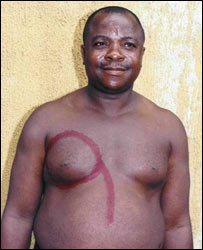
"He then tried to hit me for $18,000 for processing fees for transferring millions," Mike says.
He wrote back as Father Hector, saying that the church had plenty of money, but there was a withdrawal fee of $80.
"I persuaded him to send me the $80, which he did, inside a birthday card, by courier," Mike says.
He and his volunteers give any money they get from these reverse stings to a children's charity in the north of England.
Father Hector of the Church of the Painted Breast then entered a troubling period of religious uncertainty.
"Dear Joe,This is your good friend Hector Barnett. Please do not be alarmed that I am contacting you from a different e-mail address. I will explain what has happened.
I have been troubled recently after the death of a dear friend of mine, Minnie Mowse. She was a very, very dear friend indeed, and her death affected me greatly and started to make me question my faith. I have decided to leave the church and join a travelling circus.
I have already made two very good friends, and tomorrow I will be starting my circus training with them..."
Prince Joe then began receiving e-mails from another "Reverend" of the Church of the Painted Breast worried about the disappearance of Father Hector and $18,000 from church funds.
Joe already knew from Hector's increasingly eccentric e-mails that he had put the money into a business exporting snow to Siberia.
Despite that, Prince Joe still hasn't given up, even though he's $80 down. The e-mail exchange between the probably fake prince and the obviously fake church continues.
At the same time, the scambaiters are running several other such stings.
I asked Mike why these people who are themselves scammers can't spot an obvious scam.
"I think it operates in much the same way as it does with real victims. Greed clouds their judgement. The guy obviously thought he was going to get $18,000 so easily, he was blinded by his own greed.
"Which is what happens to those who fall for the 419 scams; they just see all these millions."
This would all be funny if it wasn't for the millions of dollars being stolen and probably put into drugs or other criminal activities.
Mike and his friends send all their e-mail exchanges to the police in the UK, Nigeria and to the FBI - he says they've had no response. And even warning the victims does no good. Most of them don't want to believe they're being scammed.
The latest e-mail scam concerns lottery winnings you didn't know you had.
If you're tempted, just remember Prince Joe who's still sending e-mails saying he's sticking to his promise and saying the daily prayer: "When all above seems a great test, Get on down with the Holy Red Breast."
"Dear Father,When I said the prayer this morning, something like a fountain went down my system making me to feel strong & happy. I have spent money to process all the necessary documents for the transfer of this fund. What remains now is the registration of your name as the contractor who executed the contract.
Yours, Joe."
419 coalition
Nigeria's economic and financial crimes commission
419eater.com
The Mystery of the Voynich Manuscript
New analysis of a famously cryptic medieval document suggests that it contains nothing but gibberish

By Gordon Rugg
In 1912 Wilfrid Voynich, an American rare-book dealer, made the find of a lifetime in the library of a Jesuit college near Rome: a manuscript some 230 pages long, written in an unusual script and richly illustrated with bizarre images of plants, heavenly spheres and bathing women. Voynich immediately recognized the importance of his new acquisition. Although it superficially resembled the handbook of a medieval alchemist or herbalist, the manuscript appeared to be written entirely in code. Features in the illustrations, such as hairstyles, suggested that the book was produced sometime between 1470 and 1500, and a 17th-century letter accompanying the manuscript stated that it had been purchased by Rudolph II, the Holy Roman Emperor, in 1586. During the 1600s, at least two scholars apparently tried to decipher the manuscript, and then it disappeared for nearly 250 years until Voynich unearthed it.
Voynich asked the leading cryptographers of his day to decode the odd script, which did not match that of any known language. But despite 90 years of effort by some of the world's best code breakers, no one has been able to decipher Voynichese, as the script has become known. The nature and origin of the manuscript remain a mystery. The failure of the code-breaking attempts has raised the suspicion that there may not be any cipher to crack. Voynichese may contain no message at all, and the manuscript may simply be an elaborate hoax.
Critics of this hypothesis have argued that Voynichese is too complex to be nonsense. How could a medieval hoaxer produce 230 pages of script with so many subtle regularities in the structure and distribution of the words? But I have recently discovered that one can replicate many of the remarkable features of Voynichese using a simple coding tool that was available in the 16th century. The text generated by this technique looks much like Voynichese, but it is merely gibberish, with no hidden message. This finding does not prove that the Voynich manuscript is a hoax, but it does bolster the long-held theory that an English adventurer named Edward Kelley may have concocted the document to defraud Rudolph II. (The emperor reportedly paid a sum of 600 ducats--equivalent to about $50,000 today--for the manuscript.)
Perhaps more important, I believe that the methods used in this analysis of the Voynich mystery can be applied to difficult questions in other areas. Tackling this hoary puzzle requires expertise in several fields, including cryptography, linguistics and medieval history. As a researcher into expert reasoning--the study of the processes used to solve complex problems--I saw my work on the Voynich manuscript as an informal test of an approach that could be used to identify new ways of tackling long-standing scientific questions. The key step is determining the strengths and weaknesses of the expertise in the relevant fields.
The first purported decryption of the Voynich manuscript came in 1921. William R. Newbold, a professor of philosophy at the University of Pennsylvania, claimed that each character in the Voynich script contained tiny pen strokes that could be seen only under magnification and that these strokes formed an ancient Greek shorthand. Based on his reading of the code, Newbold declared that the Voynich manuscript had been written by 13th-century philosopher-scientist Roger Bacon and described discoveries such as the invention of the microscope. Within a decade, however, critics debunked Newbold's solution by showing that the alleged microscopic features of the letters were actually natural cracks in the ink.
Newbold's attempt was just the start of a string of failures. In the 1940s amateur code breakers Joseph M. Feely and Leonell C. Strong used substitution ciphers that assigned Roman letters to the characters in Voynichese, but the purported translations made little sense. At the end of World War II the U.S. military cryptographers who cracked the Japanese Imperial Navy's codes passed some spare time tackling ciphertexts--encrypted texts--from antiquity. The team deciphered every one except the Voynich manuscript.
[click image to enlarge]
In 1978 amateur philologist John Stojko claimed that the text was written in Ukrainian with the vowels removed, but his translation--which included sentences such as "Emptiness is that what Baby God's Eye is fighting for"--did not jibe with the manuscript's illustrations nor with Ukrainian history. In 1987 a physician named Leo Levitov asserted that the document had been produced by the Cathars, a heretical sect that flourished in medieval France, and was written in a pidgin composed of words from various languages. Levitov's translation, though, was at odds with the Cathars' well-documented theology.
Furthermore, all these schemes used mechanisms that allowed the same Voynichese word to be translated one way in one part of the manuscript and a different way in another part. For example, one step in Newbold's solution involved the deciphering of anagrams, which is notoriously imprecise: the anagram ADER, for instance, can be interpreted as READ, DARE or DEAR. Most scholars agree that all the attempted decodings of the Voynich manuscript are tainted by an unacceptable degree of ambiguity. Moreover, none of these methods could encode plaintext--that is, a readable message--into a ciphertext with the striking properties of Voynichese.
If the manuscript is not a code, could it be an unidentified language? Even though we cannot decipher the text, we know that it shows an extraordinary amount of regularity. For instance, the most common words often occur two or more times in a row. To represent the words, I will use the European Voynich Alphabet (EVA), a convention for transliterating the characters of Voynichese into Roman letters. An example from folio 78R of the manuscript reads: qokedy qokedy dal qokedy qokedy. This degree of repetition is not found in any known language. Conversely, Voynichese contains very few phrases where two or three different words regularly occur together. These characteristics make it unlikely that Voynichese is a human language--it is simply too different from all other languages.
The third possibility is that the manuscript was a hoax devised for monetary gain or that it is some mad alchemist's meaningless ramblings. The linguistic complexity of the manuscript seems to argue against this theory. In addition to the repetition of words, there are numerous regularities in the internal structure of the words. The common syllable qo, for instance, occurs only at the start of words. The syllable chek may appear at the start of a word, but if it occurs in the same word as qo, then qo always comes before chek. The common syllable dy usually appears at the end of a word and occasionally at the start but never in the middle.
A simple "pick and mix" hoax that combines the syllables at random could not produce a text with so many regularities. Voynichese is also much more complex than anything found in pathological speech caused by brain damage or psychological disorders. Even if a mad alchemist did construct a grammar for an invented language and then spent years writing a script that employed this grammar, the resulting text would not share the various statistical features of the Voynich manuscript. For example, the word lengths of Voynichese form a binomial distribution--that is, the most common words have five or six characters, and the occurrence of words with greater or fewer characters falls off steeply from that peak in a symmetric bell curve. This kind of distribution is extremely unusual in a human language. In almost all human languages, the distribution of word lengths is broader and asymmetric, with a higher occurrence of relatively long words. It is very unlikely that the binomial distribution of Voynichese could have been a deliberate part of a hoax, because this statistical concept was not invented until centuries after the manuscript was written.
In summary, the Voynich manuscript appeared to be either an extremely unusual code, a strange unknown language or a sophisticated hoax, and there was no obvious way to resolve the impasse. It so happened that my colleague Joanne Hyde and I were looking for just such a puzzle a few years ago. We had been developing a method for critically reevaluating the expertise and reasoning used in the investigation of difficult research problems. As a preliminary test, I applied this method to the research on the Voynich manuscript. I started by determining the types of expertise that had previously been applied to the problem.
The assessment that the features of Voynichese are inconsistent with any human language was based on substantial relevant expertise from linguistics. This conclusion appeared sound, so I proceeded to the hoax hypothesis. Most people who have studied the Voynich manuscript agreed that Voynichese was too complex to be a hoax. I found, however, that this assessment was based on opinion rather than firm evidence. There is no body of expertise on how to mimic a long medieval ciphertext, because there are hardly any examples of such texts, let alone hoaxes of this genre.
Several researchers, such as Jorge Stolfi of the University of Campinas in Brazil, had wondered whether the Voynich manuscript was produced using random text-generation tables. These tables have cells that contain characters or syllables; the user selects a sequence of cells--perhaps by throwing dice--and combines them to form a word. This technique could generate some of the regularities within Voynichese words. Under Stolfi's method, the table's first column could contain prefix syllables, such as qo, that occur only at the start of words; the second column could contain midfixes (syllables appearing in the middle of words) such as chek, and the third column could contain suffix syllables such as y. Choosing a syllable from each column in sequence would produce words with the characteristic structure of Voynichese. Some of the cells might be empty, so that one could create words lacking a prefix, midfix or suffix.
Other features of Voynichese, however, are not so easily reproduced. For instance, some characters are individually common but rarely occur next to each other. The characters transcribed as a, e and l are common, as is the combination al, but the combination el is very rare. This effect cannot be produced by randomly mixing characters from a table, so Stolfi and others rejected this approach. The key term here, though, is "randomly." To modern researchers, randomness is an invaluable concept. Yet it is a concept developed long after the manuscript was created. A medieval hoaxer probably would have used a different way of combining syllables that might not have been random in the strict statistical sense. I began to wonder whether some of the features of Voynichese might be side effects of a long-obsolete device.
It looked as if the hoax hypothesis deserved further investigation. My next step was to attempt to produce a hoax document to see what side effects emerged. The first question was, Which techniques to use? The answer depended on the date when the manuscript was produced. Having worked in archaeology, a field in which dating artifacts is an important concern, I was wary of the general consensus among Voynich researchers that the manuscript was created before 1500. It was illustrated in the style of the late 1400s, but this attribute did not conclusively pin down the date of its origin; artistic works are often produced in the style of an earlier period, either innocently or to make the document look older. I therefore searched for a coding technique that was available during the widest possible range of origin dates--between 1470 and 1608.

[click to enlarge]
A promising possibility was the Cardan grille, which was introduced by Italian mathematician Girolamo Cardano in 1550. It consists of a card with slots cut in it. When the grille is laid over an apparently innocuous text produced with another copy of the same card, the slots reveal the words of the hidden message. I realized that a Cardan grille with three slots could be used to select permutations of prefixes, midfixes and suffixes from a table to generate Voynichese-style words.
A typical page of the Voynich manuscript contains about 10 to 40 lines, each consisting of about eight to 12 words. Using the three-syllable model of Voynichese, a single table of 36 columns and 40 rows would contain enough syllables to produce an entire manuscript page with a single grille. The first column would list prefixes, the second midfixes and the third suffixes; the following columns would repeat that pattern. You can align the grille to the upper left corner of the table to create the first word of Voynichese and then move it three columns to the right to make the next word. Or you can move the grille to a column farther to the right or to a lower row. By successively positioning the grille over different parts of the table, you can create hundreds of Voynichese words. And the same table could then be used with a different grille to make the words of the next page.
I drew up three tables by hand, which took two or three hours per table. Each grille took two or three minutes to cut out. (I made about 10.) After that, I could generate text as fast as I could transcribe it. In all, I produced between 1,000 and 2,000 words this way.
I found that this method could easily reproduce most of the features of Voynichese. For example, you can ensure that some characters never occur together by carefully designing the tables and grilles. If successive grille slots are always on different rows, then the syllables in horizontally adjacent cells in the table will never occur together, even though they may be very common individually. The binomial distribution of word lengths can be generated by mixing short, medium-length and long syllables in the table. Another characteristic of Voynichese--that the first words in a line tend to be longer than later ones--can be reproduced simply by putting most of the longer syllables on the left side of the table.
The Cardan grille method therefore appears to be a mechanism by which the Voynich manuscript could have been created. My reconstructions suggest that one person could have produced the manuscript, including the illustrations, in just three or four months. But a crucial question remains: Does the manuscript contain only meaningless gibberish or a coded message?
I found two ways to employ the grilles and tables to encode and decode plaintext. The first was a substitution cipher that converted plaintext characters to midfix syllables that are then embedded within meaningless prefixes and suffixes using the method described above. The second encoding technique assigned a number to each plaintext character and then used these numbers to specify the placement of the Cardan grille on the table. Both techniques, however, produce scripts with much less repetition of words than Voynichese. This finding indicates that if the Cardan grille was indeed used to make the Voynich manuscript, the author was probably creating cleverly designed nonsense rather than a ciphertext. I found no evidence that the manuscript contains a coded message.
This absence of evidence does not prove that the manuscript was a hoax, but my work shows that the construction of a hoax as complex as the Voynich manuscript was indeed feasible. This explanation dovetails with several intriguing historical facts: Elizabethan scholar John Dee and his disreputable associate Edward Kelley visited the court of Rudolf II during the 1580s. Kelley was a notorious forger, mystic and alchemist who was familiar with Cardan grilles. Some experts on the Voynich manuscript have long suspected that Kelley was the author.
My undergraduate student Laura Aylward is currently investigating whether more complex statistical features of the manuscript can be reproduced using the Cardan grille technique. Answering this question will require producing large amounts of text using different table and grille layouts, so we are writing software to automate the method.
This study yielded valuable insights into the process of reexamining difficult problems to determine whether any possible solutions have been overlooked. A good example of such a problem is the question of what causes Alzheimer's disease. We plan to examine whether our approach could be used to reevaluate previous research into this brain disorder. Our questions will include: Have the investigators neglected any field of relevant expertise? Have the key assumptions been tested sufficiently? And are there subtle misunderstandings between the different disciplines that are involved in this work? If we can use this process to help Alzheimer's researchers find promising new directions, then a medieval manuscript that looks like an alchemist's handbook may actually prove to be a boon to modern medicine.
GORDON RUGG became interested in the Voynich manuscript about four years ago. At first he viewed it as merely an intriguing puzzle, but later he saw it as a test case for reexamining complex problems. He earned his Ph.D. in psychology at the University of Reading in 1987. Now a senior lecturer in the School of Computing and Mathematics at Keele University in England, Rugg is editor in chief of Expert Systems: The International Journal of Knowledge Engineering and Neural Networks. His research interests include the nature of expertise and the modeling of information, knowledge and beliefs.
Odor Eliminating Light Bulbs
There's an interesting review at The Gadgeteer about odor-eater lightbulbs.
July 12, 2004
Reagan son to address Democrats
Ron Reagan, son of the late Republican president, is to address the Democratic Party National Convention which begins on 26 July in Boston.
Mr Reagan said he would speak about the role of stem cell research in finding cures for diseases like Alzheimer's.
Ronald Reagan died on 5 June a decade after announcing he had the disease.
The Bush administration has limited public funding of this type of research because of ethical reservations about using stem cells from human embryos.
The use of embryonic stem cells is controversial because a living human embryo is destroyed in order for the cells to be extracted.
But Mr Reagan, 46, told the Philadelphia Inquirer newspaper that the Democratic Convention would give him an important platform to educate people about the issue.
"The conservative right has a rather simplistic way of characterising it as baby killing. We're not talking about fingers and toes and brains. This is a mass of a couple hundred undifferentiated cells," he said.
In May this year, Mr Reagan's mother Nancy, the former first lady, publicly urged President George W Bush to reverse his stem cell policy.
The president has cut federal funding for such research, citing ethical concerns about performing experiments with fertilised human embryos.
The Democratic Party platform calls for lifting restrictions on such research.
Mr Reagan, an outspoken critic of the Bush administration, said he would not campaign for the Democratic presidential candidate, John Kerry, but that he would vote for him "as a way to defeat Bush."
He told the Philadelphia Inquirer he expected criticism from many Republicans for his speech to the Democrats but said he was not a Republican and never had been.
"My father wouldn't expect me to be a Republican just to emulate him."
Odor May Be Clue to Missing Airport Fish
something fishy's going on...
ANCHORAGE, Alaska (AP) - A strong odor led airline officials to what they believe is the 40 pounds of halibut a traveler reported missing from his checked bags two weeks ago.
Brenee Davis, a general manager for Continental Airlines in Anchorage, said the company's baggage handlers discovered "a ton of rotting fish" under a luggage conveyor belt recently at Ted Stevens Anchorage International Airport.
There's no way to be certain, but she suspects it was the halibut that Ray Bolanos reported missing from a fish cooler he checked on a flight June 24 from Anchorage to Seattle. The fish smelled terrible and was thrown away immediately.
"We've gone through a few cans of Lysol," Davis said.
She said there is a new baggage belt system in the room, which has been in use for only a few weeks. Her theory is that Bolanos' cooler wasn't properly secured and came open on the conveyor belt.
Bolanos is not sure he buys that explanation.
When his fish cooler came off the luggage carousel in Seattle, he said he found a rope he had tied around the chest inside and his 40 individually wrapped one-pound chunks of halibut gone.
Reached on his cell phone Saturday in Kenmore, Wash., Bolanos told the Anchorage Daily News he had already heard from a Continental official about the rotten fish.
"She was trying to say that maybe the new conveyor chewed off my rope," Bolanos said. "It's not something that was chewed off. It was a clear cut."
He said he made arrangements to send the rope to the woman so she could investigate further.
He also passed along the name of another passenger who flew round trip to Anchorage from Seattle on Continental around the same time he did.
That woman, Marian Maxwell, said about 20 pounds of halibut, a box of .38-caliber bullets and some fishing tackle vanished from her checked bags.
Maxwell also believes her bags were pilfered. She said her two fish boxes came out last on the carousel, with their lids open and the nylon cords that had been tied around them sitting on top.
Officials at Continental's headquarters in Houston, Texas, could not be reached for comment over the weekend because their office was closed.
In Anchorage, Continental shares a baggage room with Frontier Flying Service, and Davis said usually five to 10 handlers are working in the area at a time.
Davis said when the smell first arose in the days after Bolanos' flight employees thought it was related to construction at the airport. Then it got worse.
"We started to get this huge smell like sewer," she said. "There was mass migration down there to figure out what the smell was."
Davis wasn't sure how many pieces of fish had been found.
"We're still finding it," she said. "We've got a long bag belt system."
Several airport officials confirmed that rotten fish had been found, though none were directly involved in the discovery.
Chinese author moves into texts
A Chinese author is writing a novel aimed to be transmitted in text message-size chunks.
Qian Fuchang has reduced his novel Outside the Fortress Besieged into 60 chapters of 70 characters each, Chinese state news agency Xinhua reported.
Described as a "steamy tale of illicit love among already married people", the novel will be available exclusively to mobile phone users.
China's expanding mobile phone market already has 300 million.
Xie Wangxin, vice chairman of the Guangdong Literary Academy in southern China, told Xinhua that the mobile phone novel was no gimmick and would be "a real literary work".
Last year, Chinese people sent more than 220bn text messages, more than half of all messages sent in the world, according to the Xinhua news agency.
July 08, 2004
Hi-tech rays to aid terror fight
A new way of identifying metal and explosives could provide a valuable tool in the fight against terrorism.
Airport security has become big business following the terrorist attacks in the US.
A system that detects both metal and non-metallic weapons using terahertz light has been developed by technology firm TeraView.
It could make passenger screening at airports more effective and quicker, say experts.
Dr Ruth Woodward, an independent scientific adviser for terahertz consultancy firm HT Consultants, said the technology could provide one of the most innovative ways of dealing with security threats.
"It presents a positive step forward, although the economic benefits are yet to be determined," she told BBC News Online.

Terahertz light sits between microwave and infrared on the electro-magnetic spectrum.
It has a number of properties that can be harnessed to screen passengers.
Unlike X-ray, it is perfectly safe to use on people. It can pass through clothing, paper and plastics to detect metal, ceramic or plastic weapons.
And it can identify explosives by reading their characteristic spectral 'fingerprints'.
TeraView is a firm looking at ways of exploiting terahertz light.
It is developing a handheld security wand that could be used by airport security guards to pass over the body of passengers.
It is expected that the product will be available for commercial use within two years, following a trial at an as yet unspecified airport.
The firm is partnering with detection equipment firm Smiths Detection on the project.
The terahertz 'wand' will be attached to a box which will bleep when suspicious objects are found.
Eventually the firm also hopes to make a walk-through portal that uses the same techniques as the wand to scan passengers.
"The big challenge for airports is to keep the passengers happy and provide a high level of security," said Dr Mike Kemp, the vice-president of TeraView.
"What we are trying to do with terahertz light is create something that is more automatic and reduces the dependence on the sharp-eyed operator," he said.
The technology is not likely to replace current methods of scanning, rather will sit alongside them, he explained.
And there is no substitute for old-fashioned human alertness.
"Any technology, whether it is new or old, is only there to complement commonsense," said Dr Woodward.
Following the September 11 attacks, airport security has taken on a new-found urgency.
"Many companies are looking at new technologies that can offer substantially increased security," said Chris Yates, aviation security editor at Jane's Transport.
A system that blows air at passengers to detect explosives is under trial at Terminal One of Manchester airport.
And several US airports are testing technology that can virtually undress passengers to detect any suspicious items.
This has caused uproar from civil liberty organisations in the US and led to some modification to allow passengers a degree of modesty.
"Basically the most sensitive areas of the body have been blocked out," said Mr Yates.
Terahertz light is the last unexplored frontier of the radio wave and light spectrum. and can be also be utilised in a variety of ways such as medical imaging.
Video diary from beyond the grave
A US inventor has come up with a hi-tech way of allowing the deceased to talk from beyond the grave - by fixing video screens to their tombstones.
Robert Barrows says people could leave video messages before they died, to be played to friends, loved ones or the just plain curious from the grave side.
He told the BBC that messages could include telling life stories or having the final say on a disagreement.
It could also be a money-making enterprise for cemeteries, he added.
Mr Barrows, of Burlingame, California, has filed a patent application for his design of a tombstone that can accommodate video equipment operated by a remote control.
"You can go from grave to grave and click on anything that person wanted to say before they died," he told BBC Radio 4's Today programme.
Messages could include telling your side of the story, making amends or saying "sweet things to loved ones", he added.
Mr Barrows said it would be a far more "dramatic" way of communicating from beyond the grave, than leaving a videotaped message to be played at home.
"There's no business like showbusiness," he told Today. "Imagine how interesting it would to go to tombstones where you didn't know the person, or historical tombstones to find out what someone had to say..."
He said computer equipment could also be installed in the tombstone that connected up to the internet, enabling people to programme their messages to be delivered long after they have died.
The tombstone could be coin-operated or swiped with a credit card. "Cemeteries could basically one day charge fees to rent the headsets you need to listen to [the messages]," he added.
Dementia has dictated our history
[I'm always highly suspicious of 20/20 hindsight second-guessing, and I think the researchers in this study are sensationalizing their results, in part by invoking the lay concept of 'dementia' rather than being more specific in their clinical descriptions. The article omits critical pieces of information, such as the fact that Woodrow Wilson's "dementia" was likely a side effect of a physical ailment, rather than a psychological deterioration per se (PBS just did a really interesting episode of 'American Experience' on him last week). And, their determination that Stalin was probably demented, prompts an immediate "Ya THINK?!?" response. But it's still a moderately interesting read. - K]
The course of history might have been very different if some of the world's past leaders and dictators had seen a psychiatrists, according to doctors.
Consultant psychiatrist Dr George El-Nimr said World War II might not have happened if past US president Woodrow Wilson had bowed down to his dementia.
Stalin and Franklin D Roosevelt most probably had dementia too, he said.
Dr El-Nimr and colleagues spoke at the Royal College of Psychiatrists' annual conference in Harrogate.
Dr El-Nimr, from Haywood Hospital in Stoke-on-Trent, and his colleagues Dr Baseem Habeeb, at Mersey NHS Trust, and Dr Emad Sulib, senior lecturer in psychiatry at Liverpool University, looked at the possible impact dementia may have had on seven world leaders.
Millions of Russians might have been saved from death if the dictator Stalin had seen a psychiatrist, they believe.
They told doctors attending the conference that Stalin's behaviour could easily be explained by dementia following a series of strokes.
"This might be an explanation for the florid paranoia, dimming of superior intellect and the unleashing of his most sadistic personality traits," said Dr El-Nimr.
He said Franklin D Roosevelt's dementia might have impaired negotiations with Stalin at Yalta at the end of World War II in 1945.
World War II might never have happened if the US president around the time of the end of World War I, Woodrow Wilson, had stepped down after developing dementia, the researchers suggest.
It might then have been possible to persuade Congress to ratify the Versailles Treaty, which, in turn, would have led to the US embracing the League of Nations and possibly have averted the war, they said.
Dr El-Nimr said the British Prime Minister Harold Wilson as an example of the best case scenario.
The shock resignation of Harold Wilson in 1976 was down to his "remarkable awareness" a year earlier of his cognitive deterioration, said Dr El-Nimr.
According to the researchers, other leaders who developed dementia include Urho Kekkonen of Finland and British Prime Minister Ramsay MacDonald.
"It was obvious that some had what we call dementia," said Dr El-Nirm.
"It's not only to do with memory, it is to do with things like decision making, prioritising and sense of direction as well.
"If these have been affected this can obviously effect people's decisions, even in the early stages of dementia," he said.
He said people with high intellectual function before they get dementia might function well for longer and people might not notice, but their condition would still affect their performance at work.
"Early detection and treatment of this could have benefited the future of those countries and even the world," he said.
Pooh auction items fetch £9,300
A family photo album including a picture of Pooh author AA Milne's son Christopher Robin fetched £3,500 at auction on Thursday.
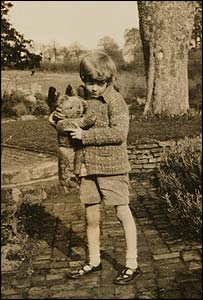
Christopher Robin inspired the Pooh stories
The photos, including one of Christopher aged six clutching Winnie the Pooh, went for more than three times their expected value.
Ink sketches by Pooh illustrator EH Shephard featuring the bear and his friends fetched £5,800.
The items went on sale at Dukes Auction House in Dorchester, Dorset.
The photograph album contained a number of images of the Milne family at Cotchford farm near Hartfield, East Sussex, and a photo of actor Leslie Howard in his younger years.
The sketches, entitled Pooh lowers the Sail, show Pooh, Eeyore, Piglet and friends in a sailing ship pulled by a horse landing at what looks like Toyland.
Gary Batt, partner at Dukes Auction House, said the two lots were sold to separate bidders, both based in England.
One was bought in the sale room by a dealer acting for a private collector; the other went by telephone to a London-based dealer.
First Antarctica painting on show
The first painting of Antarctica, which has been hidden under another painting for the last 200 years, is going on public view in London.
The painting was the work of artist William Hodges, who joined Captain Cook's second epic voyage in 1772.
The oil painting, later painted over with a view of a New Zealand harbour, is one of 80 Hodges' paintings on show at the National Maritime Museum.
An X-ray of the painting is being shown to prevent damage to the artwork.
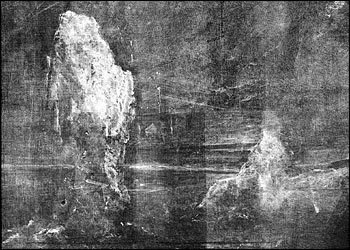
"He was undoubtedly the most unjustly neglected British painter of the 18th Century," said naturalist Sir David Attenborough, launching the exhibition on Monday. It is on public view from Tuesday.
Hodges' painting, which shows the icebergs in the water, is the first eye-witness view of the southern continent ever captured.
Hodges' work has not been on public show since 1795. The artist, who was the son of a London blacksmith, was 28 when he joined Cook's exhibition to Antarctica.
"These pictures are absolutely lyrical. They show the southern ocean paradise as it was, almost untouched by outside influence," Sir David said.
"This is the real thing, not someone's overactive imagination."
Like the icebergs, the landscape of New Zealand's Pickersgill Harbour was painted on the voyage, not from memory. Canvases were often re-used on long voyages.
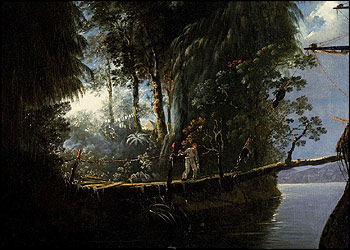
Hodges' work fell into obscurity after his suicide in 1795, when he lost all his money in a bank crash.
Hodges was married three times, with his last wife dying soon after his own death, leaving behind five destitute children.
Tiger From a Jar?
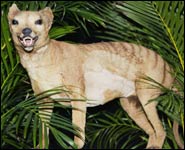
Could Cloning Bring Back Tasmanian Tiger and Other Species?
By Lee Dye
July 8, 2004 ? A mysterious predator in a far-off corner of the world, hunted to extinction decades ago, has emerged as the central character in what is likely to be a prolonged and bitter scientific debate.
The Tasmanian Tiger, which wasn't really a tiger, is being asked to answer questions of staggering implications. Is it possible to bring extinct species back to life through cloning? And if we can, should we?
This is not an academic exercise. The prestigious Australian Museum, under the directorship of Mike Archer, has vowed to do just that, using DNA from animals that have been dead for more than a century. Some say it can't be done. Archer himself says he isn't sure, claiming that success would be the "biological equivalent of the first walk on the moon."
The effort has taken on almost religious overtones, modern humans seeking a way to atone for the sins of their forefathers. Or as Archer puts it, it's a chance to "redress our immoral actions when we willfully and wrongly exterminated this animal."
Cloning the tiger would require so many scientific breakthroughs that success would be a "technological miracle," Archer maintains, and others agree.
"It would be a miraculous birth, a clone from aged DNA," writes David Owen, author of Tasmanian Tiger, The Tragic Tale of How the World Lost its Most Mysterious Predator, recently released by The Johns Hopkins University Press. Owen, a Tasmanian novelist, has chronicled the plight of the tiger from the years when it roamed across much of Australia and the southern island state of Tasmania to the present. It has reached a mythical status with sightings still being reported despite convincing evidence that the beast no longer survives.
But as Owen meticulously points out, all the hoopla over the possibly of cloning an extinct animal may just make it easier for us to ignore the desperate need to protect the habitat of endangered species that are barely hanging on.
The lead character in this ongoing drama is a strange beast indeed. The Tasmanian Tiger is actually a marsupial, with a pouch to carry its young. It has also been called a wolf, a dog and a hyena, but its lineage is clearly revealed in its kangaroo-like hind quarters, and the shape of its ears and muzzle, as well as the pouch. It is about the size of a Dalmatian.
It is officially named "thylacine," and it is the largest carnivorous marsupial known in modern times. But most references still call it a tiger.
Its end began thousands of years ago when humans introduced dogs to Australia. Wild dogs competed with the tigers for food, and the tigers gradually disappeared from mainland Australia. They thrived in the rugged terrain of Tasmania for centuries, but in the 1800s they found themselves accused of killing sheep, an economic crime that the people of that era could not tolerate.
There's precious little evidence to support that, Owen argues. It's far more likely that sheep were killed by wild dogs, not tigers that avoided human contact. But by then the animal's reputation was established as a vicious killer with a vampire's taste for blood and internal organs. It was a thrill killer, according to the legends of the day, sometimes wiping out entire flocks of sheep just to watch them die.
In 1886 the Tasmanian government passed a law that mandated the destruction of the species, and bounties for dead tigers led to feverish hunting expeditions over the next 50 years. The only known surviving tigers ended up in zoos, despite a gradual awakening to the fact that the tiger was not a demon and should be protected.
In 1936 legislation was passed by the parliament declaring the tiger to be wholly protected, but it was too late. Two months later, the last known survivor died in a Tasmanian zoo.
Myths about the tiger continued to grow, with frequent reports of sightings in the wild, but little evidence to support them. Owen has documented eight official expeditions between 1957 and 1966 in search of remaining tigers.
"What they had in common was justified optimism at the outset and negative results at the end," he writes.
So does the tiger still thrive somewhere in the dense forests of Tasmania, as so many residents claim? The museum's Archer describes himself as "sadly unconvinced. Without a single hair, dropping or any tangible evidence, I have to remain skeptical."
Extinct species have long fascinated Archer, and his courting of the tiger began about 15 years ago when he discovered a pickled tiger pup in the museum. It had been preserved since 1866 in a jar of alcohol rather than the more commonly used formalin, which would have destroyed the DNA.
That was long before Dolly ruled the headlines but even then Archer began thinking about bringing the tiger back.
But its one thing to clone a living species, with an abundance of specimens from which DNA can be extracted, and it's quite another to create a clone from ancient DNA. In all, museum researchers have extracted DNA from three different preserved tigers, but that still leaves enormous gaps in the animal's genome.
The last step in this long and tortured scientific journey will be to put a complete set of the tiger's chromosomes in a living cell, and implant that cell in another animal, probably the closely related Tasmanian devil, which would serve as a surrogate mother.
But in the end, even if it all works, that may not be enough. Owen notes that no tigers reproduced while in captivity, and any cloned animals would likely be quite different from those that once roamed across Tasmania.
The museum has targeted the year 2010 for completion of the project. Even if it fails, Archer maintains, it should lead to numerous scientific breakthroughs, possibly paving the way for cloning extinct animals sometime in the future.
The nightmare in that dream, of course, is that the prospect for cloning might lead to a relaxation of the effort to protect species that are still living.
Uncounted thousands of species have perished at human hands. Bringing the tiger back would be thrilling, but it won't lift that burden. Protecting what we have left must remain our first priority.
Suffering in Silence
People Who Sweat Excessively Are Often Too Embarrassed to Seek Help
Wendy Burke lives with an embarrassing secret that has made her terrified of first dates, job interviews and parties.
Burke, a 30-year-old schoolteacher, has spent every waking moment of her life in fear that she will break out into an uncontrollable sweat. Her attacks come on quickly and often, sometimes for days at a time.
"Ever since I was in elementary school, I'd say probably second grade, I remember being in class and my hands just sweating as I worked, having my hand on a paper, and the paper being saturated from my hands sweating so much. So, I mean it's really been something I've lived with almost all my life," Burke said on ABC News' Good Morning America.
For years, her condition was a mystery ? both to her and her doctors.
"I said, 'Wow, my hands are really sweaty, my feet are really sweaty, is there a name for this condition?' And the doctor laughed me off," Burke said. They said, 'Oh, you're just clammy.' Everybody blew me off."
Finally, while being treated for an unrelated condition, she found a doctor who didn't dismiss her complaints.
"It wasn't until recently, when I had foot surgery, that my podiatrist said, 'You have a condition called hyperhidrosis,' " she said. "And I was just so relieved that there's an actual name behind the condition."
She says she finds solace in the fact that she is not alone.
Dr. David Pariser, president of the International Hyperhidrosis Society, says most people with hyperhidrosis don't seek help because they're humiliated.
"It's quite socially embarrassing and it's a true physical disease," Pariser said. "About 3 percent of Americans are thought to have excessive sweating, and many of these people suffer in silence. They don't even know that it's a disorder. They don't even know that there's help for this."
No one knows what causes people with hyperhidrosis to sweat so much, but Pariser says the condition leaves his patients socially crippled.
"I had a young woman one time who had excessive sweating of her hands who dropped her baby once because her hands were so sweaty," he said. "I had a teenage patient who had to wrap her pencil in school with a paper towel so she could hold it because her hands were so sweaty.
"I constantly hear about patients who are having to change their shirt three to four times a day, who stuff diapers in the sleeves of their shirt under their arms to absorb the moisture, who only buy black clothes and wear multiple layers, who never wear tank tops in the summer because they're afraid of the embarrassment of the sweating."
Today, doctors can offer a wide range of treatments to their suffering patients.
Patients can undergo therapy that involves sending electrical pulses through their sweat glands.
Or, they can turn to Botox, as Burke has. Botox, a neuromuscular blocking agent that has become a popular alternative to plastic surgery, is the latest experimental therapy for hyperhidrosis. It's supposed to paralyze particularly overactive sweat glands.
As a last resort, some desperate patients turn to a controversial surgery in which doctors literally snip the nerves that cause the sweat glands to overact.
Burke says she hopes she'll finally find relief for the medical problem that has plagued her for as long as she can remember.
"I am hoping for a slight miracle, I guess," she said. "I've sweated all my life. I'm just hoping for something better than I have now. Anything could be better than what I have now."
You can find out more about hyperhidrosis at www.sweathelp.org.
July 07, 2004
Canada guide dog in language row
A blind francophone student in Canada has been barred from English immersion classes - because his guide dog only responds to commands in French.
Yvan Tessier, 39, from Quebec says it would be too confusing to retrain his black Labrador, Pavot, to respond to "stay" instead of "reste".
But the University of New Brunswick insists English must be the only language spoken in its lessons.
Canada is officially bilingual but this status can provoke tensions.
Mr Tessier says he is entirely dependent on his dog and is worried that trying to teach him English commands could be confusing and even dangerous.
"My dog is my eyes, my autonomy, and my independence," he told the Globe and Mail newspaper.
"He represents everything to me. I knew that I'd have to speak English to people. But I thought I could speak French to my guide dog."
Mr Tessier says he is considering bringing a claim for discrimination against the university in the anglophone province neighbouring Quebec.
Language minefield
But the university says the success of its intensive language course depends on everything being conducted in English.
And they say there have been other cases of students attending the classes with their guide dogs.
"In the past, with advance preparation, the guide dog has been trained in a few English commands to make sure the person is safe and mobile," spokeswoman Susan Mesheau told the Toronto Star newspaper.
Commentators say Pavot's ability to understand just one language throws the spotlight on the minefield of Canada's linguistic legislation which aims to guarantee the status of both English and French.
The issue of language is also intricately tied to the perpetually thorny issue of separation of the French-speaking province of Quebec from Canada.
Australia on angry kangaroo alert
Residents in Australia's capital city have been warned to beware starving kangaroos after a spate of attacks.
The desperate marsupials have been attacking people and other animals as drought conditions drive them to seek food in the Canberra suburbs.
Wildlife authorities said the normally harmless, grass-eating animals were grazing on fields or golf courses.
Officials said a woman and her dog had recently been attacked, and two dogs hurt in a separate incident.
Government wildlife ecologist Murray Evans told The Associated Press: "Kangaroos don't come bounding out of the bush looking for people to attack.
"It's usually kangaroos minding their own business and people thinking they're cute and cuddly and getting too close."
But in a recent letter to the Canberra Times, dog owner Christine Canham said her pet had been drowned by a kangaroo in a city park.
The dogs had been swimming when a large kangaroo appeared on the bank and entered the water, she said.
The kangaroo "held her under the water with its back legs and drowned her as we watched helpless," Ms Canham wrote.
Kangaroos can weigh up to 80 kilograms (176 pounds) and grow as tall as an average man.
Experts say they rarely attack humans, but because of the shortage of food could be more likely to stand their ground if confronted.
Censors refuse to ban film depicting real sex
See it before it is banned!
That provocative advertising slogan helped the controversial French film Anatomy of Hell take close to $50,000 in cinemas over the past week.
But when the appeal against the R18+ rating was heard yesterday, the Classification Review Board went against the script.
It decided last night to retain the rating, rejecting appeals by the Australian Family Association and the South Australian Attorney-General, and merely toughened the consumer advice for the release. It now says Anatomy of Hell includes "actual sex, high-level sex scenes and high-level themes".
The 3-1 decision was a victory for common sense, considering director Catherine Breillet's drama has been treated by many critics as a serious statement on female sexuality.
Starring the Italian porn star Rocco Siffredi and Amira Casar, it centres on a woman who pays a gay man to study her body.
The distributor, Mark Spratt, of Potential Films, was relieved: "I'm pleased that they have recognised both the merits of the film and the right of the public to judge for themselves." Mr Spratt said the box office takings had been inflated by the possible ban.
The provocative advertising for the film has attracted some criticism within the cinema business.
"The distributor of that film specialises in taking films that are likely to be banned essentially as a marketing ploy," said one cinema operator, citing controversies over Baise Moi and Romance as previous examples. "The interest generated is often men in raincoats."
Miracle cow
Thousands of ill Cambodians are flocking to the village of Phum Trapeang Chum to be licked by a mystical cow named Preah, who is curing their complaints, its owner has claimed.
Farmer Puch Pich said up to 400 people have been turning up daily for the past fortnight to be slobbered over, after the 13-month-old white animal apparently cured his wife Kong Mich of a chronic illness.
They have been braving Cambodia's notoriously bad rainy season roads to travel from around the kingdom, paying 500 riel (18 Australian cents) a person for four licks on the limb or body part of their choice.
"The cow won't lick people who don't put in their money ... and if he doesn't think you believe in his powers, she won't lick you either," Puch Pich said.
Ros Sath, 68, told AFP that before he underwent the unconventional treatment he could barely walk a few metres due to a stiff leg.
"After the cow licked me four times I felt comfortable again and now I can walk 300 or 400 metres without getting exhausted," he said.
The curative powers of Preah - which means God in Khmer - were revealed when Kong Mich took the animal out to graze, said Puch Pich, who has owned the cow for five months.
"The cow was always wanting to lick my wife's arms and legs and, two months after she started, she completely recovered from an illness we'd spent a lot of money trying to fix," he said amid the mayhem at his farm, about 90 kilometres north of Phnom Penh in Kampong Chhnang province.
The couple's theory was first tested on a 72-year-old visually impaired woman from the village, whom Puch Pich claimed regained her sight after four licks.
"Then the news really spread," he told AFP.
Some of the hundreds are bringing water for "take away" licks, while others are taking grass the cow has touched while eating, hoping to boil up some of its magic.
Puch Pich attributes the cow's powers to its birthplace at nearby commune Banteay Rongvek, which Cambodians believe was also the site of a mystical cow that was stolen by Cambodia's historical rival Thailand in ancient times.
Cambodians are highly superstitious, particularly in the countryside where people continue to meld animist practices with Buddhism.
July 06, 2004
Computerising the body: Microsoft wins patent to exploit network potential of skin
Call it the ultimate wireless network. From the ends of your fingers to the tips of your toes, the human body is a moving, throbbing collection of tubes and tunnels, filled with salty water and all capable of transmitting the lifeblood of the 21st century: information.
In what may seem a move too far to some, the computer software giant Microsoft has been granted exclusive rights to this ability of the body to act as a computer network. Two weeks ago the company was awarded US Patent 6,754,472, which bears the title: Method and apparatus for transmitting power and data using the human body.
Microsoft envisages using the human skin's conductive properties to link a host of electronic devices around the body, from pagers and personal data assistants (PDA) to mobile phones and microphones, although the company is uncharacteristically coy about exactly what it may have in mind.
In a statement it said: "Microsoft hasn't recently held discussions about this patent, and it does not currently map to any particular Microsoft product that is either shipping or in development. That said, one of the objectives of the intellectual property licensing policy Microsoft adopted in December 2003 is to provide other parties with access to the fruits of Microsoft's nearly $7bn annual investment in R&D - especially to innovations that do not end up manifesting as Microsoft products."
According to the patent, the technology could usher in a new class of portable and wearable electronic gizmos such as earrings that deliver sounds sent from a phone worn on the belt, and special spectacles with screens that flash up accompanying images and video footage.
Linking electronic devices raises other possibilities. Gadget lovers could use a single keypad to operate their phone, PDA and MP3 music player, or combine the output of their watch, pager and radio into a single speaker. At its most far-reaching, the technology could combine with chips and sensors fitted around our bodies and clothes to sense and react to the changing circumstances of our everyday lives.
Chris Baber, an expert in wearable computers at the University of Birmingham, said: "You could tailor your technology in the same way that you tailor your clothes. Because you put different clothes on for different occasions, if you didn't want to be contacted by work people while you're socialising then your casual jacket could tell your phone not to accept business calls. Equally you might not want your phone to give you text alerts about football while you're in an important business meeting."
The technology also raises the prospect of an array of sensors fitted around the body to monitor health. Earrings could read pulse rate and a bracelet monitor the composition of your sweat. Together with other medical information this would be sent via the skin to a central chip and, when you shook hands with your doctor, be instantly transmitted through your hand to theirs, and then onto their computer to update your records before you even sat down. According to the patent, a num ber of different devices could be powered from a single power source strapped to the skin. And, already dominant in the world of computers, Microsoft has now set its sights on the animal kingdom. "It will be apparent that the body may be that of a wide variety of living animals," the patent says.
Different technologies can already link various electronic devices to form a so-called personal area network (PAN), but Microsoft says sending signals through the skin avoids problems that plague existing techniques. Unlike radio signal networks such as Bluetooth, common on laptops, there should be no interference from other sources, and it should be more secure because nobody can eavesdrop.
The patent says the body could generate the power needed to run its various attached devices in a similar way to self-winding watches.
Most futuristically, it proposes that an area of skin could even act as a keypad: "The physical resistance offered by the human body can be used in implement ing a keypad or other input device. By varying the distance on the skin between the contacts corresponding to different keys, different signal values can be generated representing different inputs." In other words, you could type by tapping on your forearm.
Many experts in the field were surprised that Microsoft has been granted the patent, as IBM has already demonstrated that data can be transmitted through the human body, as well as between individuals. In 1996, the company unveiled a prototype PAN at the Comdex trade show that allowed two people to exchange busi ness card details to each other electronically with a handshake. A spokesman for IBM confirmed the company had filed several patents in the area, but said its research has since moved on.
Some civil liberties groups have expressed concern over Microsoft's move. "Body parts, in this case skin, should not be in any way patentable," said Jim Thomas of the ETC group, which monitors developments in technology. "There are big questions here about whether individuals will be able to refuse this technology if it is used in, for example, tracking devices."
Eau d'Mac
Just a quickie, here, folks, because this is far too weird to say much about, but there's no way we can let it pass without comment. The background info's going to seem so far off-topic it's six dimensions over and four parallel universes down, but bear with us, because it really is going somewhere, we promise. Have we ever led you astray? Other than that time we mistakenly assured you that all of Apple's motherboards are dishwasher-safe, we mean. That was just a typo.
Okay, here goes: faithful viewer mrmgraphics forwarded us an Associated Press article about a New Jersey company named International Flavors & Fragrances, which has apparently found a way to reproduce the smells of living flowers. This is significant because most floral perfumes are made from "extracts, essential oils, or ground petals," all of which are drawn from dead plants and therefore smell, logically enough, rather different than the real live flower in bloom. Indeed, the same flower may smell different at different times; "Each flower has a biorhythm, a life cycle. A perfumer may or may not want the 'peak' scent. There are many different accords from the same single flower."
(At least, that's what IFF says; to us and our tin noses, a rose is a rose is a rose. In a blind smell test, we're not entirely sure we could distinguish between an actual blooming rose and a scratch 'n' sniff sticker.)
Anyway, so here's how IFF works its magic: it has a special glass-globe-'n'-retractable-needle rig and the needle is positioned in the flower's "headspace," as close as possible to the flower itself. The needle collects the odor molecules given off by the live flower for half an hour, a computer crunches the data, and IFF gets a "fragrance profile" that enables them to produce "nature-identical molecules" synthetically which duplicate the exact scent as captured. Kinda like duping music from CDs, actually. Or not. Whatever. The upshot is that they can sample a smell and then reproduce it exactly in the lab.
And this is where we finally get to the point: any smell. When it wasn't sticking a needle in front of a night-blooming orchid, "IFF produced Gigabyte, a perfume based on the smell of computers as a special project for Visionaire magazine. Instead of the needle collecting a flower's molecules, it captured the headspace in the Apple computer store in Manhattan's SoHo neighborhood."
Yes, ladies, you heard correctly: there's a perfume out there somewhere that can make you smell like a Mac sitting in a flagship Apple retail store. Just imagine the hordes of rampaging Mac geeks chasing you everywhere you go! What could possibly be better?
July 05, 2004
Wildfire threatens powerful telescope; Blaze moves closer to homes
Two wildfires burning in the southeast part of the state moved closer to cabins and continued to threaten an observatory that houses the $120 million Large Binocular Telescope -- one of the world's most powerful optical instruments.

Smoke and flames draw near to the Large Binocular Telescope atop Mt. Graham on Saturday.
One of the fires on mountainous terrain grew to 6,179 acres Sunday and had burned to within less than a mile southeast of the $200 million-plus Mount Graham International Observatory.
"It's threatened, but I think it's defendable," said Duane Archuleta, an operations chief for the fire management team. "It's going to take some work of course."
That lightning-started wildfire and a nearby 6,130-acre blaze prompted the evacuation of the observatory and 85 cabins on the mountain Friday. The observatory has a 200-foot defensible space designed to help crews protect the property.
By Sunday, the flames were about three miles away from the communities of Turkey Flat and Columbine and state officials issued a health advisory warning residents of nearby towns about the smoke. No structures were threatened, said Jennifer Plyler, a fire spokeswoman.
No structures were immediately threatened, said Jennifer Plyler, a fire spokeswoman.
"They have some time," she said. "It's not bumping up against structures like the observatory."
About 1,000 firefighters aided by 10 helicopters, 12 bulldozers and two C-130 military air tankers were fighting the fire. No serious injuries were reported but one firefighter was hospitalized for treatment of heat exhaustion.
The fires were a few miles apart and were expected to join in the next couple of days, said Paul Summerfelt, a deputy incident commander.
Plyler said fire management teams hoped to have the fires fully contained by July 27, and were aiming at keeping them from growing beyond a combined 50,000 acres.
Elsewhere in Arizona, the threat posed to the city of Payson by a 79,500-acre wildfire was lessened after crews strengthened protection lines near the forest community, officials said Sunday. The fire, which started June 24, was 10 percent contained.
A firebreak on the Willow fire's northeastern flank was built about two miles from Payson, a city of about 14,000 people some 70 miles northeast of Phoenix.
"We feel confident it will hold," U.S. Forest Service spokesman Jim Payne said.
In Alaska, an evacuation order remained in effect Sunday for 277 homes and businesses still threatened by a blaze near Fairbanks that has spread over 306,000 acres, up from 280,000 the day before.
Most people displaced by the fire were urged to stay away Sunday, though state troopers let some homeowners return to retrieve possessions or check on property, fire officials said.
The fire, started June 13 by lightning, is about 30 miles north of Fairbanks.
Coca-Cola makes Somalia return
A new bottling plant has opened in the Somali capital Mogadishu.
It is the largest single investment in the country since central government collapsed 13 years ago, and is a sign of growing business confidence.
More than 500 people attended the opening of the Coca-Cola plant, whose forerunner was destroyed in the early 90s.
The absence of a central government and continuing lawlessness in Somalia has, until now, deterred investors.
The old Coke plant was destroyed at the beginning of the country's civil war.
But the relative calm of the last few years has encouraged Somalis living overseas to put more money back into the country.
The man behind the Coca-Cola factory, AbdiRisak Isse, told the BBC that the opening was a big day, not just for him but for the whole of Somalia.
'Automatic rifles'
"This is the beginning of a new era for Somalia," Mr Isse said, "This is the turning point. Somalia is normal and anybody can do business here.
"We need to work for to make the security better, and we want to create investment confidence in this country, and we need so many people to come back to their home country and do business here."
Other businesses have sprung up already, such as mobile phone companies, internet cafés and radio stations.
But conditions are tough.
Mogadishu's main airport and sea port have been closed for years because of rivalries between clan-based militias.
The Somali capital's roads have disintegrated and there is no mains electricity.
It is a sign of how insecure Mogadishu remains that the new Coca-Cola factory has more than 100 security staff, many of them armed with automatic rifles.
'Magic ink' that makes metal grow
An eco-friendly way of "growing" metal for circuitry or antennas has been developed by UK firm QinetiQ.
The metal printing technique replaces conventional copper etching by using a special ink which attracts metals.
It means antennas for tiny mobiles or radio frequency identification (RFID) tags, used for tracking goods, could be made cheaply and quickly.
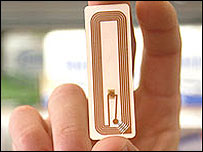
RFID tags are tiny microchips that talk to each other and experts predict they will be big business by 2006.
They are widely tipped to replace eventually the barcoding on products. Because they connect by radio, they do not require the scanners, so familiar with the barcoding system, to read their unique identification codes.
The metal printing technique could transform how RFID tags are made.
"The very basic principle is that you apply an ink to a surface that is water resistant, like a flexible plastic," Chris Bishop, general manager of QinetiQ Metal Printing (QMP), explained to BBC News Online.
"When you pass it through an electroless chemical solution, metal will 'grow'. It is not a special solution; it is an industry standard one."
'Magic dust'
The secret lies in the ink, the ingredients of which QMP is keeping a secret. To Mr Bishop, it simply contains "magic dust".
After the ink is printed on to a flexible or rigid surface, the surface is lowed into a tank which contains the electroless solution.
The solution is made up of metals which are attracted to the ink. A quarter micron (millionth of a metre) of metal can be grown within two minutes.
Metal printing is 50% cheaper than conventional methods which use etching - acid and copper - but the bigger benefit is that it is far more environmentally friendly.
This could spell good news for manufacturers gearing up to mass-produce RFID tags, once issues surrounding common standards are ironed out.
"The electroless solution lasts for six to eight weeks, and it is non-toxic, which means workers can be in the same room without the need for protective clothing," said Mr Bishop.
"And because we are not etching copper with an acid, we have no acid to dispose of."
Other agents associated with conventional circuit etching methods include the use of chromium.
A European Union directive requires companies to stop using six hazardous and carcinogenic materials, including chromium, after July 2006.
"The major benefit for us is that it takes less time, less space, it is environmentally friendly and it uses fewer materials," said Mr Bishop.
"Although the world is blessed with copper, if you can just apply copper where you need it - that is far better."
Wallpaper circuitry?
The technology was developed by QinetiQ, formerly Dera (Defence Evaluation and Research Agency), because it needed to make sheets of frequency selective surfaces (FSS) for radar applications.
FSS only let certain wavelengths pass through them and are most often found in devices like microwave ovens.
QMP is currently in talks with major blue-chip organisations to farm out the technique as a mass production system.
But it has already used the method in some commercial goods it has manufactured on site.
The biggest potential for the technique lies in the production of RFID tags, however.
Applications for RFID tags are endless: they can be embedded in goods - such as trainers or razor blades - so that they can be tracked by manufacturers and suppliers.
They can also be combined with sensors so that a tagged crate of refrigerated goods could alert a system if perishable items inside became too warm, for example.
Even though privacy groups have voiced concerns about the potential misuse of the technology, RFID tags look set to become commonplace soon.
But looking ahead, the metal printing technique could also be used to help miniaturise devices. Mobile antennas could be printed into the casing of the phone, for example, reducing bulkiness in mobiles.
Or special wallpaper could be printed which could covertly block radio frequencies, such as mobile phone or Wi-fi (wireless broadband) signals.
"It gives you the ability to print very fine metal patterns that could be used in biosensors or security features where you need to print a pattern and pass an electrical current through it," said Mr Bishop.
So far, QMP has filed 11 international patents for the technology, three of which have almost been finalised.
Centenarian sprint record foiled
A South African man's bid to become the fastest 100-year-old to run 100 metres was foiled when a power failure stopped the electronic clock timing his sprint.
Philip Rabinowitz said he ran the distance in 28.7 seconds in Cape Town, beating the record of 36.19 seconds.
But the time cannot be recognised because it was not confirmed by the official timer.
Mr Rabinowitz, who turned 100 in February, said that despite the mishap, he felt "absolutely wonderful".
"I never thought I would be able to do it," he added.
The current record for a centenarian running the 100m was set by Erwin Jaskulski from Austria in 2002.
'Rabonoblitz'
Mr Rabinowitz will get another chance to make it into the Guinness Book of World Records in the autumn.
The competitor - known as Rabonoblitz - trains by walking six kilometres (3.7 miles) each day.
His diet includes two apples a day, oats, tea and toast for breakfast, a main meal of vegetables combined with either chicken or fish and a sundowner of ginger ale laced with cane spirits, according to the SABC News.
Mr Rabinowitz - who holds the record in the Guinness Book of being the world's oldest competitive walker - still works, handling accounts for his daughter's business.
He also participated in the South African leg of the Olympic torch relay earlier this year.
July 04, 2004
Estonian carries 'wife' to glory
An Estonian couple has carried off the gold medal in the world wife-carrying championships in Finland.
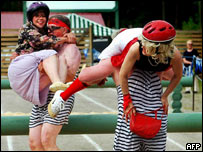
20 year-old Madis Uusorg ran through sand, waded across waist-high water and scrambled over timber logs to win the prize of a portable sauna.
And all with his 19-year-old "wife" Inga Klauso clinging on for dear life.
The couple used the famed "Estonian Carry" where the woman clamps her thighs to the sides of the man's face while hanging upside down on his back.
The long-standing wife-carrying competition, which took place in the remote village of Sonkajarvi, a few hours' drive from the Arctic circle, has its roots deep within Finnish tradition.
Stealing women
According to the town's website, carrying weights over an obstacle course was an initiation test for local brigands.
And it was apparently also common practice for men to steal women from local villages.
Nowadays couples, who do not necessarily have to be married, come from around the world to take part in the competition.
Petite Inga Klauso put the couple's victory down to the fact that Mr Madis was simply very good at carrying women.
"Its pretty unpleasant but not as bad as it seems," said Ms. Klauso, who weighs just 48 kilos, one kilo under the minimum requirement.
Mr Uusorg had to carry an additional rucksack to make up the weight requirement.
The couple completed the course in one minute and 5.3 seconds, narrowly beating a Finnish couple who had run earlier.
The prize includes the "wife's" weight in beer but the portable sauna cabin is only big enough for one.
July 02, 2004
Snuffed goat gets up burglars' noses
The drug-fuelled burglars had ransacked the house, stealing antique furniture, jewellery, electrical equipment and dinner sets. They also grabbed a wooden box containing a powder they thought might be a drug.
So they began sniffing it, until one of them, Elizabeth Kniese, suspected that the box contained "the remains of someone". She was almost right. They were the ashes of the family's pet goat.
In the County Court yesterday, the prosecutor, Sebastian Reid, said the box was taken by the gang during the burglary on January 8 because it was believed it "contained drugs of some description".
Kniese, 37, pleaded guilty in Melbourne yesterday to charges of burglary and theft over the incident at Menzies Bay, in the city's outer south-east, and to identical charges involving a house last December.
Her counsel, Simon Moglia, said Kniese's multifaceted and compulsive drug use stemmed from her "terrible" experiences as a parentless child and teenager in foster care.
Mr Moglia said Kniese, who has been in custody since her arrest in March, had low self-esteem but felt she had achieved something by raising a teenage son.
Kniese, who had not identified her co-offenders out of fear, had not offended for eight years until 2002, when she got a suspended sentence that she had now breached, he said.
She will be sentenced on July 23.
Hollywood lobby names new leader
The powerful organization that lobbies on behalf of America's movie industry said Thursday it has selected as its new chief Dan Glickman, a former Kansas lawmaker and agriculture secretary under President Clinton.
Glickman, 59, has lobbied on behalf of The Walt Disney Co. and his son is a successful producer. He replaces Jack Valenti, a one-time White House adviser who has been Hollywood's influential champion in Washington the past 38 years.
The Motion Picture Association of America's choice of Glickman over several studio insiders reflects the industry's preference for a chief executive already known in the nation's capital.
Glickman said his top priorities will be fighting piracy and ensuring Hollywood's ability to sell its films overseas. Valenti acknowledged that Glickman's salary will be "in that alluring range of seven figures." Glickman joked that he will earn "more than I make now, a very comfortable wage."
Both Valenti and Glickman said there was no pressure for the MPAA to appoint a Republican, and Glickman said he was known in Congress as a moderate with many GOP friends.
"This is not a partisan job," Valenti said.
The MPAA oversees U.S. movie ratings and lobbies for Hollywood's top seven studios.
Valenti retiring
Valenti, 82, announced his retirement in March. He said Thursday he will remain at least partly in charge of the industry's ratings system but turn over all other responsibilities to Glickman after September 1. The board secretly voted to hire Glickman last week.
"I've got a lot to learn, a steep learning curve," Glickman said.
Glickman is director of the Institute of Politics at Harvard University's John F. Kennedy School of Government. His son, Jonathan Glickman, is a producer whose films include Shanghai Knights, Shanghai Noon, Rush Hour and Rush Hour 2.
Glickman, a native of Wichita, represented Kansas from 1977 to 1995. He was principal author of the 1990 Farm Bill and headed the House Intelligence Committee during its investigation of the Aldrich Ames espionage case inside the CIA.
Baby lobsters to rebuild sinking stocks
Scientists have released 7,000 tiny lobsters into New Brunswick's Bay of Chaleur as part of a pilot program to rebuild stocks.
The lobsters were hatched in captivity at the Shippigan campus of the University of Moncton.
Martin Mallet helped pump the baby lobsters into the Bay of Chaleur near Herron Island. "It's like watching children go off to school for the first time," he said.
Mallet is the biologist who raised the dime-sized lobsters for the past month. He knows most of the larvae won't make it to adulthood six years from now.
He hopes their chances of survival have been increased by spending their first few weeks in a tank, safely away from predators.
"The idea of this project is to try to give a little help to Mother Nature," said Mallet. "The big thing with this project is we're bypassing the larval stages where the lobsters are actually in the water column and that's where we have the biggest mortality rates."
If all goes well, this pilot project will eventually move from the lab to the wharves, where communities will have their own lobster hatcheries.
Euclide Chiasson, spokesperson for the Maritime Fishermen's Union, supports the project as a way for fishermen to take their future into their own hands.
"If it's a resource they want to sustain, then they have to invest in it," said Chiasson. "And they have to make sure it's there for their children and so on."
The project also teamed up with a nearby First Nation, who share a similar outlook.
"I know money means a lot to some people, but we don't have to kill the resource for money," said Robert Labillois of Eel River Bar First Nation.
The Department of Fisheries and Oceans helped to pay for the project. Divers followed the lobsters to the bottom to make sure it was successful and that the creatures had a place to hide.
Later this summer, 20,000 more baby lobsters will be released into the waters near Caraquet. Scientists will monitor their progress during the next few years.
'Double-double'? Now you can look it up
"Double-double," "stagette" and "goal suck" are among the 5,000 new words and definitions added to the Canadian Oxford Dictionary.
The newly published second edition of the dictionary "accurately reflects how Canadians speak and write in the 21st century," Katherine Barber, the book's editor-in-chief, said in a statement.
Barber cites the research into "double-double" ? a coffee with double cream and double sugar added ? as an example.
"We had to determine if it was used only in Tim Hortons doughnut shops or more widely," Barber said. "We found evidence in the Globe and Mail, the National Post, the Hamilton Spectator and the book Men with Brooms, based on the curling movie."
Researchers also surveyed Canadians across the country and were sent to eavesdrop in coffee shops to gauge whether people really use the term.
Some of the words and definitions added to the second edition also reflect changes in Canadian attitudes: the "stagette," a pre-wedding party for the bride and her female friends, made it in as did "lesbigay", which denotes "lesbian, bisexual or gay." The new edition also updates the definition of marriage to "the legal or religious union of two people."
Sports terms added include "goal suck" (a player who lingers by the net so as to score easily) and "hurry" (the curling term meaning "sweep"). The edition includes 100 new biographies of prominent Canadians ? including Izzy Asper, Jim Carrey, Diana Krall and Northern Dancer ? and specifies a number of place name derivatives (Banffite and Charlottetonian).
First published in 1998, the Canadian Oxford Dictionary was both a bestseller and an award-winner, netting two awards from the Canadian Booksellers Association for non-fiction book of the year and specialty book of the year. The association also named Barber editor of the year.
The official publication date of the new edition is Aug. 10, 2004 ? the 100-year anniversary of the opening of Oxford's Canadian offices.
Military on alert for Coke's chip contest
There's a new security threat at some of the nation's military bases -- and it looks uncannily like a can of Coke.

Specially rigged Coke cans, part of a summer promotion, contain cell phones and global positioning chips. That has officials at some installations worried the cans could be used to eavesdrop, and they are instituting protective measures.
Coca-Cola Co. says such concerns are nothing but fizz.
Mart Martin, a Coca-Cola spokesman, said no one would mistake one of the winning cans from the company's "Unexpected Summer" promotion for a regular Coke.
"The can is dramatically different looking," he said. The cans have a recessed panel on the outside and a big red button. "It's very clear that there's a cell phone device."
Winners activate it by pushing the button, which can only call Coke's prize center, he said. Data from the GPS device can only be received by Coke's prize center. Prizes include cash, a home entertainment center and an SUV.
"It cannot be an eavesdropping device," he said.
Nonetheless, military bases, including the U.S. Army Armor Center at Fort Knox, Ky., are asking soldiers to examine their Coke cans before bringing them in to classified meetings.
"We're asking people to open the cans and not bring it in if there's a GPS in it," said Master Sgt. Jerry Meredith, a Fort Knox spokesman. "It's not like we're examining cans at the store. It's a pretty commonsense thing."
Sue Murphy, a spokeswoman for Wright-Patterson Air Force Base in Dayton, Ohio said personal electronic devices aren't permitted in some buildings and conference rooms on base.
"We've taken measures to make sure everyone's aware of this contest and to make sure devices are cleared before they're taken in" to restricted areas, she said.
"In the remote possibility a can were found in one of these areas, we'd make sure the can wasn't activated, try to return it to its original owner and ask that they activate it at home," she said. "It's just another measure we have to take to keep everyone out here safe and secure."
The Marine Corps said all personnel had been advised of the cans and to keep them away from secure areas.
Paul Saffo, research director at The Institute for the Future, a technology research firm, compared the concern about the Coke cans to when the Central Intelligence Agency banned Furbies, the stuffed toys that could repeat phrases.
"There's things generals should stay up late at night worrying about," he said. "A talking Coke can isn't one of them."
But Bruce Don, a senior analyst at the Rand Corp. said the military's concern is rational and appropriate.
"There's a lot of reason to worry about how that technology could be taken advantage of by a third party without Coke's knowledge," he said.
"I wouldn't worry if one was in my refrigerator, but if you had a sensitive discussion or location, it's not inconceivable the thing could be used for something it was not designed for," he said.
Martin said Thursday the world's largest soft drink maker has received phone calls inquiring about the promotion from Hill Air Force Base in Ogden, Utah, and from a military base in Anchorage, Alaska. The callers did not mention any concerns, and Coke has not been contacted by the bases in Ohio and Kentucky, Martin said.
Asked if Coke would curtail the promotional campaign because of the security issues raised, Martin said, "No. There's no reason to."
Bill Cosby has more harsh words for black community
Bill Cosby went off on another tirade against the black community Thursday, telling a room full of activists that black children are running around not knowing how to read or write and "going nowhere."
He also had harsh words for struggling black men, telling them: "Stop beating up your women because you can't find a job."
Cosby made headlines in May when he upbraided some poor blacks for their grammar and accused them of squandering opportunities the civil rights movement gave them.
He shot back Thursday, saying his detractors were trying in vain to hide the black community's "dirty laundry."
"Let me tell you something, your dirty laundry gets out of school at 2:30 every day, it's cursing and calling each other n------ as they're walking up and down the street," Cosby said during an appearance at the Rainbow/PUSH Coalition & Citizenship Education Fund's annual conference.
"They think they're hip," the entertainer said. "They can't read; they can't write. They're laughing and giggling, and they're going nowhere."
In his remarks in May at a commemoration of the anniversary of the Brown v. Board of Education desegregation decision, Cosby denounced some blacks' grammar and said those who commit crimes and wind up behind bars "are not political prisoners."
"I can't even talk the way these people talk, 'Why you ain't,' 'Where you is' ... and I blamed the kid until I heard the mother talk," Cosby said then. "And then I heard the father talk ... Everybody knows it's important to speak English except these knuckleheads. You can't be a doctor with that kind of crap coming out of your mouth."
Cosby elaborated Thursday on his previous comments in a talk interrupted several times by applause. He castigated some blacks, saying that they cannot simply blame whites for problems such as teen pregnancy and high school dropout rates.
"For me there is a time ... when we have to turn the mirror around," he said. "Because for me it is almost analgesic to talk about what the white man is doing against us. And it keeps a person frozen in their seat, it keeps you frozen in your hole you're sitting in."
Cosby lamented that the racial slurs once used by those who lynched blacks are now a favorite expression of black children. And he blamed parents.
"When you put on a record and that record is yelling 'n----- this and n----- that' and you've got your little 6-year-old, 7-year-old sitting in the back seat of the car, those children hear that," he said.
He also condemned black men who missed out on opportunities and are now angry about their lives.
"You've got to stop beating up your women because you can't find a job, because you didn't want to get an education and now you're (earning) minimum wage," Cosby said. "You should have thought more of yourself when you were in high school, when you had an opportunity."
Cosby appeared Thursday with the Rev. Jesse Jackson, founder and president of the education fund, who defended the entertainer's statements.
"Bill is saying let's fight the right fight, let's level the playing field," Jackson said. "Drunk people can't do that. Illiterate people can't do that."
Cosby also said many young people are failing to honor the sacrifices made by those who struggled and died during the civil rights movement.
"Dogs, water hoses that tear the bark off trees, Emmett Till," he said, naming the black youth who was tortured and murdered in Mississippi in 1955, allegedly for whistling at a white woman. "And you're going to tell me you're going to drop out of school? You're going to tell me you're going to steal from a store?"
Cosby also said he wasn't concerned that some whites took his comments and turned them "against our people."
"Let them talk," he said.
Cop on the beat now a walking database
A police officer stops you on the street, then taps something into a device in the palm of his hand.
The next minute, he knows who your relatives are, who lives in your house, who your neighbors are, the kind of car you drive or boat you own, whether you've been sued and various other tidbits about your life.
A growing number of police departments now have instant access via handheld wireless devices to vast commercial databases that contain details on just about anyone officers encounter on the beat.
In a time of terrorism worries, the information could theoretically save lives, or produce clues that an eagle-eyed cop could use to solve a case.
But placing a commercial database full of personal details at an officer's fingertips also raises troubling questions for electronic privacy activists.
"If the police went around keeping files on who you lived with and who your roommates were, I think people would be outraged," said Jay Stanley, a spokesman for the American Civil Liberties Union, "And yet in this case, they're not doing it, but they're plugging into a company that is able to do it easily."
In recent years, police departments have been testing different handheld wireless devices. Typically, they've used the devices to gain access to law enforcement databases meant only for police that, for example, alert them when someone is wanted for arrest.
At the same time, many police departments have been using desktop computers to search commercial databases to help them learn more detailed information about people they are investigating. These databases can hold billions of public records from a variety of sources. Thousands of law enforcement bodies now use them; five states have linked their own records with a huge commercial database in a federally funded program known as Matrix.
Computerized dossiers
Now, in a convergence of the two trends, police are beginning to access the commercial databases using handheld wireless devices.
LocatePLUS Holdings Corp., a Beverly, Massachusetts-based company that says it maintains more than 6 billion records and has data on 98 percent of the U.S. population, announced this week that it would provide Blackberry wireless devices to state police at Logan International Airport. Two of the planes hijacked on September 11, 2001, took off from Logan.
The officers can use the Blackberrys to access the LocatePlus database wherever and whenever they want, though the records don't include state and federal criminal justice databases or terrorist watch lists.
Such empowerment gains even more heft with Monday's ruling by a sharply divided Supreme Court that people who refuse to give their names to police can be arrested, even if they've done nothing wrong.
Justice John Paul Stevens, one of the dissenters, expressed concern that, with simply a name, officers could quickly tap into databases and learn a "broad array of information about the person."
Indeed, that's already happening.
LocatePlus now has more than 50 law enforcement agency customers that use wireless handhelds to access its database, said chief executive Jon Latorella.
Latorella said the company's database takes information from such sources as registries of motor vehicles, credit bureaus, property tax departments, telephone directories -- even unlisted numbers -- and courts to create computerized dossiers on people on demand.
ChoicePoint Inc., based in Alpharetta, Georgia, also offers police wireless access to its vast databases, but so far has a smaller number of clients, said James E. Lee, the company's chief marketing officer.
Need for standards
Massachusetts State Police Lt. Thomas Coffey, who works at Logan, said he felt the LocatePLUS service would be useful.
"We're in the information business, obtaining information about individuals or groups. It's an intelligence gathering tool. It just allows us to do our job better," he said.
Privacy activists argue, however, that information collected for one purpose shouldn't be used for others. They call for federal standards on the access and use of data as well as mechanisms to prevent abuse.
The ACLU's Stanley said the need for standards is even more urgent as cops on the street get wireless access to databases, and could make snap judgments based on incorrect data.
Harlin McEwen, a former police chief who chairs the technology committee of the International Association of Chiefs of Police, said private database searching via handhelds is getting a lot of interest from police chiefs.
But he also cautioned that police should be wary about relying on information from databases not controlled and maintained by the government.
"It may be a tool for me. It may be a tip. But I'd better not rely on its accuracy without doing further investigation," McEwen said.
Privacy activists agree on the accuracy issue, and have broader concerns.
"These new services ... literally alter the balance of power between the individual and the state," giving the government more power, said Chris Hoofnagle, associate director of the Electronic Privacy Information Center in Washington. "The private sector has become Big Brother's little helper."
July 01, 2004
News machine outfoxed by bloggers
The online community has become a powerful force in shaping public opinion, writes Paul Carr.
Last month, the Boston affiliate of America's Fox TV network ran a news item about a new craze sweeping cyber space. It turns out that all over America young people are creating websites full of information about their daily lives.
Or, as Fox's breathless reporter put it, "to catalogue the details of their lives on web pages created for them, by them ... just blah-blah-blogging".
Incredible. I wonder what burgeoning technological trend Rupert Murdoch's news machine will uncover next? Mobile tar-tar-telephony? The rah-rah-radio? Far-far-fire? The devil may have the best tunes but it'll be a long time before he works out how to upload them to his aye-aye-iPod.
Fortunately in most other sections of the media, attitudes towards blogging - and online journalism in general - couldn't be more different. Not only are news organisations rolling out blogs of their own, but in the past year the influence of bloggers over their print, television and radio counterparts has grown massively.
Consider a decision made by organisers of the Democratic National Convention (DNC) in Boston next month. So keen are they to get their message through to the people of Blogistan that for the first time they have issued press accreditation to political bloggers.
Just try to imagine any major political organisation recognising blogs in the same way this time last year and you'll realise how far bloggers have gone up in the estimation of those in power. Or, in the case of the DNC, those who will probably be in power next year, voter fraud notwithstanding.
An even more impressive example of how web journalism has started to influence the mainstream media comes from the US's newest radio network, Air America Radio. The New York-based station was set up as a liberal challenge to the dominance of right-wing talk radio in the US.
Through affiliates in cities from New York to Honolulu, angry liberal voices such as Al Franken, author of the anti-Bush bible Lies and the Lying Liars Who Tell Them, and Hollywood's Janeane Garofalo are taking on right-wing blowhards such as Rush Limbaugh and Bill O'Reilly.
But unlike Limbaugh and O'Reilly, who frequently replace research and reason with rage and rhetoric, Air America's hosts are armed to the teeth with hard, up-to-the second facts to support their relentless Bush bashing. Their sources? Blogs. And the blogging bloggers who blog them.
On Garofalo's show, barely a minute goes by without Janeane or her co-host Sam Seder referring to a news article or nugget of information they have discovered via a weblog or online news source. And they're not afraid to admit it, either. At the end of each day's show all of the links mentioned are reposted on their show's own blog, Majorityreportradio.com.
And the influence of the web on Air America's output doesn't stop there. Its small affiliate base - 11 stations, compared with the 666 that broadcast Limbaugh's show - means a large percentage of listeners listen online.
The effect of this is to guarantee a large web-savvy audience for the station, an audience for whom it is perfectly natural to visit the shows' official blogs and to comment on what they're hearing, as they're hearing it.
And by crikey do the presenters listen to their critics. Not only do Garofalo and Seder frequently read out blog feedback as it comes in, but they once halted an interview with the rock bore-ette Peaches after bloggers complained it was the worst thing the station had ever broadcast. Add to this the fact that bloggers and online journalists frequently appear as guests, and Air America starts to look like the world's first major blog-powered radio station. But if it is, it certainly won't be the last.
As the popularity of internet radio continues to grow and as more people discover the beauty of Blogistan, it will soon become almost impossible to utter a sentence on the air without it being torn apart by an army of live critics.
What will be interesting to see is how the radio stations adapt to this new level of accountability.
I hope they follow Air America's lead and work alongside bloggers rather than against them. After all, it's not so easy to sound convincing about the war in Iraq or tax cuts or global warming when listeners have access to billions of pages of information and you're armed only with a hunch and a microphone.
Blah-blah-blogging may be just a craze to Fox, but to almost everyone else it's a terrifyingly powerful influence on what the media say and how they say it. And it's an influence that the world's talk radio hosts ignore at their peril.
Prince Charles makes it official - Camilla is a kept woman
Camilla exists. Mrs Parker Bowles, the Prince of Wales's mistress, has been acknowledged in an official royal document for the first time, scoring three mentions by name in an unprecedented annual review of the prince's good works, duties and healthy accounts.
In a new-found spirit of openness after recent scandals, the future king has revealed that Mrs Parker Bowles, the woman Princess Diana blamed for her failed marriage, is what used to be called a kept woman - and as much a part of his household as his sons, Prince William and Prince Harry.
Coming clean about Camilla will raise speculation that the prince is preparing the British public for a marriage announcement, though senior staff at Clarence House and royal watchers played down such talk.
The prince funds her two secretaries, a driver and a gardener, and is believed to pay for other costs, such as grooming, travel and security from income derived from the Duchy of Cornwall. While the exact figure is not revealed, it has been estimated she costs the prince about £250,000 ($650,000) a year.
Not that he is short of a quid. The prince's income from the Duchy of Cornwall, a massive portfolio of land and property, rose by £2 million to £11.9 million in 2003-04.
The 48-page review shows the Prince has 112 full staff - 84 for his official and charitable works and 28 personal servants - and paid £4.4 million in tax and personal expenditure.
Implanted Device Relieves Man of Hiccups
Surgeons Implant Device to Relieve Seven Months of Constant Hiccups for 50-Year-Old Texas Man
After seven months of constant, bark-like hiccups, a first-of-its-kind operation has returned normal life to a 50-year-old Texas man. Shane Shafer's speech is now a hoarse whisper a side effect of the electronic device that cured him, one generally used to treat epilepsy and recently approved for major depression.
But for the first time since November, he can eat. He can sleep. He no longer has to make himself gag to make the hiccups stop. He can talk without a bark-like hiccup every three to four seconds.
"Even something as simple as a kiss is now performed without a hiccup," said his wife, Lori Shafer.
Surgeons implanted the device a "vagus nerve stimulator" in Shafer's chest June 23 in New Orleans. It was activated June 24.
On Wednesday, the Shafers were back home in Vidor.
"I don't hiccup any more," Shane Shafer said in a telephone interview. On a scale of 1 to 10, he said, the relief is definitely a 10.
The Shafers married in May 2003, on the first anniversary of the first of three strokes that Dr. Bryan Payne of LSU said apparently damaged Shane Shafer's brain stem, leading to the hiccups.
"We had just recently started dating when he had his stroke. We tried to take the negative day of the stroke and make it positive, so the next year we got married," Lori Shafer said.
Then, around Thanksgiving, the hiccups began. They got worse with the new year.
Their local physician, Dr. Richard England of Beaumont, and other doctors tried a number of drugs, including tranquilizers and seizure drugs. They didn't work.
A technique England had used on himself to stop an attack of hiccups lasting several days in 1983 making oneself gag by sticking a nasogastric feeding tube down the nose and into the throat relieved Shafer's hiccups for up to 90 minutes.
Then Lori Shafer noticed that after her husband got an opiate injection for pain in his left leg, he'd stop hiccuping. England checked that out, and wrote a prescription.
England said that probably saved Shafer's life noting that he regained the 30 pounds he had lost before using the drug.
But because it was an opiate, Shafer had to take more and more to get the same effects. Since hiccups aren't a government-approved use, insurance would not cover that $100 daily cost.
England asked a surgeon friend if he would cut the nerves to Shafer's diaphgram an operation he'd found described in one medical book as a last resort. The surgeon said no, he'd never done such an operation before, and it would be too risky.
Lori Shafer called 15 doctors. The few who called back, weeks later, said they couldn't help.
An aunt of Shafer's read about Dr. Bryan Payne, an LSU Health Sciences Center neurosurgeon who had operated on people for Parkinson's disease. England called.
Payne talked with several neurologists and another neurosurgeon. They decided to start by seeing whether the hiccups were affected by stimulating or blocking the phrenic or vagus nerves.
Each phrenic nerve sends signals from the brain to one side of the diaphragm. The vagus nerves, almost two feet long, communicate with a number of organs.
The vagus block stopped hiccups for about four hours.
"Most of the folk remedies that are actually effective are different forms of vagus nerve stimulation," Payne said. Those include holding your breath, coughing, bending over and drinking water upside down, and even making yourself gag.
The vagus nerve stimulator, the doctors decided, could disrupt the miscommunication causing Shafer's hiccups just as it does to control seizures that can't be stopped by drugs.
In about 4 percent of patients, the device itself can cause hiccups. That wasn't really a worry, Lori Shafer said: "Nothing could have made them worse."
When Payne turned on the battery-operated device in his Shafer's chest, he tried several settings before finding one that stopped the hiccups.
He said Shafer will be back in New Orleans in a couple of months. "If he hasn't hiccupped at all, we'll try to lower his settings as much as possible," Payne said.
That will help the battery last as long as possible about five to seven years are expected and could reduce the effects on Shafer's vocal cords, he said.
Top court rules ISPs not liable for royalties
Internet service providers are not responsible for paying royalties on music downloaded by users, Canada's Supreme Court ruled Wednesday.
In a unanimous 9-0 decision, the court ruled that although ISPs provide the hardware and technology, they aren't responsible for what people download.
The court ruled that companies providing wide access to the web are "intermediaries" who are not bound by federal copyright legislation.
Millions of songs and videos are downloaded for free without musicians, composers and artists being paid any royalties.
The Society of Composers, Authors and Music Publishers of Canada, representing Canadian artists, argued that ISPs are liable because they have a hand in transmitting recorded music.
But the Canadian Association of Internet Providers, including companies like Bell, Sprint, and AOL, said artists should ask for royalties from sites that offer their works, not companies that provide the access.